
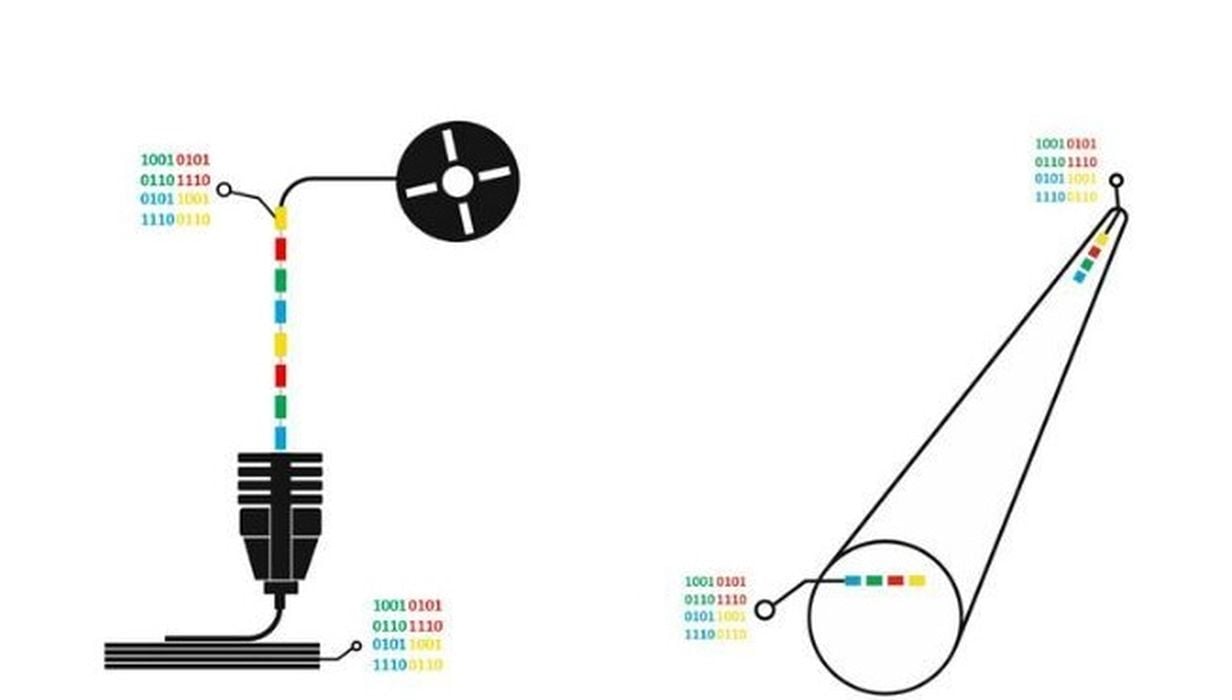
There’s an interesting proposal to produce “hollow filament”.
Materials developer Kai Parthy has proposed an unusual method to combine materials in FFF 3D printing: hollow out the centre of the filament and replace it with various other materials.
There are composite materials already present on the market, and we use them all the time: PETG-CF, for example, is a homogeneous mix of PETG material and tiny chopped carbon fibre segments. The added material changes the properties of the resulting composite material. In the case of PETG-CF, the material becomes much more rigid.
There are many other possibilities here, since the added ingredient doesn’t have to mix with the polymer filament tube.
One very intriguing material would be conductive. There has been a long-term goal to use “conductive filament” to enable printing of electrical circuits within a 3D print. To date, this has been done by simply mixing conductive material with a polymer, much like PETG-CF. However, the resulting conductivity is poor because, well, it’s mixed in with the non-conductive polymer.
Now imagine a conductive material inside a hollow filament. When printed, the conductive material will be far less mixed and therefore more electrically conductive.
You might be thinking this concept is the same as the hollow filament made by Filament2.
It’s not. Filament2’s concept involves a hollow tube, but the tube is peeled away at the last minute, leaving the extrusion to be made only from the tube’s contents.
In the new concept, the tube actually enters the hot end and is softened and printed in the usual manner. It’s just carrying along some additional material stored in the hollow.
The concept also allows for continuous fibres. Instead of using chopped carbon fibre, for example, you could insert a complete length of fibre inside the filament. Of course, you’d need to modify the 3D printer to cut the filament at the right moment, since carbon fibre doesn’t melt. This approach could also be used with other types of fibres, such as glass, copper wire, etc.
This is an intriguing concept because (aside from the continuous fibre angle), the filament could be printed on almost any FFF system. In other words, we could have a significant breakthrough in material properties if this concept catches on.
However, at this point, it seems to be just a proposal, but there are indications a patent may have been filed for the method. Unfortunately, I was unable to find any public record of a filing, but that doesn’t mean it hasn’t been done.
This is something we should keep watch for in the future.
Via LinkedIn (Hat tip to Benjamin)
