
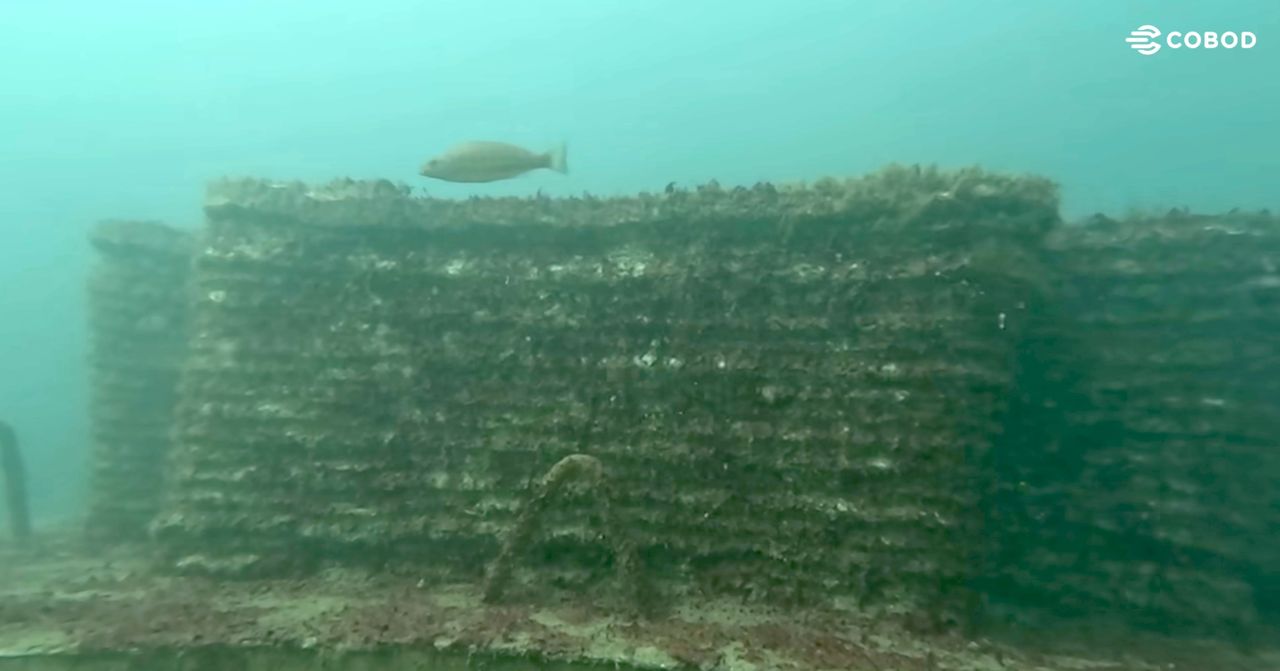
COBOD and partners have developed a new application for 3DCP: caissons.
Caissons are underwater structures that are watertight and typically used for construction. The idea is that the caisson is sunk near or on top of the construction site, and water is pumped out. This leaves the seabed exposed to the air, facilitating contraction activities.
As you might guess, these structures can be enormous, as they must match the size of the intended construction. That requires gigantic amounts of concrete to be poured to create the caisson, which is then towed out to the site.
The innovation here was announced by COBOD chief Henrik Lund-Nielsen. COBOD worked with several partners, including ACCIONA, Seaboost, and long-time partner Holcim, on Project BEEYONDERS, which was funded by an EU grant. Lund-Nielsen explains the innovation:
“In the project, it has been documented that for a reference caisson with roughly the above size, using optimal geometries only possible with 3DCP, the quantity of concrete needed for the structure can be reduced by 50%, and the amount of reinforcement almost similarly. On this basis, it is very easy to imagine the massive cost and speed of execution advantages this provides.“
This is quite analogous to developments in other 3D print technologies: the ability to create geometries with fewer constraints opens up new possibilities.
Lund-Nielsen also reports that the rougher surface texture of the 3D-printed caissons is far more amenable to sea life after the project completes. The texture creates nooks and crannies that are ideal for fish and plant life. Apparently, in their experiments, they observed “5-10x” the number of fish in the vicinity of the 3D-printed caisson as compared to the dull, flat surfaces of conventional caissons.
This is yet another example of how 3D print technology can dramatically change the picture for a specific application. This is similar to a previous discovery by COBOD in the production of wind turbine towers, where significant savings can be made.
If caissons can be produced with 50% less concrete, that will be incredibly attractive to large construction projects.
There’s another hidden benefit here: less concrete means less cement, which means less CO2 was released into the atmosphere. The production of cement requires exposing minerals to very high temperatures, typically created by burning fossil fuels. Cement production is a very significant proportion of today’s CO2 sources.
Via LinkedIn
