
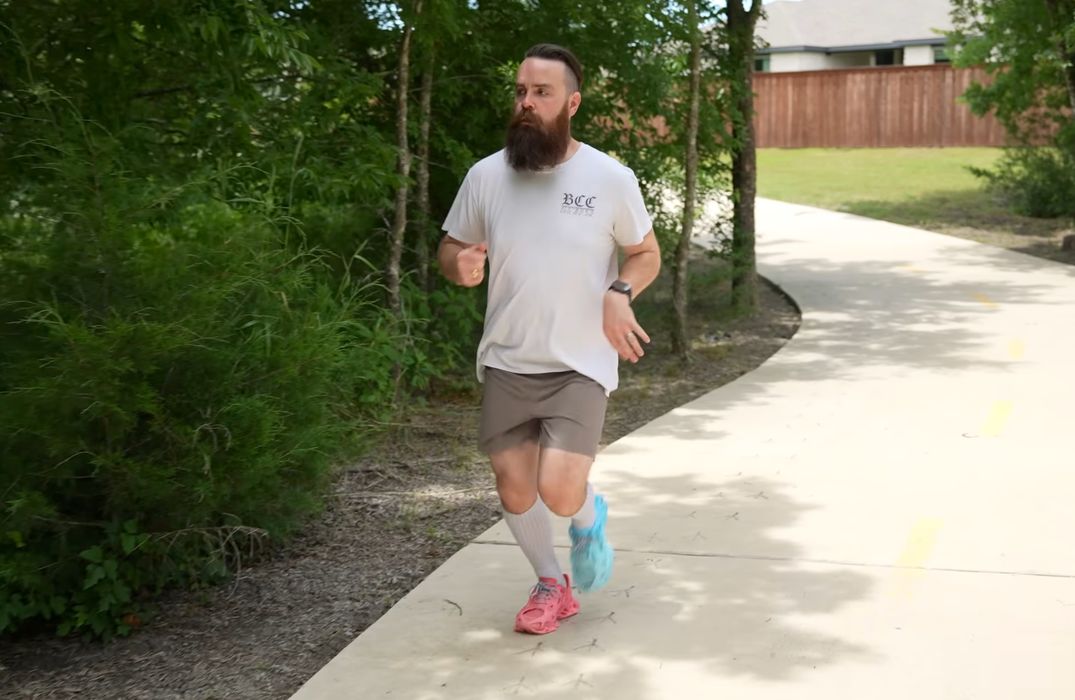
Can you run in 3D-printed shoes? Someone gave it a try, and there are implications.
YouTuber NetworkChuck, who normally focuses on homelab technology, and definitely someone you should watch if you’re into homelab tech, obtained a Bambu Lab H2D and attempted to run on 3D-printed shoes.
Most of his video involves exploring the H2D and discovering the peculiarities of using TPU material, but in the end, a pair of 3D-printed shoes were produced. It appears that the specific model used was the popular WhaleBerry shoe, found on MakerWorld.
NetworkChuck then attempted to do a five-mile (8km) run in the shoes, using a homemade cork insole, since the raw printed shoes were uncomfortable.

The run was completed, but at the end, the exasperated NetworkChuck said:
“Yeah, don’t do this. Don’t ever do this to yourself. These are not ready for prime time. I can’t feel my feet. But on the bright side, I think the shoes held up well. So they did not protect my feet, but they protected themselves. I haven’t felt them since mile three.”
He also discovered at least one rock embedded in the sparse geometry of the Whaleberry shoe.
In other words, it wasn’t the greatest experience.
So what can we learn from all this?
Given that there is an explosion of interest in 3D-printed shoes, with new services, 3D models, and even materials appearing constantly, it is time for some refinement.
Just because something “looks like” a shoe doesn’t mean it actually is a shoe. NetworkChuck found this out the hard way, and, as he says, he’s not able to run for two weeks while healing occurs.
NetworkChuck also noted that the size of the printed shoes was off. They didn’t fit.
I believe we need the following to enable 3D-printed footwear to really take off:
A standard method of sizing a shoe, which involves not just resizing a 3D model in the conventional way. No, instead, we need to adjust a shoe based on actual foot measurements:
- Foot length (heel-to-toe length)
- Foot width (ball width)
- Arch length (heel-to-ball length)
- Instep / girth (ball girth)
- Heel width (sometimes heel breadth)
We need a 3D modeling system that would take a shoe 3D model and tweak its geometry based on applying the above measurements. This should result in perfectly fitting shoes every time.
We need to also consider the materials comprising the shoe. NetworkChuck correctly noted that the printed shoe was uncomfortable and had to add a midsole. Today, most shoe models simply assume they are one-piece affairs, which doesn’t work. Real shoes have midsoles, and they are an integral part of the shoe experience. Instead, we should always have midsoles as a secondary item that is part of the shoe package.
If we made those changes to 3D models and modeling software, we could then have a good chance of printing perfect shoes on our 3D printers.
Via YouTube
