
Tripo just received US$200M, and there’s a reason for that.
The AI company specializes in generating 3D content and is consistently mentioned as one of the top options in technical comparisons.
They’ve been quite active in collecting investments, with a US$50M round in March led by Alibaba, and then followed earlier this week with a whopping US$200M investment from INCE Capital.
Since Tripo (and its parent VAST) are private entities, we can’t know the actual valuation of the company after this most recent raise. However, analysts are suggesting that the valuation of this software company could be in the US$1.5B range, with some estimates going as high as US$2B or even US$3B.
Regardless of what the valuation truly is, it is absolutely massive.
Tripo isn’t a 3D printer company but can create content for 3D printing by generating it through their text to 3d and image to 3D services. Therefore, it will have a strong influence on how 3D printers are used.
This is because it is still quite challenging for many people to create 3D content. Sure, there are lots of people that can use CAD tools, but they are a very, very small fraction of the general public. And that general public is the target of forward-looking 3D printer manufacturers.
3D print technology has long been confined to those with serious technical abilities, which they use to overcome the many quirks of operating desktop 3D printers. That has held back the general public from buying the equipment for, well, decades.
Nowadays, the 3D printers are fantastically more capable than the machines of ten years ago. Or even three years ago. They typically include a large number of sensors and intelligent processing that manages calibration, automation, operation, and other aspects that previously would be done by a highly trained operator.
The public should now buy desktop 3D printers, right?
Wrong. There is still a major barrier, and that is content. Even though a 3D printer may itself be very capable, it still needs something to print.
Most 3D printer manufacturers attempt to overcome that problem by tying in a large repository of pre-made 3D models, all ready to print. That’s fine, but it still does not address situations where the operator needs something specific, something new that doesn’t exist or cannot be found in a model repository.
That’s where AI-based 3D generative content comes in. These systems can quickly create useful 3D content that can then be 3D printed. Today, these systems tend to produce interesting decorative objects, but it’s only a matter of time before they can also generate functional parts.
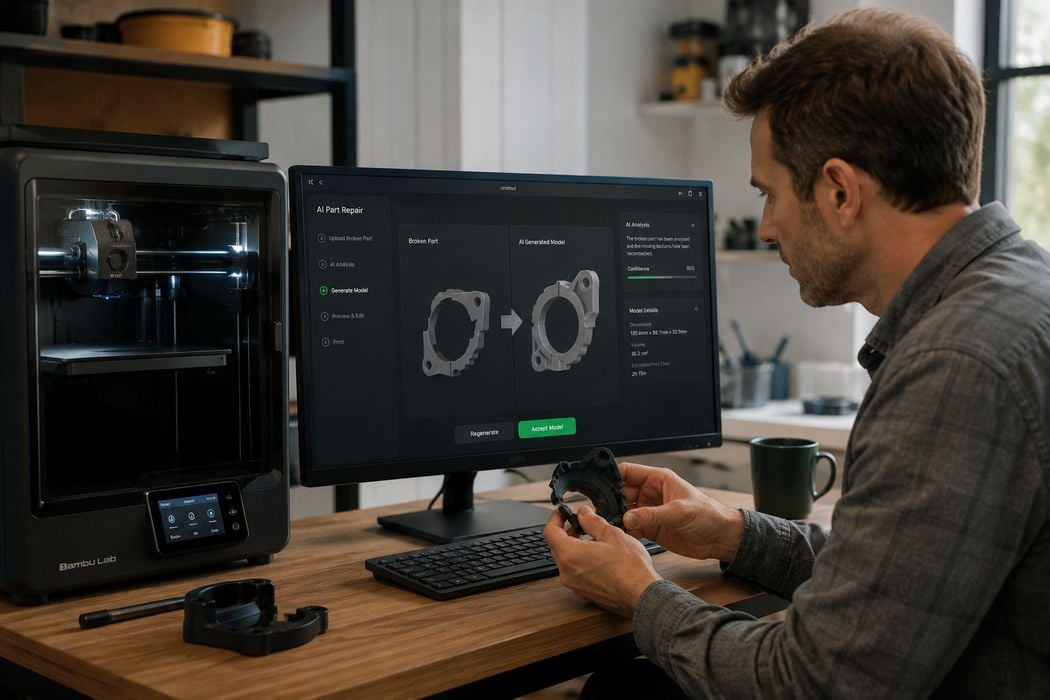
At that point, I would expect most 3D printer manufacturers to integrate AI generative tools directly into the printers themselves. You would then simply ask your 3D printer to produce something for you. For example, the “ask” might involve showing a broken part to a camera on the 3D printer, and it would measure and create the appropriate 3D model.
That’s something that may happen in years to come, but it seems that investors are thinking that companies like Tripo could be at the focus of that functionality. Could Tripo (or similar competitors) strike licensing agreements with 3D printer manufacturers to be present on their equipment?
The fact that Tripo’s valuation is now vastly larger than most of the 3D printer manufacturers tells you the potential importance of this technology.
On the other hand, we did see a similar boom a few years ago when investors sunk billions into a few 3D printer manufacturers that claimed they were going to take over the manufacturing world.
They didn’t.
But will the AI companies succeed instead?
Via Crunchbase
