
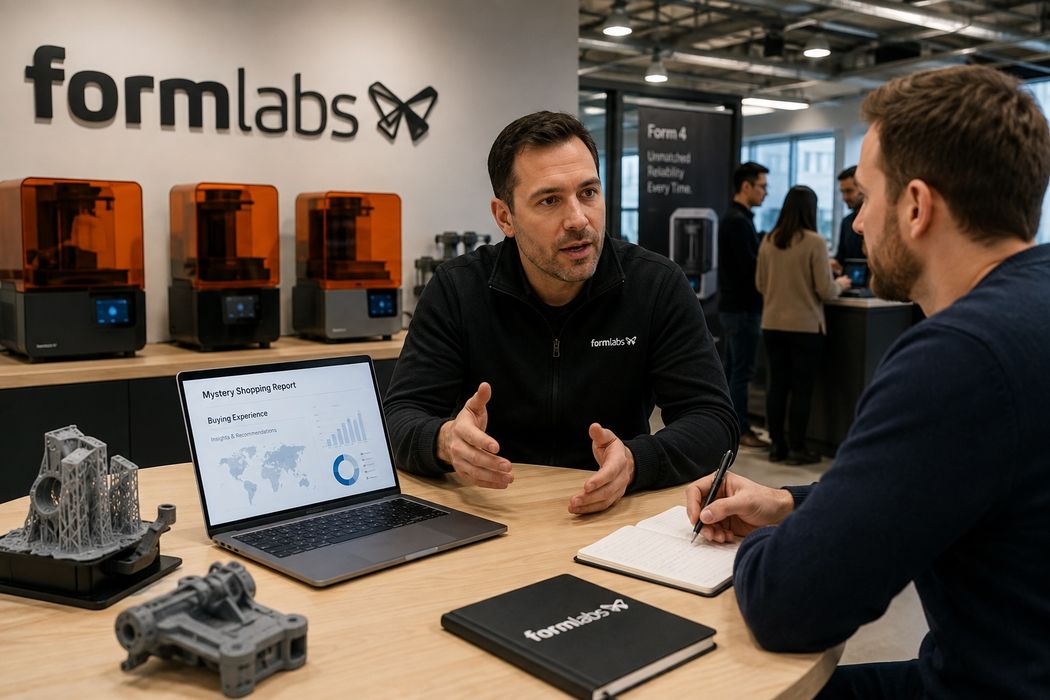
Formlabs CEO Maxim Lobovsky leaked one of the company’s secrets for success.
Formlabs could be termed the “winner” of the early set of 3D printing startups that emerged after the original 1980s patents started to expire. At that time, there were countless startups, including notables like MakerBot, UltiMaker, and others like SoliDoodle, M3D, etc.
Now, more than ten years later, we find Formlabs as one of the largest companies in the space, highly profitable and able to compete against Asian rivals that have swept away most of the remaining competition.
How did they do it?
There are multiple reasons, but in a recent LinkedIn post, Lobovsky revealed an interesting approach done by the company:
“One of the key tools we use to make this happen is mystery shopping. Have people test the buying experience and share what they found and what can be improved. We do it across geographies, verticals, direct, indirect. Then we use that to improve our processes. It might be the single most important input for our S&M team on what they can improve.”
Lobovsky said that this practice is “unheard of” in 3D printing, and he is almost certainly correct. Most companies are overly focused on certain technical aspects of their products and treat everything else as baggage.
This is especially true in the software dimension. Asian 3D printer manufacturers typically make decent hardware, but their software is often catastrophically bad.
Meanwhile, Formlabs has been shipping their incredibly easy-to-use PreForm software for many years.
All of this is part of the overall experience of a 3D printer operator. It’s more than just some specs — people have to actually USE the machine, too. And like it.
In the new reveal, Lobovsky shows that Formlabs is doing the same experience inspection on the buying experience, which is about as far from the technical specs as you can get. But even so, it is still very much part of the 3D printing experience.
Somehow I am not at all surprised at this development. Many years ago when I first tested a Formlabs device, the Form 2, I was surprised that the machine asked me about each print job when it completed.
No other machine had ever done that, in my experience. I was impressed at the time, because I knew that the company would be taking that feedback, analyzing it, and using that information to make the next products better.
And this is precisely what happened: the company has a long track record of releasing increasingly improved and more powerful equipment, software, materials, and processes.
At the end of the day, it’s about experience, and that’s where Formlabs’ competition tends to fall down.
Via LinkedIn
