
I’m a bit puzzled over a US Navy test of a 3D printing solution.
The story at Defense One details how Firestorm Labs recently printed a large number of parts during a big naval exercise. A 3D printing company working with the military is not new; this has been going on for many years, and it’s a good idea: print parts near the front instead of waiting for them to be shipped from the homeland.
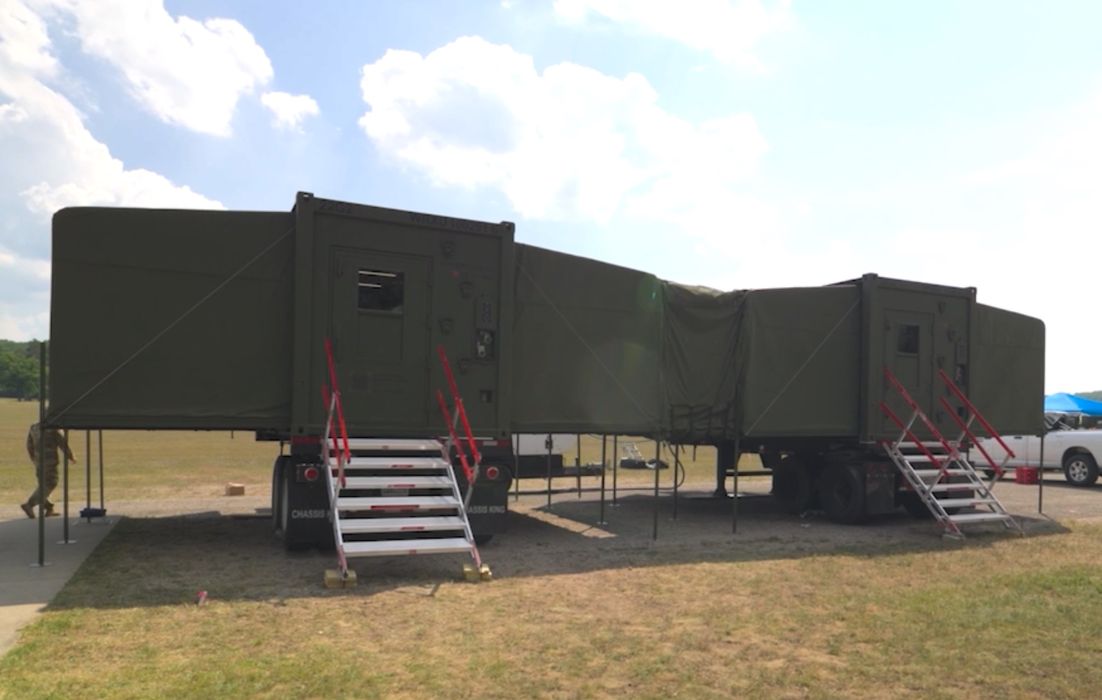
Firestorm Labs is not a 3D printer manufacturer, but instead packages up 3D printing tech into a bite-sized module that is deployable by the military. They take equipment from others and bundle it up securely, and provide an end-to-end ability for military personnel to design, print, and finish any parts they’d like to make.
Specifically, the product in question is the Firestorm Labs XCELL, which is everything you need to run an HP MJF system in a box, including power.
That’s all good. But the Defense One report said:
“Heavy seas didn’t stop Firestorm Labs from printing ‘thousands’ of unique parts aboard the USS Essex amphibious assault ship on the way to the Rim of the Pacific naval exercise here, the expeditionary manufacturing company announced this week.”
Heavy seas, you say? Firestorm Labs CEO Dan Magy told them:
“We were told it was the roughest water off the California coast in the last five years, and what we’ve found is that the systems and the machines are quite resilient.”
OK, so the MJF systems were able to operate successfully in “heavy seas”, where the ship was being tossed about by large waves.
This is where I am getting confused.
If you’re not familiar with the MJF process, watch this video from HP, which explains how it works:
MJF is a terrific 3D print process, optimized for production applications. It’s essentially a powder/thermal process, as you can see in the video.
Here’s where I am confused: how, exactly, does a powder system work when it is being tipped back and forth on a ship? Doesn’t the powder slide around by gravity?
Normally, an MJF system is stationary, and gravity holds each layer of powder flat. You obviously wouldn’t want to shake the machine during printing. But that’s what’s happening on these ships.
How does this work? Is there some mysterious electrostatic force that holds the powder stable? Is the wave energy translated into slow tipping rates instead of “shock” shakes? Is there a specific angle envelope in which MJF works before the powder slides away?
So many questions. But apparently, there is an answer because thousands of parts were printed.
This just goes to show that today’s industrial 3D printers are probably a lot more resilient to some kinds of environmental changes than you’d expect.
I’m now wondering which other machines might be put to this test.
Via Defense One and Firestorm Labs
