
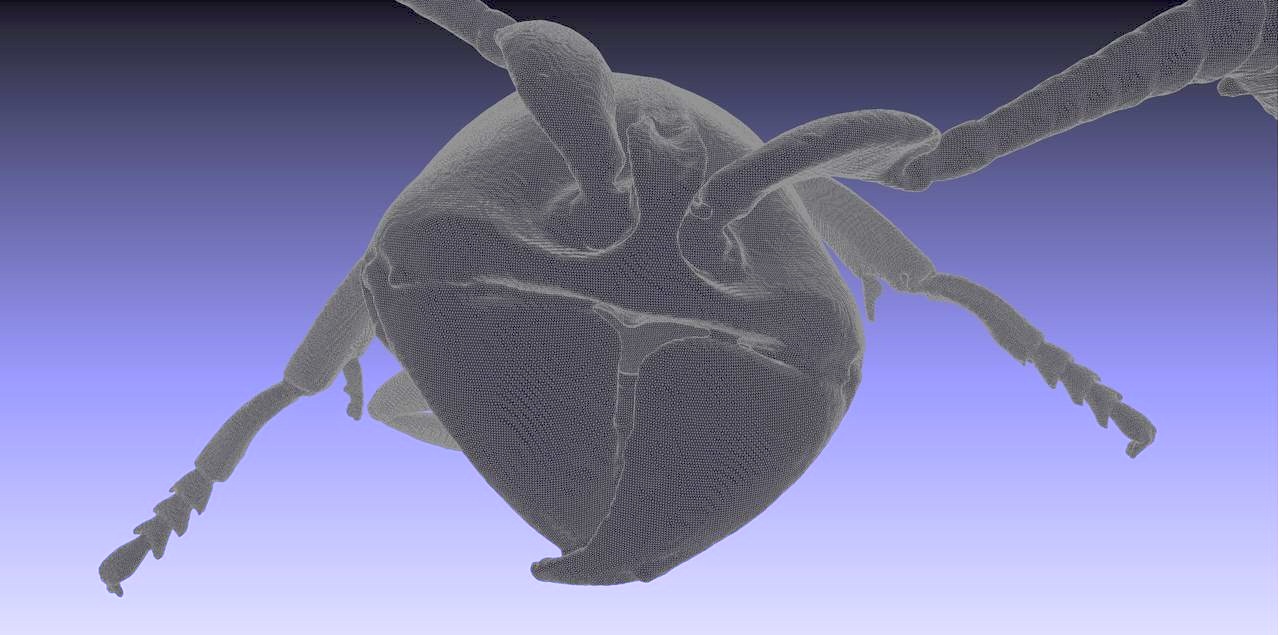
Do you like ants? Do you like 3D printing? There’s a solution available.
That solution is Antscan, a digital library of 3D scans of, well, ants.
Researchers from Japan and Germany saw a gap in digital knowledge of ants and sought a solution. They organized a team of biodiversity stakeholders to collect and present digital specimens for any researcher — or anyone — to access.
They explain:
“The Antscan initiative had the ambitious goal of generating 3D images of thousands of insects in a short period of time. Conceived as a pilot project for the digitization of a diverse group of small invertebrates, the initiative focuses on ants as a globally distributed, ecologically dominant group of insects, but at the same time offers a project design adaptable to other small organisms.”
As of this writing, their collection includes an amazing 15,000 species of ants. That may sound like a lot, but apparently there are over a million documented species of ants, and very likely many more undocumented species. But you have to start somewhere.
Ants are very tiny, so conventional 3D scanners aren’t really going to do a very good job of capturing the insect geometry. Instead, the Antscan team uses a room-sized synchrotron micro-CT system. This device includes a synchrotron that emits intense X-rays that illuminate the specimens with tremendous resolution.
They say that the raw captured data for a typical specimen is a massive 92.5GB, but they apply processing and present the results as STL files with more reasonable sizes. For example, I was able to download the critter shown at the top in only 148MB.
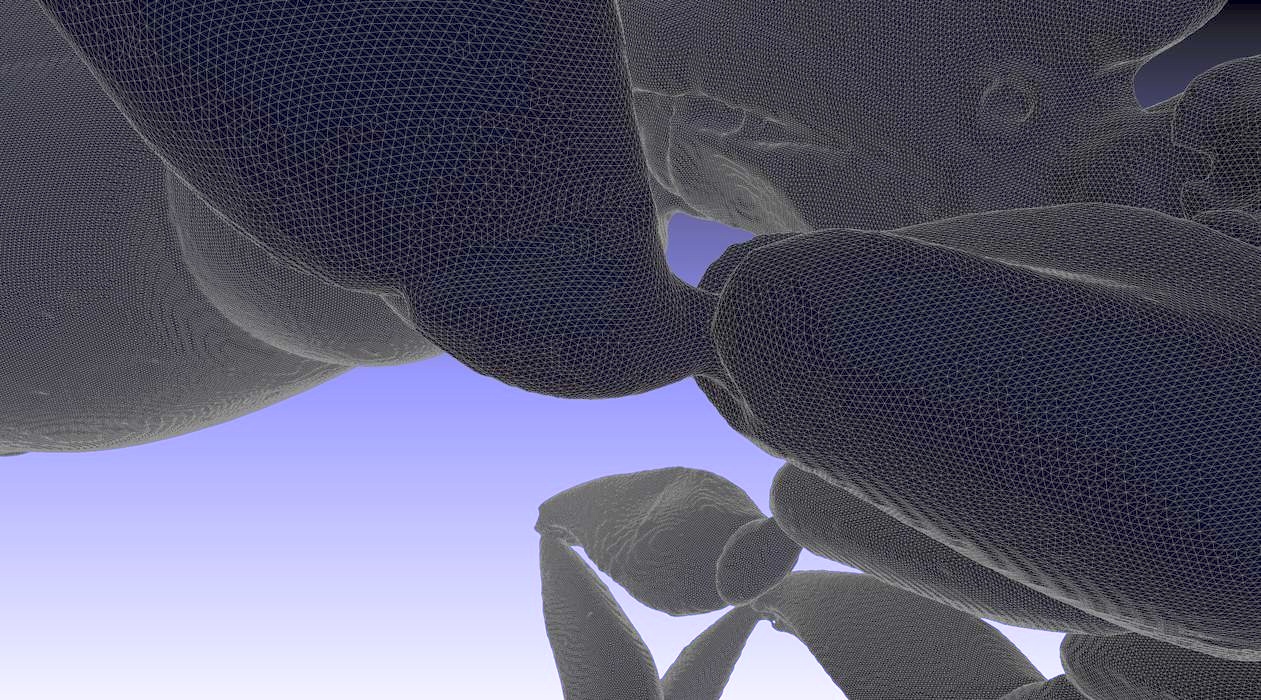
The detail of these scans is ridiculous. Here you can see a leg joint on my downloaded ant 3D model. This particular model included 148m triangles, so there’s plenty of resolution.
Since these are 3D models, it’s easily possible to print them with support structures.
But you’d better scale them up because, well, they are ants.
Via Antscan
