
There has long been the idea that 3D printing will “bring back manufacturing”, but is that ever going to happen?
It really hasn’t, at least so far. There have been a few exceptions in particular situations, but by and large the majority of manufacturing has gone overseas and hasn’t returned.
A LinkedIn post by Dimitar Hristakiev described what could be a milestone, but it also leads to another conclusion.
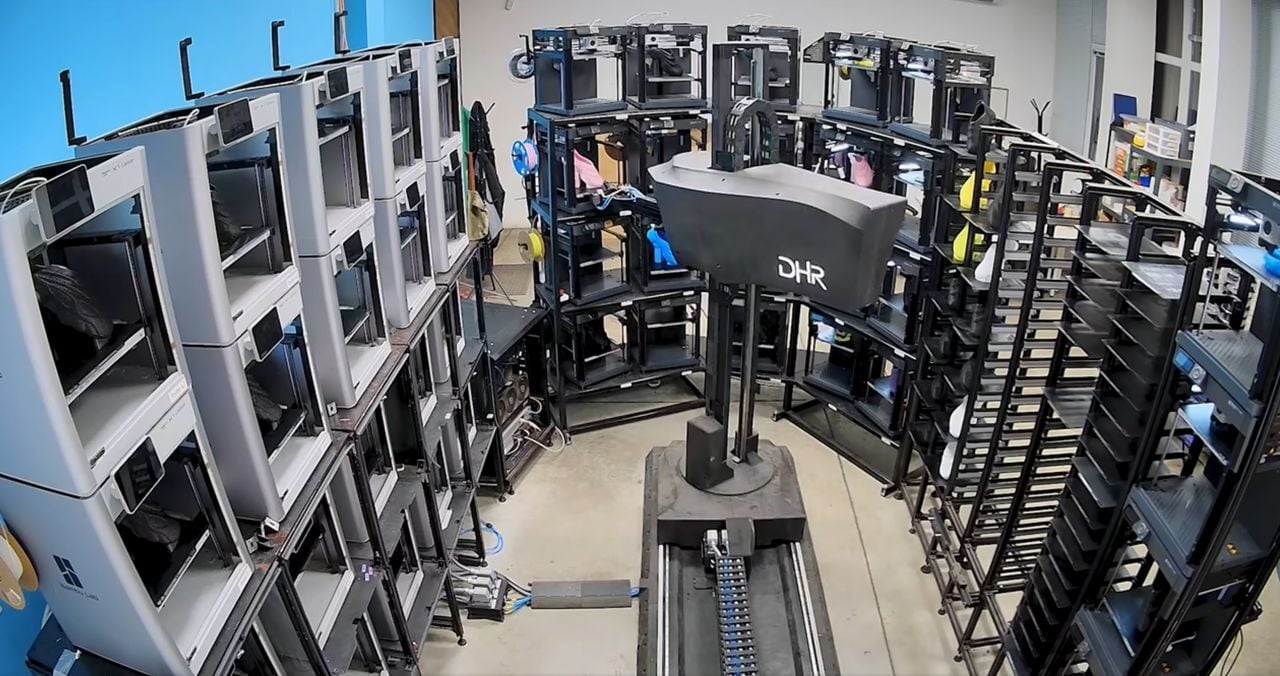
In the post, Hristakiev tells of a fully automated 3D print farm producing footwear components in California. The image shows a circular arrangement of 3D stacked 3D printers, entered on a robotic system. The robot picks up completed print plates and places them aside for post processing, and sets up the printers for their next jobs.
Hristakiev explained that the cost of producing one component using this approach was only US$15.42. He writes:
“Why does $15.42 matter? Because while it proves cost parity with the average $15-$16 ex-works cost of a mass-produced sneaker in China, the real revolution lies in the ability to deliver customization and flexibility that the traditional model fundamentally cannot match. We have a unique, custom-fitted shoe produced on-demand, locally, eliminating inventory risk VS a mass-produced, standard-sized shoe, requiring high MOQs, expensive tooling, not to mention shipping costs, customs and tariffs, time, and risk.”
Note that the setup involves the use of low-cost desktop 3D printers, not expensive professional or industrial equipment.
If more operations were able to achieve this type of success, perhaps more manufacturing would indeed reappear in the West.
But there’s a bit of a problem here. Hristakiev also said that his setup requires one operator for one hour per day, which was included in the US$15.42 estimate.
The return of manufacturing, at least in this case, did not create new job opportunities.
That was really the point of the offshoring problem: it wasn’t that manufacturing went overseas, it was that manufacturing JOBS went overseas. The fully automated approach (potentially) brings back the manufacturing, but not the jobs.
Automation through 3D print technology is only a partial solution.
In the end it is likely we will see ever-increasing amounts of automation. Companies will have to compete mostly on branding and function, since the machines they use to automate their manufacturing are priced at similar levels, unlike the labor cost differences that generated the offshoring in the first place.
So where will the new jobs come from? Will everyone have to set up their own manufacturing service using automation and robots? Will we all have to be plant managers in the future?
Via LinkedIn
