
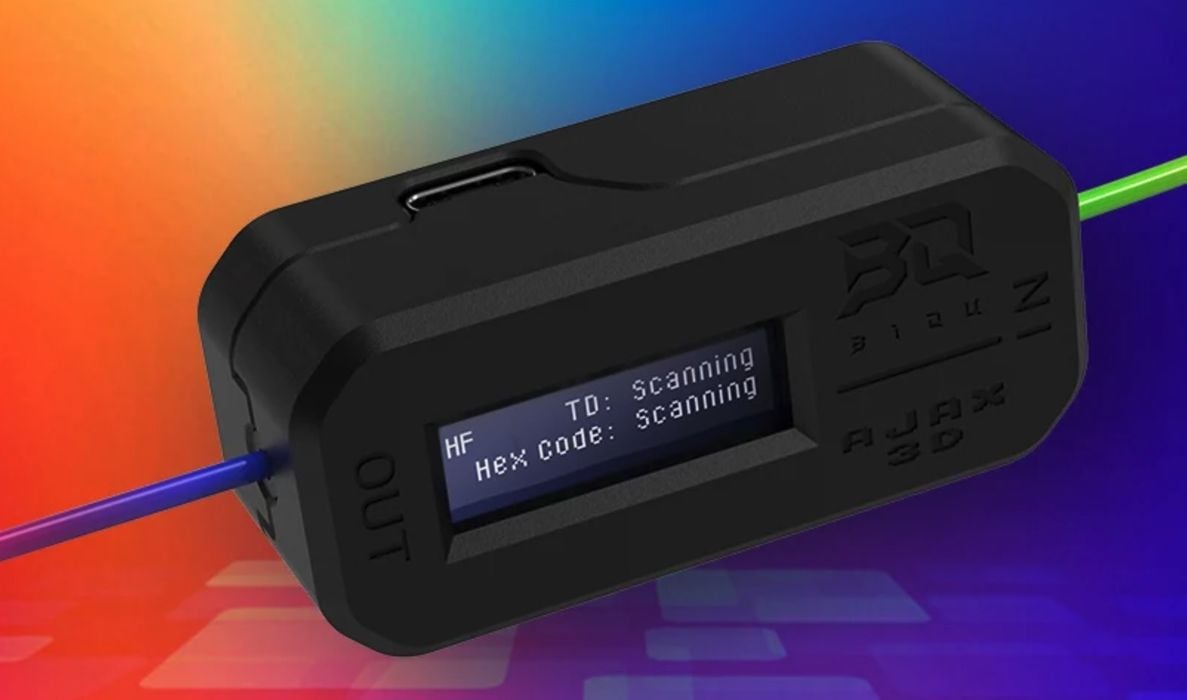
It seems every week BIQU has something new for us. This time they have an unusual colour accessory.
BIQU has been producing all manner of 3D printer accessories, mostly for Bambu Lab products, but also for other machines, too. They’ve produced machine modifications of all sorts, which typically must be installed on the equipment.
Here we’re looking at their AJAX TD1S, which is not something that modifies a 3D printer. Instead, it’s an accessory used for inspecting filament. I’m not sure there is anything else like it on the market.
The AJAX TD1S is a small handheld box that has an OLED readout panel and a hole on each end through which you insert a filament.
When powered on, the AJAX TD1S performs two functions:
Computes the RGB hex code for the filament’s colour
Measures the transmission distance of the material
The hex code is the same thing you’d see in a graphics program: x000000 is full black; xFFFFFF is full white; xFF0000 is full red; xFF00FF is purple; etc. Graphic artists use these codes to ensure colours are fully consistent.
But what does this have to do with filament? It turns out that filament colours actually vary considerably. You might buy the same product from the same company and find that the colour is slightly different between the two spools due to manufacturing variances.
Often, this doesn’t matter if you’re just printing a mechanical part or painting the part after printing. However, in some applications like HueForge, the colour is actually quite important. The wrong colour could result in a messed-up image.
The AJAX TD1S attempts to resolve this issue by definitively identifying the actual colour of the filament by simply sliding it into the device. If the colour is correct (or close), you can proceed. If it isn’t, then you should get a different spool.
But what about the “transmission distance”? What’s that all about?
The transmission distance is a measure of the material’s transparency. Some materials are entirely opaque, but others do let a little bit of light through. This is again usually not very important, but is critical when producing any print that requires light transmission. This would certainly be the case with HueForge output, but also any lithograph application.
If that wasn’t all, it seems that BIQU intends on doing some integration with the AJAX TD1S. They say they directly integrate with HueForge, which would be an incredible benefit. But they also say they are working with Mainsail (3D printer firmware) and OrcaSlicer to provide direct colour integration.
How would this work? The idea is that the 3D printer would have an AJAX TD1S installed so that the filament would automatically pass through on its way to the extruder. The AJAX TD1S would report the detected colour to the firmware, which could then send that information up the line to the slicer — in this case, OrcaSlicer.
This has to be one of the most unusual 3D printer accessories I’ve run across, and BIQU is selling them for only US$80.
Via BIQU
