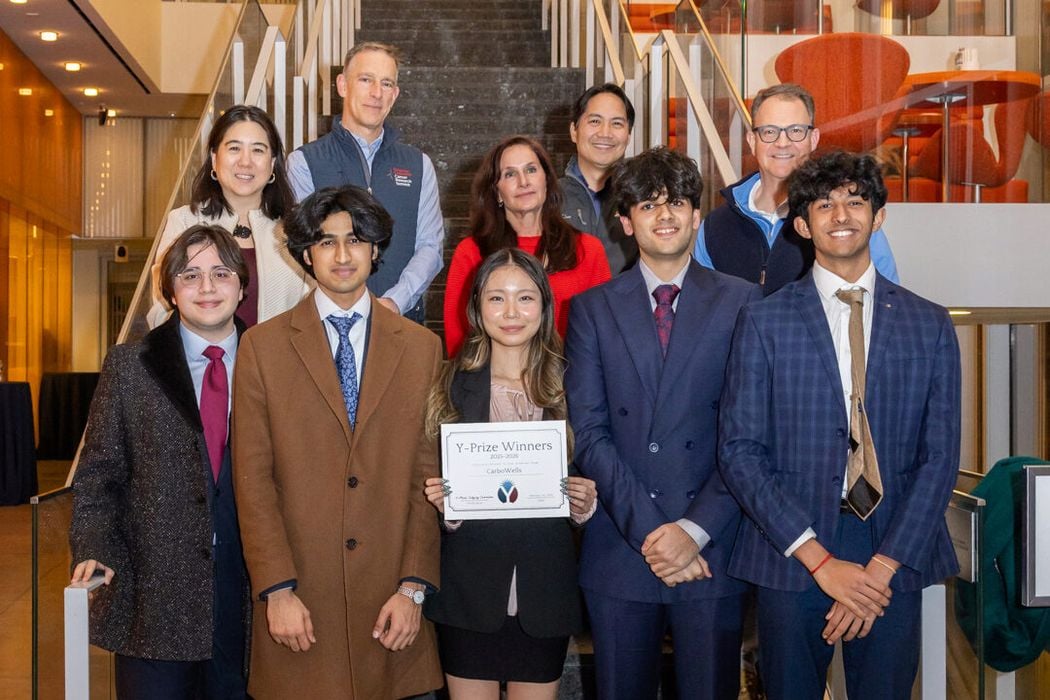
Charles R. Goulding and Preeti Sulibhavi report on the Y-Prize-winning CarboWells concept, which combines advanced materials and 3D printing to improve the long-term safety of abandoned oil wells.
Each year, the University of Pennsylvania’s Y-Prize competition challenges students to take emerging technologies developed in university labs and imagine entirely new real-world applications for them. The goal is not incremental improvement, but invention at the intersection of engineering, business, and societal need.
The competition is jointly run by Penn Engineering, the Wharton School, the Mack Institute for Innovation Management, Venture Lab, and the Penn Center for Innovation. Its format is simple but demanding: teams of students are given access to early-stage technologies and asked to build a full commercial concept around them, including technical feasibility, market strategy, and real-world impact.
Winners receive a cash prize to help advance their idea. In the most recent cycle, the grand prize was US$15,000, awarded to support prototyping and early validation work for the winning concept.
In 2026, the top honor went to a team called CarboWells, whose idea stood out for its combination of environmental urgency and advanced manufacturing. Their concept uses 3D printed carbon-capturing concrete to solve one of the United States’ most persistent infrastructure problems: leaking and failing oil well plugs.
The Y-Prize: A Launchpad for Applied Innovation
The Y-Prize is often described as an “inverse X-Prize.” Instead of starting with a major global problem and asking for solutions, Penn researchers first develop breakthrough technologies in areas such as materials science, robotics, and biomedical engineering. Students then choose one of those technologies and figure out what it could become in the real world.
The competition has been running for over a decade and has produced a steady stream of prototypes and early-stage ventures. It is designed to force interdisciplinary collaboration between engineers, business students, and designers.
The 2026 edition focused on a new class of 3D printed, carbon-capturing concrete developed in Penn Engineering labs. This material can form complex internal geometries, absorb carbon dioxide, and maintain or even improve structural strength as it cures.
That technology became the foundation for CarboWells.
Meet the CarboWells Team
The winning team consisted of five first-year students from across Penn’s engineering and business programs:
- Yash Iyer — BSE in Mechanical Engineering, Wharton School (Class of 2029)
- Ronith Lahoti — Bachelor of Science in Engineering (CBE), College of Engineering (Class of 2029)
- Bhuranyu Mahajan — BSE in Mechanical Engineering, Wharton School (Class of 2029)
- Yuki Qian — BSE in Materials Science and Engineering, College of Engineering (Class of 2029)
- Ali Altan Yilmaz — BSE in Materials Science and Engineering, College of Engineering (Class of 2029)
Each student brought a different strength to the table. Some focused on materials behavior and structural design, others on financial modeling and market feasibility. That blend of technical and commercial thinking is exactly what the Y-Prize is designed to encourage.
The Problem: Millions of Aging Oil Wells
There are approximately two million abandoned oil and gas wells in the United States, including 350,000 in Pennsylvania alone. These sites pose significant risks due to outdated sealing methods:
- Material Degradation: Traditional cement plugs crack and shrink due to freeze-thaw cycles, chemical exposure, and extreme pressure changes.
- Methane Emissions: Failed seals allow methane (CH4), a greenhouse gas significantly more potent than CO2, to leak into the atmosphere.
- Environmental Contamination: Integrity loss leads to groundwater pollution and surface soil degradation.
How can 3D printing and carbon-capturing concrete solve leaking oil well problems?
CarboWells solves the environmental hazard of leaking abandoned oil wells by replacing traditional passive cement plugs with 3D printed, carbon-capturing concrete systems. Unlike standard Portland cement, which is prone to cracking and degradation under geological pressure, the CarboWells system utilizes additive manufacturing (3D printing) to create internal interlocking pressure-distribution lattices. These geometries, combined with a composite material containing diatomaceous earth, allow the plug to chemically strengthen over time by absorbing carbon dioxide (CO2) while physically redistributing mechanical stress to prevent structural failure.
In practical terms, the plug does three things at once:
- Physically seals the wellbore
- Reduces crack propagation through internal geometry
- Chemically strengthens over time by absorbing CO₂
That combination makes it fundamentally different from poured cement, which is passive once it sets.
Why 3D Printing Is Essential
A conventional cement plug is poured in place and left to harden. Its shape is constrained by gravity and the geometry of the wellbore itself.
CarboWells requires something more precise.
3D printing allows the team to:
- Create custom internal lattice structures impossible to achieve with casting
- Control porosity and density gradients throughout the plug
- Tailor each design to specific well conditions (depth, diameter, pressure)
- Integrate carbon-capturing material evenly throughout the structure
Without additive manufacturing, these geometries would either be too expensive or physically impossible to produce.
In this case, 3D printing is not just a fabrication method. It is the enabling technology that turns a material innovation into a deployable system.
How does 3D printing improve oil well remediation?
3D printing is the essential enabling technology for CarboWells because it facilitates performance-engineered geometry that is physically impossible to achieve through traditional casting.
- Custom Internal Lattices: Creates complex structures inspired by natural load-bearing patterns to spread stress evenly through the plug.
- Porosity Control: Precisely manages density gradients to ensure CO2 is integrated uniformly during the curing process.
- Site-Specific Tailoring: Adjusts design parameters based on specific depth, diameter, and pressure requirements.
What is the CarboWells innovation process?
The CarboWells concept won the 2026 Y-Prize, a competition hosted by the University of Pennsylvania (Wharton and Penn Engineering) designed to commercialize early-stage lab technologies.
| Phase | Activity | Innovation Focus |
| Technology Selection | Repurposing Penn Engineering’s carbon-capturing concrete. | Materials Science & Sustainability |
| Structural Design | Engineering 3D-printed modular lattice structures. | Additive Manufacturing |
| Validation | Prototyping to prove “seal and strengthen” capabilities. | Infrastructure Reliability |
Why This Matters: Environmental Stakes
The environmental stakes behind this type of infrastructure are significant.
Methane, the primary gas released from leaking wells, is far more potent than carbon dioxide in the short term as a greenhouse gas. Even small leaks from thousands of wells can add up to meaningful climate impact.
Beyond climate concerns, there are local risks:
- Contaminated drinking water supplies
- Soil degradation near agricultural land
- Air quality issues in nearby communities
Abandoned wells are often described as “invisible infrastructure risks” because they are distributed, aging, and expensive to fix individually. The scale problem is what makes innovation in plugging technology so important.
CarboWells is essentially trying to shift the paradigm from “seal and hope” to “seal and strengthen.”
The Bigger Idea Behind CarboWells
What makes CarboWells notable is not just the application, but the direction it points toward.
Instead of treating concrete as a static material, the team uses it as an active system—one that can interact with its environment, capture carbon, and improve over time. Combined with additive manufacturing, that opens the door to infrastructure that is both structural and functional.
It also reflects a broader trend in 3D printing research: moving from shape-making to performance-engineered geometry, where internal structure matters as much as external form.
Final Thoughts
CarboWells emerged from a student competition, but the problem it targets is very real and very large. Millions of abandoned oil wells, decades of degradation, and growing climate pressure make oil well remediation a critical infrastructure challenge.
By combining carbon-capturing concrete with 3D printed structural design, the team proposes a system that does more than plug holes. It actively reinforces itself while reducing environmental harm.
Whether or not CarboWells becomes a commercial product, it demonstrates something important: additive manufacturing is no longer just about prototypes or parts. It is becoming a tool for rethinking infrastructure at a systems level.