
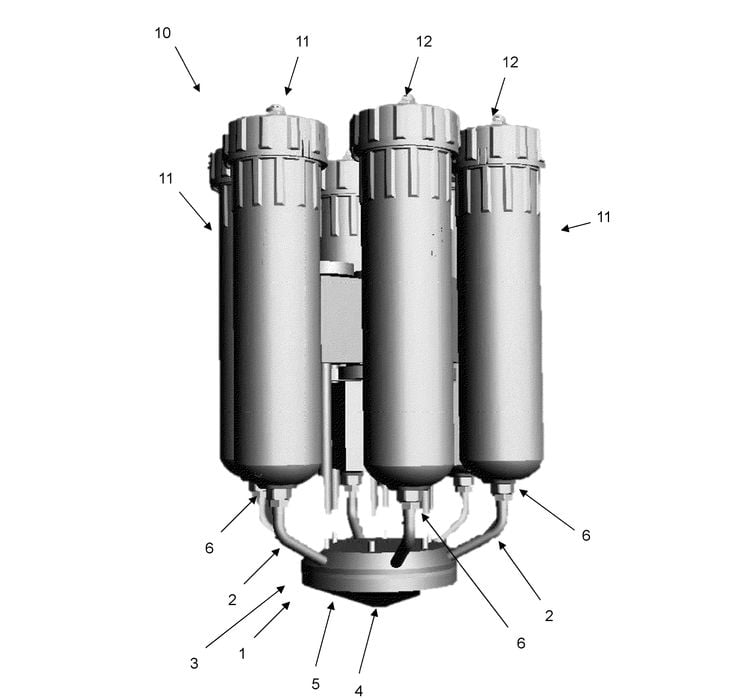
TNO has published a patent application describing a compact printhead for multi material semi solid extrusion.
The patent, EP4748554A1, is assigned to Nederlandse Organisatie voor toegepast natuurwetenschappelijk onderzoek TNO, better known simply as TNO. The application was filed in November 2024 and published on 27 May 2026.
And who are they? TNO is a major Dutch applied research organization, often involved in turning technical concepts into industrially usable processes. They have done much work on 3D print technology in the past. In this case, the work is looking at a very specific branch of additive manufacturing: extrusion of semi solid materials.
That means pastes, gels, food materials, pharmaceutical compounds, cosmetics, peanut butter like materials, jellies, and other substances that are neither fully liquid nor fully solid. These are difficult to handle cleanly and precisely, which is why paste extrusion systems often look more like homemade setups than production ready machines.
The Problem With Paste Printing
The patent describes a well known limitation in semi solid 3D printing: most systems can handle only one material at a time. If multiple materials are needed, the usual answer is a tool changer, multiple syringes, or physically separated printheads.
That works, but it creates problems. Syringe swaps take time. Multiple heads must be perfectly aligned. Materials may not mix. Cleaning becomes a major issue, particularly for food or pharmaceutical applications where hygiene is not optional.
TNO’s proposed answer is a multi channel extrusion head that brings several semi solid material feeds into one compact printhead. Each upstream channel receives material from a source, such as a tube, container, syringe, or other supply. The material is then driven toward the nozzle by a “progression actuator,” which the patent describes as potentially being a gear pump driven by a motor.
In other words, the printhead is not merely a passive manifold. It is intended to meter the semi solid materials before they reach the nozzle.
That is likely the most interesting part of this patent.
A Compact Mixing Head
The patent describes multiple upstream channels distributed around an axis aligned with the nozzle. The ducts can converge toward the nozzle, and an optional mixing chamber may sit between the multi channel body and the nozzle. The mixing chamber can have a predetermined volume and may include active or passive mixing features.
That suggests several possible operating modes. The head could dispense one material at a time. It could switch between materials without swapping syringes. It could also dispense multiple semi solids simultaneously so they meet and mix before exiting the nozzle.
For food printing, that could mean controlled gradients, filled structures, or combinations of texture and flavor. For pharmaceuticals, it could imply dose controlled combinations or personalized formulations, assuming the rest of the regulatory and process chain can support it.
The patent also puts considerable emphasis on cleaning. The multi channel body is releasably mounted in the printhead housing, ducts can be exposed for access, and the nozzle can be removed or exchanged. In paste based AM, cleanability can determine how useful a system is.
There is also a practical nozzle angle here. TNO describes a releasable nozzle and potentially adjustable or swappable opening diameters. That would matter because semi solid extrusion is highly dependent on viscosity, particle content, pressure, and nozzle diameter.
This concept is notable because it attacks a real bottleneck. Semi solid printing has long had fascinating applications, especially in food and medicine, but many systems remain slow, messy, and awkward to scale. A compact, cleanable, metered, multi material printhead would be a useful building block if it can be made reliable.
Can TNO or a partner can move this from the patent stage into a production extrusion module? We will have to wait and see if that happens.
Via Espacenet
