
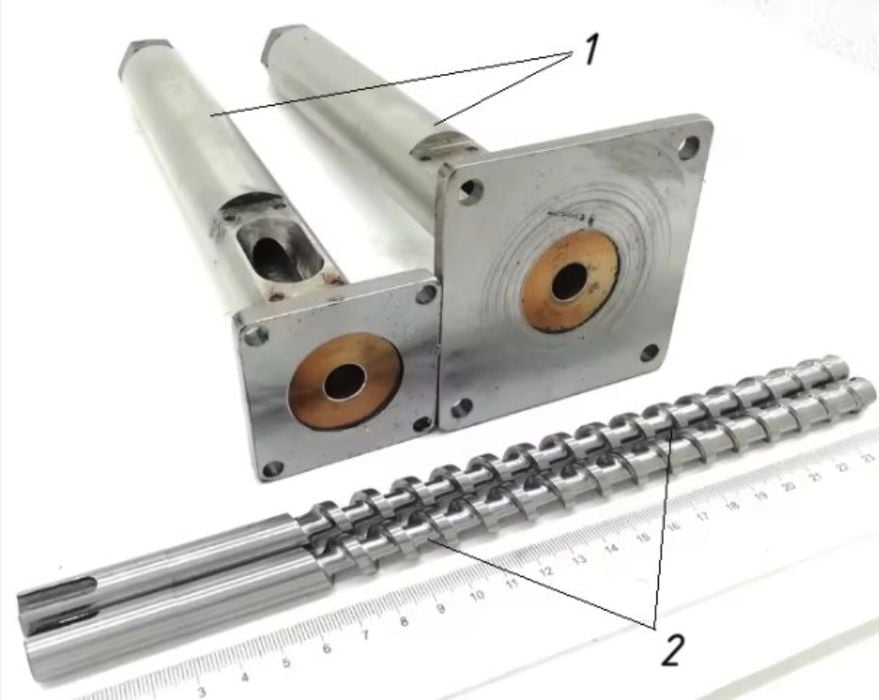
A new paper describes a single screw extruder concept for producing ABS composite filament reinforced with carbon and Kevlar fibers, a combination that could deliver tougher, stiffer feedstock for FFF users.
Composite filaments are hardly new, but they are tricky to manufacture well. Chopped fibers improve stiffness and wear resistance, yet they also raise mixing difficulty, abrasion, and diameter variability. Many labs and small manufacturers would love to compound their own materials to cut costs and tune performance, but typical setups struggle with abrasive fillers and consistent 1.75 or 2.85 mm tolerances.
That is why this study is interesting: it targets the design of a single screw extruder tailored to fiber-laden ABS. If such a design can reliably meter, mix, and extrude abrasive composites while holding roundness and diameter tolerance, it could make in-house composite filament production more practical.
This work is a peer-reviewed research paper, not a commercial launch, so think “research prototype” rather than a ready-to-buy item. The researchers focus on design features that make fiber compounding possible with a simpler, lower-cost architecture than a twin screw, which is the usual go-to for difficult mixing jobs.
Inside The Extruder Concept
The single screw path trades aggressive distributive mixing for simplicity, throughput, and cost. For chopped fiber composites, the goal is to ensure there is enough shear to disperse bundles without over-cutting fibers or scorching the polymer. That means carefully chosen feed, compression, and metering zones, controlled temperature profiles, and a die and puller setup that lock in stable diameter.
The paper’s title emphasizes “design features,” which in this context typically include wear-resistant metallurgy for screw and barrel, mixing elements that encourage dispersion with moderated shear, and attention to the die land length for pressure stability. Because carbon fiber is abrasive and aramid (Kevlar) can fuzz and entangle, hardware durability and smooth melt flow are not side issues — they are the ballgame. To be clear, those specifics are common approaches to this problem; the authors’ exact geometry and parameters are not disclosed in the source summary.
Downstream, diameter control is everything. A laser gauge, closed-loop puller, and disciplined cooling often make the difference between saleable filament and scrap. If the team can hold ovality and diameter within typical FFF-friendly bands, much of the remaining risk shifts to batch-to-batch dispersion and moisture control. ABS is relatively forgiving, but pellets and compounded blends still benefit from drying to avoid porosity and surface streaks.
Why This Could Matter For FFF Users
ABS reinforced with carbon and Kevlar fibers sets up an interesting property mix. Carbon brings stiffness and heat resistance; aramid contributes impact toughness and energy absorption. In other words, jigs, brackets, and housings that are both rigid and less brittle become more attainable — provided fiber content, length, and orientation are managed.
Commercially, the attractions could be cost and control. Premium composite filament is expensive, yet quality varies across brands. A robust single screw approach could let universities, service bureaus, and small OEM labs dial in their own formulations at lower cost per kilogram. The catch is quality assurance. Without steady diameter, homogeneous fiber dispersion, and repeatable lot properties, nozzle clogs, inconsistent layer bonding, and unpredictable strength will erase any savings.
A credible demonstration of this concept would show hours of continuous running, a histogram of diameter with standard deviation, micrographs of fiber dispersion, and printed benchmarks comparing the material to baseline ABS and to commercial CF ABS. Wear rates for the screw, barrel, and die would also matter, as would guidance on hardened nozzles for printers.
If the team can publish that data, this becomes more than a concept — it becomes a playbook for low-cost composite filament production.
Via KMHNU
