
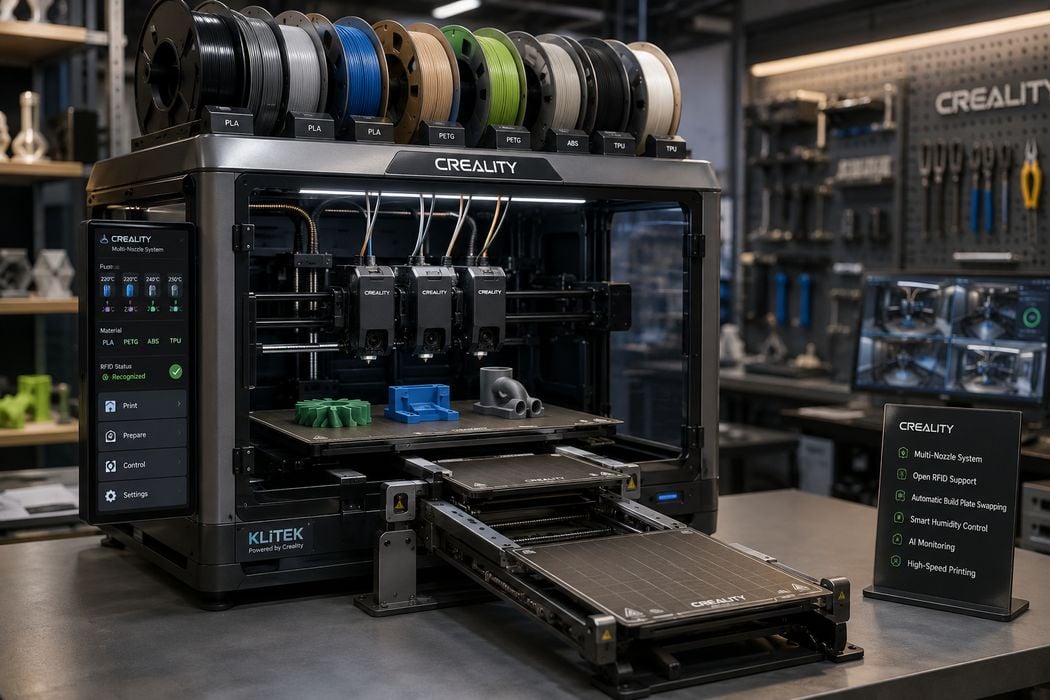
Creality has issued an interesting 3D printer operator survey, and it hints at what might be coming.
Creality is one of the largest producers of 3D printing on the planet, so when they are asking for advice, it’s a good idea to put in your two cents. Their online survey was just launched and it’s pretty easy to fill out, taking only 5-10 minutes.
However, by looking at the specific questions in the survey, we can get a glimpse of what Creality might be thinking. It makes no sense to build a new machine that no one would want, so by asking questions of operators, they can get a sense of what everyone wants. Then they will build it.
The survey questions are all around multi-nozzle FFF systems, which are now available from a range of manufacturers, including Prusa Research, Bambu Lab, Snapmaker, and several more. Two (or more) nozzles are typically used for two reasons:
- To reduce filament swaps for jobs that mostly require only two materials, saving materials.
- To enable the use of TPU in systems that otherwise wouldn’t support flexible materials.
It’s a competitive market right now, and made even more competitive with the introduction of low-waste systems from several vendors, including Creality. They announced their KliTek technology recently to compete with INDX, Vortek, and other systems from their competitors.
In other words, Creality will have to come up with an interesting new angle to distinguish their products from the competition. But what should that be? The best idea is to ask the customers what they might want, and that is surely the purpose of the survey.
Much of the survey is basic boilerplate stuff, that either categorizes the responder (age, income, industry, etc.) or validates that the responder actually does use a multi-nozzle system (system type, quantity, location, materials, etc.).
There is a question asking about which factors were most important when making a buying decision, and they asked about:
- System design
- Reliability
- Build volume
- Surface quality
- Precision
- Material scope
- Reputation
- Cost
- Ease of use
- Community support
- Intelligence
- Expandability
- Maintenance
- Support
The answer to that question will help Creality tilt their resources towards improving the factors that customers most want.
Interestingly, they also asked about how and where the existing 3D printers were set up. Were they in a lab, on a floor, on a shelf? It seems that Creality might take some hints there to determine changes to the future form factors for their systems.
But by far the most interesting question was about future expectations. This, I believe, is the question Creality will use to determine which major features they will next develop (or bring to market if they’ve already been working on these). This is the list of options they presented in the survey:
- Ultra-High-Speed Printing — e.g., sustained print speeds exceeding 1000 mm/s
- Mixed Nozzle Diameter Printing — e.g., using smaller nozzles for outer walls and larger nozzles for infill
- Independent Multi-Toolhead Printing — e.g., multiple toolheads with fully independent motion paths printing different models simultaneously on the same build plate
- Collaborative Multi-Toolhead Printing — e.g., multiple toolheads working together within the same build volume to print a single large model
- Ultra-High Precision Support — e.g., native support for 0.1 mm or smaller nozzle diameters for highly detailed prints
- Metal-Filled Material Support — e.g., printing and processing metal-filled filaments such as stainless steel or copper
- Engineering Material Support — e.g., reliable printing of materials such as PEEK and PEI
- Open RFID Support — e.g., automatic recognition of third-party (non-official) filaments
- Smart Humidity Control — e.g., automatic humidity monitoring and integrated filament drying
- Multi-Angle / Panoramic AI Monitoring — e.g., AI cameras with multiple viewpoints or movable viewing angles
- Intelligent Nozzle Takeover — e.g., automatic continuation of a print by another nozzle when the primary nozzle is unavailable
- Automatic Build Plate Swapping — e.g., continuous, unattended production through automatic build plate replacement
That is quite a list, and includes several very major new features. Imagine a system that could automatically swap build plates, for example: continuous 3D printing would be enabled.
I’m quite interested in several of these features, but the one of most interest would be the open RFID support. That would allow operators to easily load up almost any filament spool on a future Creality machine and it would automatically recognize it.
But at this point we have no idea where Creality will go with these ideas. In fact, Creality themselves probably have no idea, and that’s why they did the survey.
If you’d like to participate in the survey yourself, here’s the link.
