
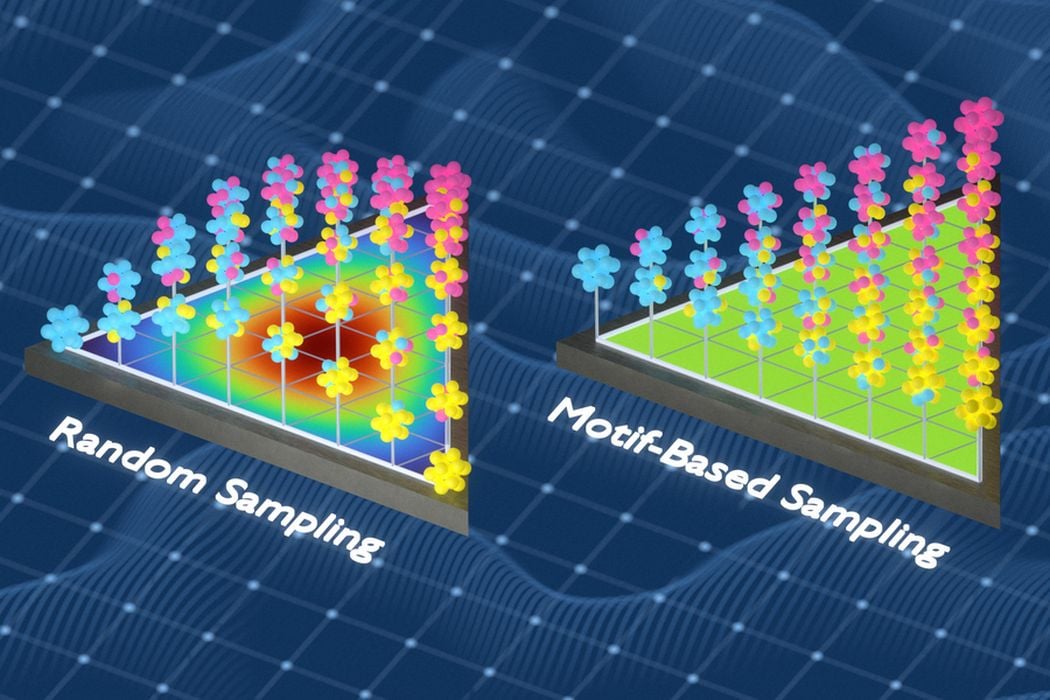
MIT researchers say they have found a more efficient way to train machine learning models that predict how complex metal alloys will behave.
For additive manufacturing, alloys are often the limiting factor rather than the machine. If the material’s microstructure shifts during processing, properties can swing from ductile to brittle, or from stable to crack-prone, even when the overall chemistry looks the same on paper. That is why designers and production engineers still heavily rely on making and testing coupons, despite major advances in simulation.
The MIT team’s work targets a specific problem in materials modeling: chemically disordered solids. Many useful engineering metals are not perfectly ordered at the atomic level. Instead, their elements form a wide mix of local neighborhoods, and those neighborhoods influence which phases form and how they evolve with temperature and composition.
Atom-by-atom simulations can capture those effects, but they require a model of interatomic interactions that is accurate for the specific material of interest. Over the past two decades, machine learning has become a leading way to build those “potentials,” yet the quality of the model depends heavily on the training dataset. MIT says today’s common dataset-building approaches can be computationally punishing, sometimes consuming more than 100,000 hours of computation for one material, and may not transfer well when the composition changes.
Motifs Instead Of Brute Force
In a paper in Science Advances, senior author Rodrigo Freitas and colleagues describe a method to build training sets that better represent the diversity of atomic environments inside disordered materials. First author Killian Sheriff and co-authors Daniel Xiao, Yifan Cao, and Lewis R. Owen (University of Sheffield) focus on metallic alloys, but Freitas says the approach could be adapted to other material classes, such as semiconductors.
The key idea is to reduce redundancy and increase coverage. Using information theory, the researchers iteratively “swap out” atoms in sample configurations so the training set contains as many distinct local environments as possible. If the same environment appears repeatedly, it is replaced with one the model has not seen. The team describes the result as a more “informative” dataset, because each example contributes new chemical context.
MIT also describes their method as capturing hidden patterns in disordered alloys, including “subtle energetic biases toward certain local chemical configurations.” Those small energy differences can be really important because they can tip which phases are stable, which in turn affects processing windows and final performance.
Why This Matters For Manufacturing
When the models were trained on the motif-based datasets, MIT reports they predicted material properties more accurately than models trained using random sampling or another popular sampling method. The researchers also applied their technique across a chemically diverse group of alloys and say their resulting models outperformed much larger models produced by major technology companies, including Google and Microsoft.
One practical demonstration comes from phase diagrams. Xiao led simulations showing that the team’s models could predict phase diagrams that closely matched experimental data. Phase diagrams are central to deciding how to cast, weld, or heat-treat an alloy, because they indicate which phases are expected to form at different temperatures and compositions. For metal additive manufacturing, they also relate to questions like whether rapid thermal cycling will promote a brittle phase or a more forgiving microstructure.
Their direction is pretty compelling: if better sampling can produce high-fidelity chemistry with far less compute power, more organizations could afford to explore composition space before getting down to work.
The next test will be whether this approach can be integrated into the “existing operating procedures” materials engineers rely on, as Freitas notes, and whether it holds up under the reality of industry. If it does, alloy development may start to look a lot less like trial-and-error and a lot more like engineering.
Via MIT News
