
We’ve just learned a whole lot more about Creality based on a document recently filed with the Hong Kong Exchanges and Clearing Limited.
Creality has been working towards an initial public offering (IPO), which would transform them from a privately held company to a publicly traded company. In the process, they would sell some unknown number of shares to the public, and therefore raise a massive amount of investment for the company to use.
We’ve known the company has been looking at an IPO for about a year now, but recently they filed one of many required documents with the exchange authorities. The document isn’t quite an official prospectus, which is a detailed description of a company for investors to review before share sales begin. Instead, it’s an “Application Proof”, a kind of draft document that precedes the official prospectus.
While only a draft, the 492-page (!) document contains mountains of details about the company and its previously private financial information.
The lengthy document includes not only copious financial information, but also long descriptions of their products, business model, sales structure, etc. It is able to fully describe the current state of the company.
Non-Financial Information
Some of the document is REDACTED, a word that’s become more popular recently. One of the blank sections is the “timeline”, where we might learn when Creality plans to become a public company.
According to the document, the company was founded in 2014 by four founders. It turns out that today these four individuals, through their separate holding companies, still control some 82% of the company. Creality is still very much founder-controlled, not a company already diluted into institutional hands.
The filing says its printers, scanners, and laser engravers are compatible with third-party consumables, accessories, and software, and that substantially all of its 3D printers use open-source firmware that users can modify. This is quite an interesting thing to declare, as some of the company’s competitors are moving towards more closed ecosystems.
The document reveals the scale of Creality’s manufacturing. Creality says its total production area exceeded 260,000 sm after its Huizhou facility came online, while an 80,000 sm Wuhan manufacturing facility started trial production in 2023. They also say that in 2025, Huizhou was running at 88.8%, Wuhan at 89.8%, and Shenzhen at 86.5%. This all suggests that the company has significant manufacturing muscle, and is not outsourcing very much.
Apparently, Creality now has over 900 patents, which is quite significant, and could be one of the largest patent portfolios for 3D print technology.
Creality states they have made some relatively small sales to Russia, but are “gradually reducing” these due to sanctions. They also state that a key risk to their business is unpredictable US trade policies.
Their online sales have also dramatically increased. This shows that the company has been slowly shifting from sales through resellers to a more direct-to-consumer approach online.
Financial Information
We have some details of the company’s revenue over time (converted from RMB to USD):
- 2023: US$272M Revenue / US$19M profit / 6.9%
- 2024: US$331M Revenue / US$13M profit / 3.9%
- 2025: US$453M Revenue / US$26M profit / 5.7%
That’s significant growth, 20-30% per year. However, they also say that the revenue from printers alone fell from 75% to only 57%, with the rest being taken up by sales of consumables and scanners.
Profitability is relatively low compared to higher-end 3D printer manufacturers, but at this scale, they still generate a lot of cash. Strangely, the profitability has not grown as the revenue increased, suggesting they are not achieving optimal economies of scale. In fact, their gross margin values have been falling.
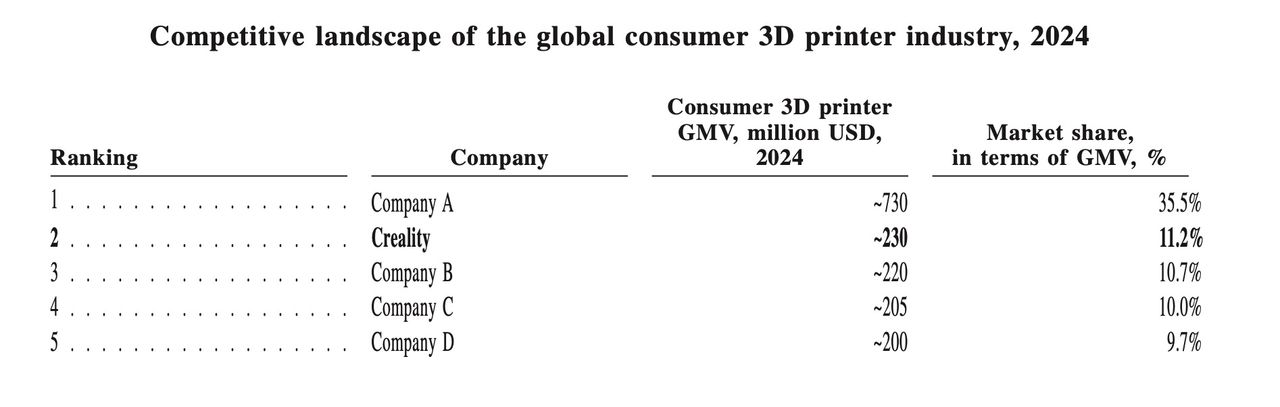
This may have something to do with what Creality calls “Company A”. They published a chart showing the leading 3D printer companies by gross market value, with Creality in position two, and “Company A” in the lead. It is all but certain that Company A is in fact Bambu Lab. Even in 2024, the chart shows that Bambu Lab was 3X the size of Creality, and that gap is likely larger now.
It may be that by doing the IPO, Creality will find itself flush with cash, and that might enable it to spend on research and development to start closing that gap.
Via HKEX (PDF)
