
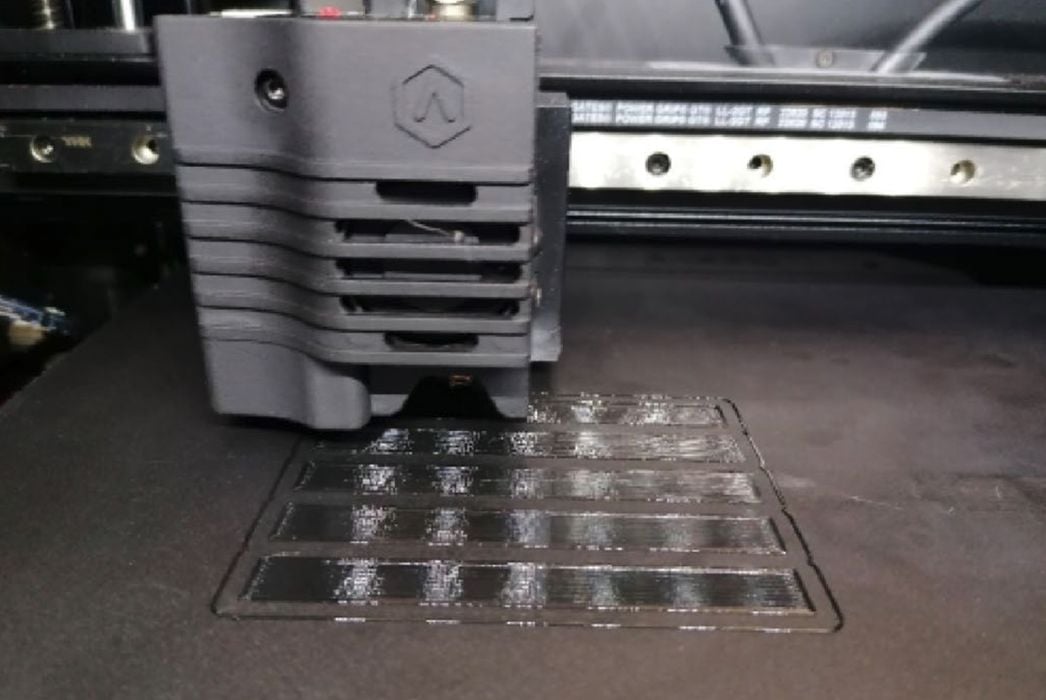
A Moroccan research team mapped how common FFF settings drive PETG flexural behavior and then used a neural network to predict the best tradeoffs.
The group at Hassan II University of Casablanca printed one hundred twenty five PETG specimens on a Raise3D E2 and ran ISO 178 three-point bending to get flexural strength, modulus, and strain. They varied five familiar knobs — layer thickness, print speed, infill density, nozzle temperature, and infill pattern — each at five levels using a Taguchi L25 design.
The results will not be a surprise to FFF operators, but they put numbers to the intuition. Flexural strength ranged from 41.3 to 66.6 MPa; modulus from 1.39 to 1.90 GPa; strain from 2.78 to 5.83 percent. Analysis of variance pointed right at infill density and nozzle temperature as the most significant factors in all situations. Layer thickness mattered for strength and strain. Print speed only moved modulus. Infill pattern influenced strength, but not stiffness.
What The Team Actually Did
The Taguchi approach cut a combinatorial space down to twenty five configurations with five replicates each. Factors and levels were practical: layer thickness 0.1–0.3 mm, speed 30–90 mm/s, infill 20–100 percent, nozzle 220–260 C, and five patterns (Line, Triangular, Gyroid, Grid, Honeycomb). Testing followed ISO 178 with 64 mm span and a 2 mm/min rate.
Strongest parts came, unsurprisingly, at full infill. The top two runs hit roughly 66.6 MPa strength with 100 percent infill, while the highest modulus reached 1.90 GPa. The data also reinforced a familiar thermal story: hotter nozzles improve interlayer diffusion up to a point, nudging both modulus and strain higher, but contribute far less to strength than simply removing porosity.
Then the team built a multioutput Artificial Neural Network (ANN) to predict all three flexural responses at once from the five inputs. Using a compact {9-8-3} feedforward network with Bayesian Regularization and five-fold cross validation at the configuration level, they report R2 of 0.957 and MSE of 0.808. In other words, the model explained more than ninety five percent of variance on unseen parameter combinations.
Why This Matters For FFF Users
A single model that simultaneously predicts strength, stiffness, and strain is exactly what part designers and print operators need when the job is not just to go fast, but to hit engineering targets. It means you can ask for a target response mix and get a good starting set of parameters without burning through spools and shop time.
Even better, the study quantified a sensible compromise using a desirability function. The globally optimal setting for balanced performance was nozzle 230 C, layer 0.20 mm, speed 70 mm/s, infill 100 percent, Line pattern. A near tie shifted toward stiffness at 240 C, 0.10 mm, and full infill with Triangular. For many PETG jigs and end-use brackets, those are practical presets.
There’s also a clear message for day-to-day tuning. If you need strength, prioritize infill density before agonizing over pattern. If ductility matters, nudge temperature up within your material window and avoid ultra thin layers. Speed barely touches strength, so you can trade some throughput without much penalty — but watch modulus.
If similar models are trained across other materials and other printers — and paired with process sensing — we could see closed-loop setups that achieve engineering targets with far fewer iterations.
