
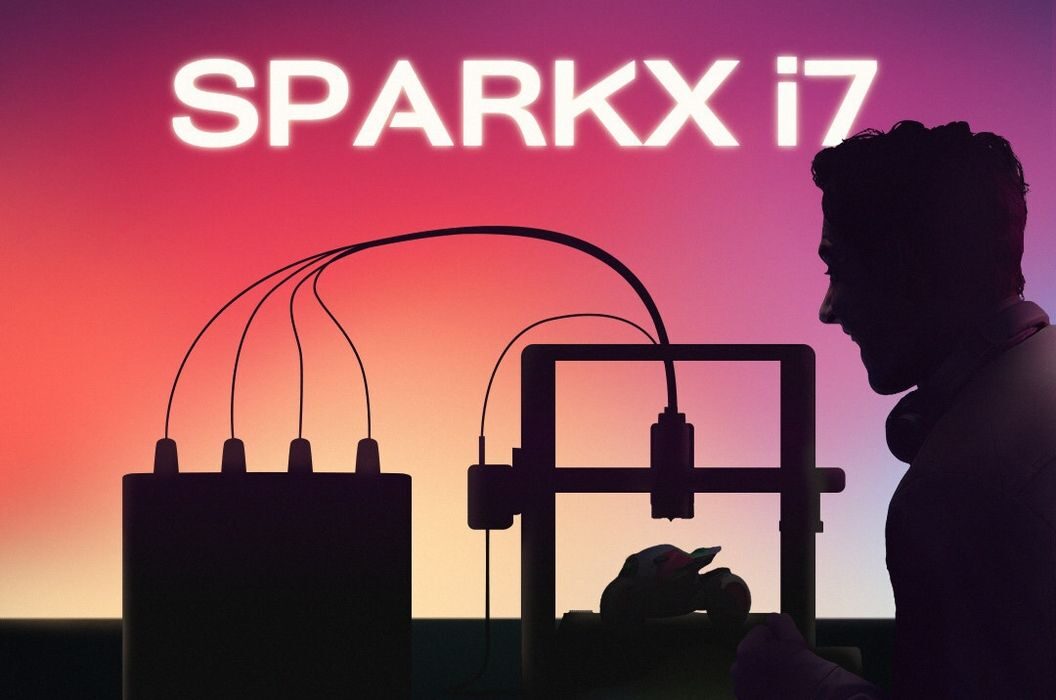
Creality quietly announced something called “Spark X” last week.
In what must be one of the strangest PR campaigns, I accidentally ran into a press release about “Spark X”. The long release described the horrors of using tricky 3D printer hardware, and how they want to solve those problems through automation, fresh designs and AI. They describe scenarios where 3D printer operators have trouble finding the right designs to print, and suggest that advanced AI tools could create those designs for them.
That sounds like a decent plan, but what exactly is “Spark X”? Is it a machine? A software tool? Something else?
It turns out that Spark X is a brand, under which Creality will no doubt develop new hardware and other components that will follow the mission stated in the long press release.
They also mention “Spark X i7”, which might be a particular 3D printer model in the Spark X brand. At top you can see a promotional image and it seems to portray an open gantry 3D printer attached to a filament swapper, perhaps Creality’s CFS unit. The operator seems quite happy, too.
That’s probably because the Spark X i7 meets their slogan, “Effortless Printing Starts Here”.
I’m all for that, but I’d like to know more. A search of Creality’s main site reveals no hits on “Spark X”. I did mention that this is a quiet reveal.
What else do we know about the i7? The press release does discuss one component, the hot end. Hot ends are often swapped out for maintenance or changing the extrusion diameter. In must cases it’s a pain to do so because of heat requirements, tools and mechanical access. Some systems have developed “swappable” hot ends that make life somewhat easier.
Here Creality talks about an entirely new hot end design that seems to be far easier to change. They write:
“Spark X’s quick-change hotend was shaped through eight full design cycles and a complete structural rethink. Early prototypes still relied on threaded retention and partial wiring, which solved speed but not reliability. Later versions explored magnetic coupling, multi-point latches, anti-rotation keys, and finally a floating alignment system capable of repeatedly positioning within 0.05mm. Each iteration exposed new failure modes—from thermal creep affecting connectors, to repeated insertion loosening tolerances, to material expansion shifting alignment. By the final rounds, the team rebuilt the module from the inside out: relocating stress points, isolating heat, reinforcing the datum surfaces, and designing a locking motion that is intuitive yet mechanically robust.
The result is a mechanism that lets users replace a nozzle in three seconds—no tools, no wires, hot-swap supported up to 220C, and over 500 verified insertion cycles. Maintenance becomes instinctive rather than technical, allowing anyone to change materials freely, recover from issues quickly, and treat the printer like a dependable tool instead of a fragile device.”
I’m interested to learn more about the new Spark X line, and how Creality intends on simplifying the user experience.
Via PRNewswire
