
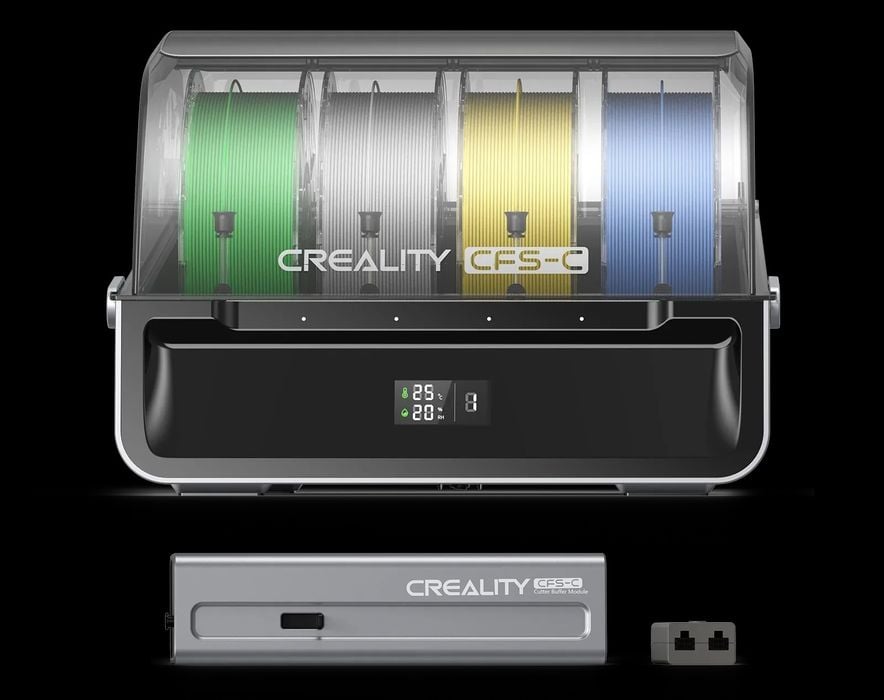
Creality has taken up the “no waste printing” problem quite differently with their new CFS-C.
Creality’s CFS, or Creality Filament System, is a four-spool accessory to many of their flagship desktop FFF 3D printers. Like their competitors, the CFS pushes and pulls filament to and from the hot end in order to change materials during a print job.
The original CFS worked much like all the other units: when a colour change was required, the filament was cut at the hot end and then pulled back to the CFS. A new filament was inserted, and then run through the hot end to purge out the previous colour. This creates a small “poop” that falls out the back of the 3D printer.
The problem has been that as operators print more complex multicolour objects, the poop ratio skyrockets. It is not uncommon to have a print job with 10X as much waste as model material. In fact, the other week I did one that was 12X. 3D printer operators are realizing this is incredibly wasteful and are now demanding more effective solutions.
Creality’s competition has already done so, with Prusa’s INDX and Bambu Lab’s Vortek systems.
But we hadn’t heard how Creality was to address the problem until now.
Their answer is the CFS-C, which at first glance appears to be a CFS unit. However, it operates quite differently.
The CFS-C’s process apparently does not require ANY purging. How do they do this? It seems they’ve moved the cutting process from the hot end all the way back to the CFS-C.
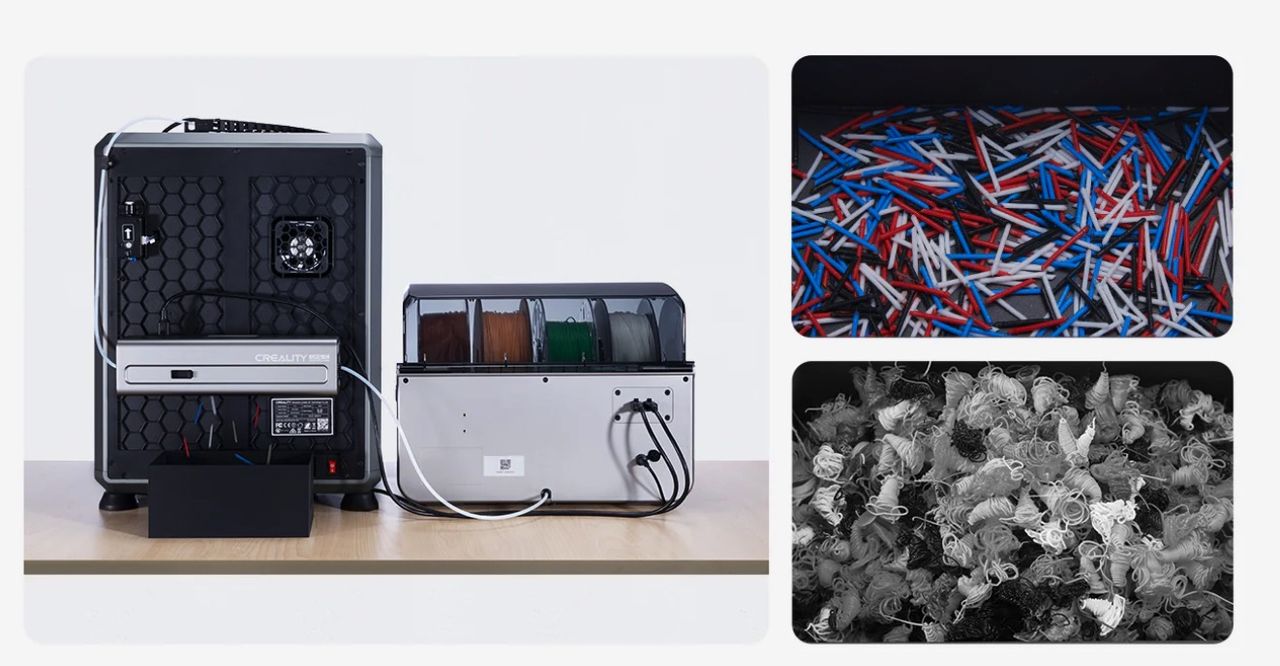
Here’s how I believe it works: when a colour change is demanded, the filament is pulled all the way back to the CFS-C. There, the end of the filament, with its stubby melted end, is cut off and dropped into a collection basket. The filament is now “clean” and ready for another go around.
The new filament is then inserted all the way down to the hot end — which is (mostly) empty of previous material. So there is no purging required.
I’m a little bit skeptical here, as there should be a small amount of the previous colour remaining in the hot end. If not purged, it will come out when extrusion restarts. I don’t know, but perhaps Creality has a solution for this by printing a small purge tower, or printing the initial extrusion into infill where it won’t be seen.
Meanwhile, the CFS-C is accumulating all those cut-off filament ends. These can be tossed out later, so there is waste. Yes, the CFS-C does not require purging — but it does waste material like other filament swappers. It’s just in a different place.
Another factor here is that in the lifecycle of a print job, the purge time is eliminated. This should speed up multicolor print jobs, but with a similar amount of waste filament segments.
This is a very interesting approach by Creality, since it is far simpler than the complex no-waste multicolor solutions from Snapmaker, Prusa, and Bambu Labs.
The new approach is also easily used on existing Creality systems: just swap out the CFS for a CFS-C, and you get the benefits described above. Creality says it is compatible with the K1 Max, K1C, K1C 2025, K1, K1 SE. Notably, they are not mentioning the K2 series for some reason.
Aside from the rather interesting cutting process, the CFS-C includes an external buffer, run-out sensors, tangle detection, and the ability to automatically detect filament type and colour — if using Creality filaments, of course. There is also a unique cutter wear monitor, which is probably necessary with all the work it will be doing.
There is a feature that’s absent: filament drying. Many filament swappers these days double as filament dryers, yet here Creality doesn’t mention anything about drying. However, the CFS-C does have a temperature and relative humidity display for some reason.
There is one interesting limitation: you can use a maximum of one CFS-C on the compatible 3D printers. This is unlike other solutions where you can bundle several together to gain access to more than four materials in a job.
It remains to be seen how the CFS-C approach is accepted by Creality 3D printer operators, but anything that improves the purge process is probably a good idea. Creality lists the CFS-C at US$319, and you can also buy those 3D printers with it as a combo if you like.
Via Creality
