
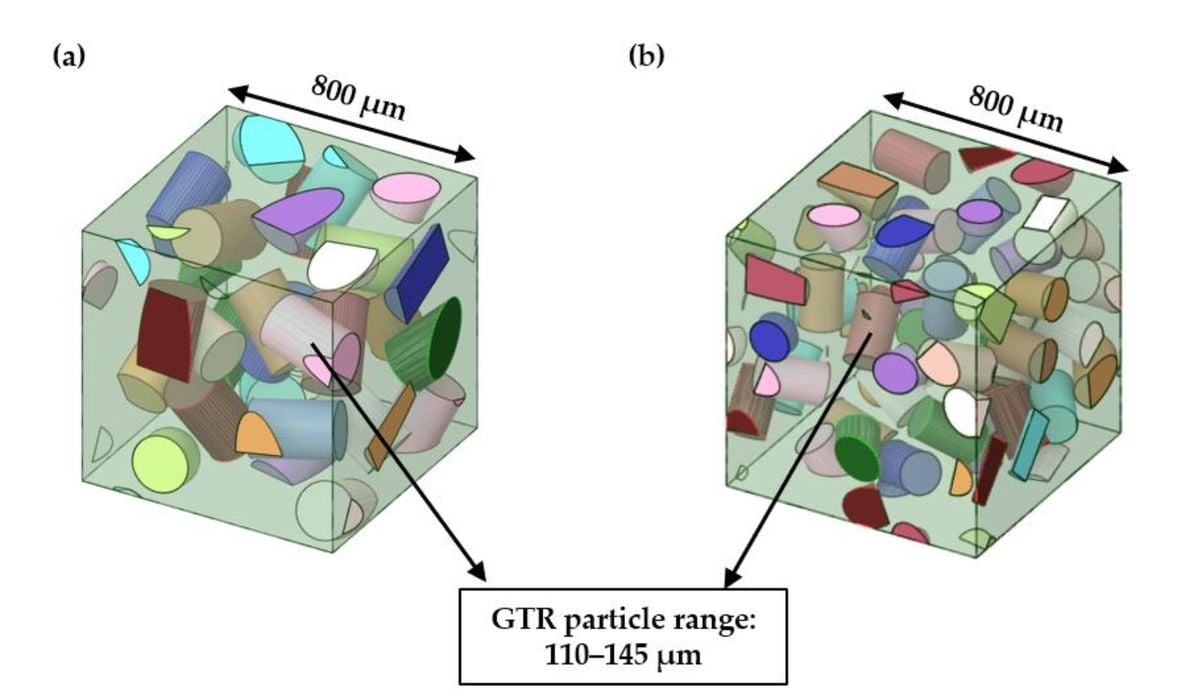
Researchers have tested PA12 and ground tire rubber composites for Selective Laser Sintering.
The paper, titled Dynamic Mechanical Response of PA12-GTR Composites Utilized with Selective Laser Sintering Additive Manufacturing, looks at an interesting material combination for SLS 3D printing: tire rubber and PA12 nylon.
PA12 is a workhorse material for SLS, by far the most commonly used powder. It has a relatively easy processing window, predictable powder behavior, and enough toughness for functional prototypes and also short run production.
GTR (ground tire rubber) is a recycled elastomeric filler produced from end of life tires. Tires are a huge waste stream, and adding rubber particles to PA12 could give printed parts more damping, energy absorption, or impact tolerance.
Why Dynamic Response Matters
Dynamic mechanical response looks at how a material behaves under changing loads, vibration, repeated stress, or time dependent deformation. For applications such as protective components, automotive brackets, vibration isolators, footwear tooling, or soft touch industrial parts, that behavior can be more important than just the material strength.
In other words, this is not about making PA12 stronger. It is about making it behave differently.
The SLS process already has great options for rigid nylon parts, glass filled nylon, flexible TPU, and some specialty powders. What it lacks, compared with injection molding, is a deep library of inexpensive filled materials with tuned viscoelastic behavior.
A PA12 and GTR composite could land between rigid nylon and full elastomer powders. That would be useful if it prints reliably, retains enough detail, and does not create a powder handling mess.
The Catch Is The Powder
This sounds good, but SLS is pretty unforgiving when the powder is not right. Particle size distribution, flowability, moisture, laser absorption, bed temperature, and thermal stability all become barriers. A filler that works in extrusion or compression molding may not automatically work in an SLS system.
Rubber particles add another complication. They may not melt or fuse in the same way as PA12. Instead, they could act as inclusions inside a nylon matrix, improving damping while also reducing stiffness or strength.
There is also the issue of unsintered powder reuse. SLS economics depend heavily on recycling powder from the build chamber. If the PA12 and GTR mixture segregates during spreading, ages differently during heating, or changes composition after multiple cycles, the material could be hard to use outside a lab.
\AM needs more materials that solve specific mechanical problems, not just more colors and simple formulation changes. Recycled filler content is also attractive, provided it isn’t just greenwashing. It has to provide actual value.
If this concept could be commercialized, PA12-GTR could become a surprisingly practical SLS composite. If not, at least researchers now know how rubber filled powders behave under laser sintering conditions.
