
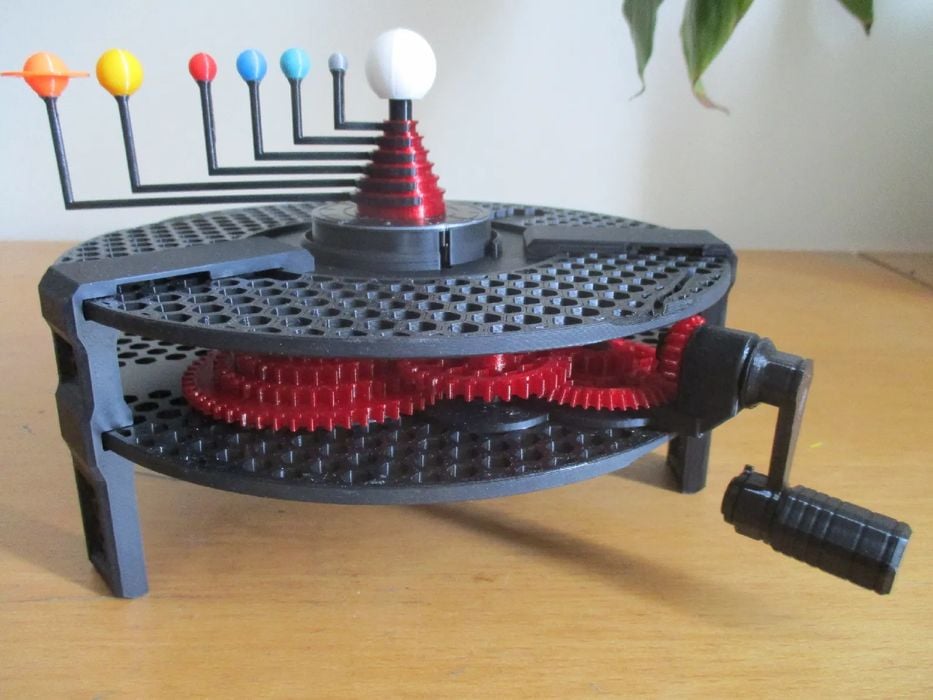
This week’s selection is the Spooletarium by Printables contributor M4NU.
This is in fact an Orrey, a mechanical device that simulates the motion of the planets in our solar system. Well, at least six of them. Uranus and Neptune somehow did not make the cut on this design.
Each planet orbits at a different distance and at a different speed, causing many unique alignments between the planets.
The Spooletarium uses a complex set of gears to translate the energy from the hand crank to each of the planets. The gears are specifically designed to match the speed ratios between the planets.
There’s something else going on with this device, if you haven’t noticed already from the images and the model’s name: it’s made out of a leftover 3D printer filament spool. Specifically, it’s a Prusament spool.
The spool is used as a mounting device for the several gears and hand crank, with the planets floating above. Some legs provide a bit of clearance from the ground to enable the crank to fully rotate.
M4NU explains:
“You need an empty Prusament Spool to build it. If you don’t have a Prusament spool, you can print one.”
I have printed spools myself, but only for holding filament, and never as part of a 3D design.
Note that Prusament has used two different spool styles over the years, with the most recent including NFC capability for automated filament identification. There are two versions of the Spooletarium, one for each spool type.
There are a lot of parts in this design, as you might suspect: plenty of gears, planets, etc., all of which must be printed and assembled.
The assembly is straightforward and fully described in the Printables entry, complete with images to show what you must do.
Via Printables
