
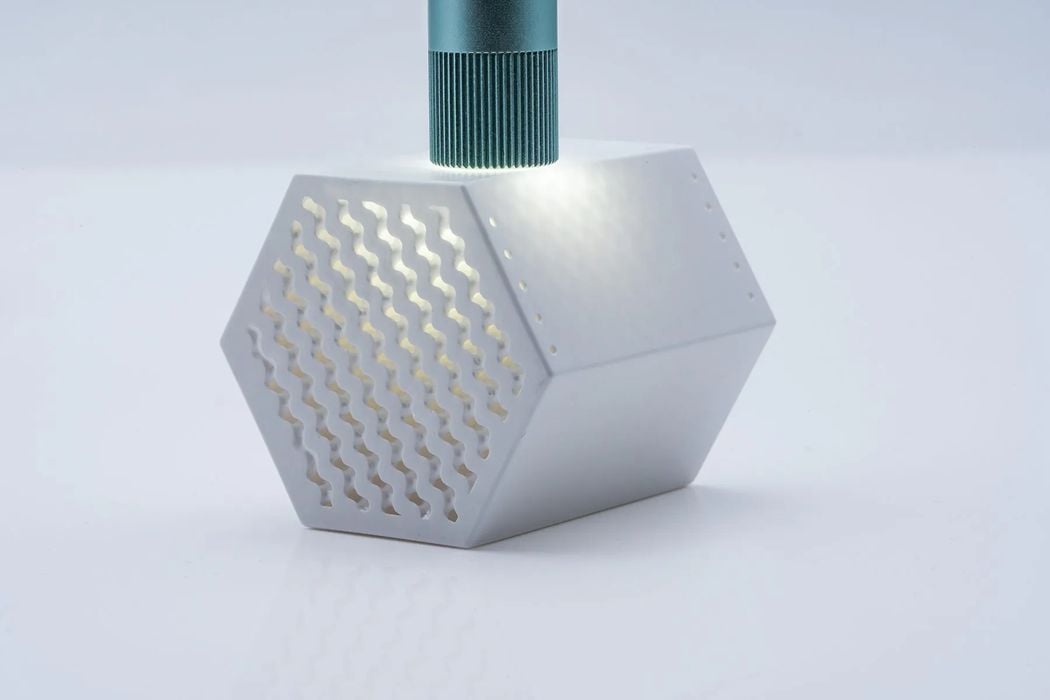
DTU researchers say a 3D printed ceramic gyroid fuel cell delivers a fivefold jump in power-to-weight.
The work was done by the Technical University of Denmark (DTU Energy) and focuses on Solid Oxide Fuel Cells (SOFCs), a class of high-temperature fuel cells often discussed for stationary power but increasingly eyed for transportation. In vehicles, the equation is straightforward: power density and mass control system design, and today’s simple SOFCs carry are challenged with interconnects, seals, and packaging. DTU’s proposition is that the SOFC architecture, not only the chemistry, is now just as important.
Instead of building a stack of flat cells, the team produced a single monolithic device with a thin-walled “gyroid” internal structure. Gyroids are a type of triply periodic minimal surface (TPMS) geometry that can create continuous, repeating channels and walls in three dimensions. It’s often used as the infill pattern in 3D printing because it provides uniform strength in all directions. This shape is extremely difficult to manufacture with conventional ceramic processing, but it is easily built with high-resolution ceramic additive manufacturing.
DTU reports that the monolithic SOFCs were printed on a Lithoz CeraFab system using an yttria-stabilized zirconia electrolyte material named 8YSZ. They evaluated mechanical behavior and stability of the gyroid ceramic under thermal and operating loads.
Why “Escaping Flatland” Matters
Planar SOFC designs are well known: flat cells separated by interconnect plates, with sealing strategies to keep fuel and oxidant where they belong. Those interconnect and sealing approaches add mass, consume volume, and can create reliability headaches as the system heats, cools, and cycles. DTU’s approach removes much of that supporting hardware by making the electrolyte structure itself a three-dimensional object that also organizes the gas pathways.
DTU describes power-to-weight ratio as the key metric for transportation use, and presents an attention-grabbing comparison. The monolithic gyroid devices are said to approach about 1 W per gram at the device level, versus about 0.2 W per gram described as typical for conventional planar SOFC designs. If those numbers hold up across wider testing and scale, it suggests a radically different packaging problem for SOFC-based auxiliary power units, range extenders, or hybrid hydrogen engines.
There is also a subtle but important geometric advantage: a gyroid can deliver a lot of surface area and continuous flow paths in a compact volume. DTU notes the thin inner walls and the elimination of interconnects and sealants reduce weight and can reduce thermal mismatch and mechanical stress. They also say the structure improves utilization of available volume, which is another way of saying less dead space in the stack.
What LCM Adds
Lithoz’s 3D printing process is Lithography-based Ceramic Manufacturing (LCM), a vat photopolymerization-style approach adapted to ceramic slurries. It can produce fine internal features and repeatable lattices that are hard to match with extrusion-based ceramic printing. DTU emphasizes repeatability for these TPMS geometries and believes that the monolithic concept only became feasible with the precision needed for very thin internal walls plus a sealed outer “shell frame” to maintain gastight conditions.
The company’s CEO, Johannes Homa, said the work is shifting attention away from incremental improvements to seals and interconnect exit points and toward a rethinking of the entire fuel-cell object. That is plausible: once you stop treating the cell as a 2.5D laminated product, you can distribute structure, flow, and sealing functions differently. Additive manufacturing is often strongest exactly there — collapsing multiple parts and interfaces into one manufactured artifact.
At the same time, this press release from Lithoz is not a full engineering analysis. DTU did not provide details here on lifetime, thermal cycling durability, sealing yield, or manufacturability at scale, all of which tend to decide whether SOFC concepts move beyond the lab. There is also no pricing or commercialization timeline for an industrialized version, only an intention to “scale the project to an industrial level” now that design and test phases have concluded.
The question is whether the monolithic gyroid can maintain performance over the long term in production environments. If that is possible, the implication is that ceramic 3D printing could increasingly become a design tool for electrochemical devices.
Fuel cells designed using this approach would have a much better power-to-weight ratio, and that might lead to the development of fuel cell-powered vehicles, perhaps even aircraft.
Via Lithoz
