
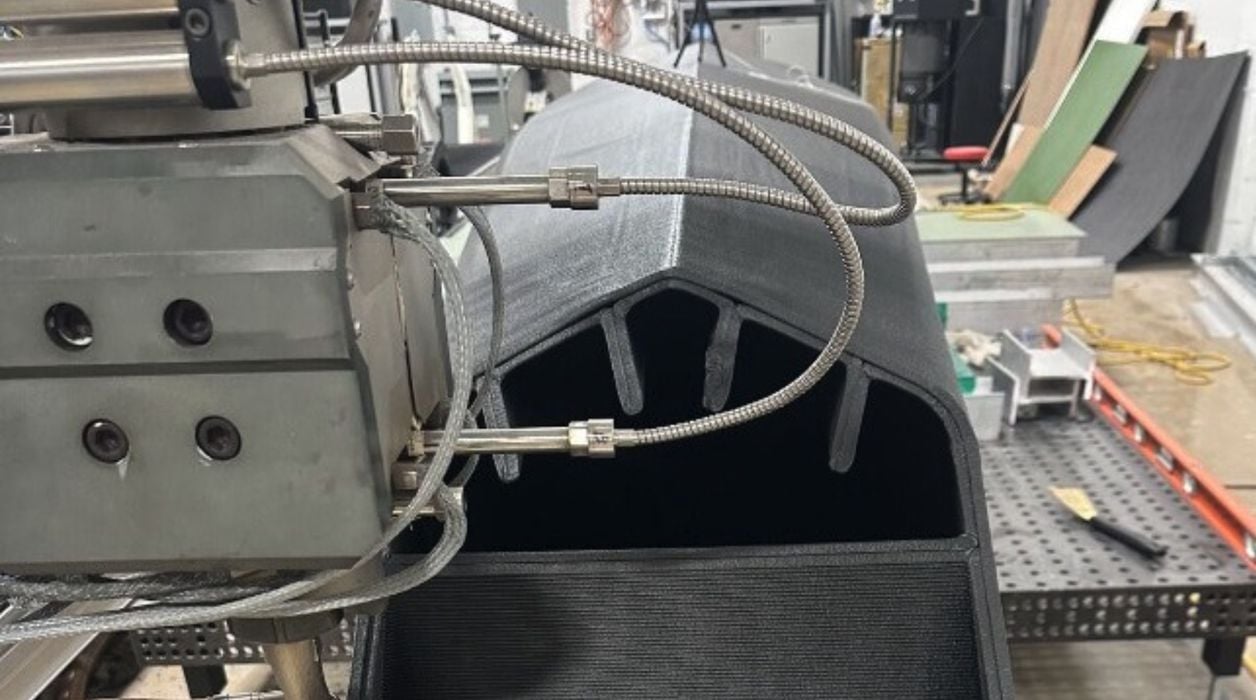
Red Cat says it plans to build fleets of 3D printed autonomous “drone boats” for on-demand delivery, which might the very first mass production of boats using AM.
Red Cat is a new US company that intends on bringing Ukraine’s powerful naval drone technology to North American production. The report from The Maritime Executive describes their plan is to produce unmanned surface vessels (USVs) aimed at logistics work—essentially small, robotic delivery craft. The “3D printed” part is of course the main hull of the vessels.
This is not exactly a new idea. Over the last decade we’ve seen plenty of eye-catching 3D printed boats: demonstration hulls, short-run prototypes, and other projects that prove you can indeed print something that floats. What’s different here is that they are gearing up for fleet production with on-demand delivery. That is not just a demonstration.
What “3D Printed Boats” Usually Means in Practice
When companies talk about 3D printed boats, they’re typically using large-format polymer extrusion — basically oversized FFF-style deposition with pellets, usually using reinforced thermoplastic materials, followed by a lot of finishing work. That finishing work includes: bonding sections, sealing gaps, machining part interfaces, coatings, and finally installing all the conventional hardware (propulsion, power, navigation sensors, communications, etc.)
So the 3D printer isn’t really 3D printing an entire boat, it is just producing the near-net shape hull. That’s still very valuable: it can eliminate molds, speed up iterations and enable complex internal geometries (ribs, cable runs, buoyancy compartments, etc.) without the need to pay for tooling as would be done with traditional manufacturing.
It also means the printed portion is only one part of the process, very analogous to 3DCP where only the concrete portion of a building is 3D printed.
This all means that Red Cat’s “on-demand delivery” service will not only require the 3D printing, but all the other steps in the long process to produce a complete, working boat. And it’s more complex than you might think: the 3D print technology allows each job to print something different since there is no tooling involved. In other words, new designs can be brought online very quickly, leading to rapid iteration. That’s a complexity that conventional boat manufacturing does not face.
All of that is a pretty high bar, since customers require predictable performance, maintenance and documented QA. They are buying a boat, not a manufacturing method.
To get all this done they are partnering with Haddy, a growing large-format 3D print service that has done considerable work printing huge items, such as furniture. Haddy uses a combination of Siemens and CEAD devices for their production.
There’s a lot for this group to do, but in the end they may end up what could be the very first mass production AM setup for boats.
If Red Cat can pull this off, it could be a clear demonstration of the potential for large-format polymer printing beyond experimental prints. That in turn could set the stage for other industries to take a hard look at additive manufacturing options for their production products.
