
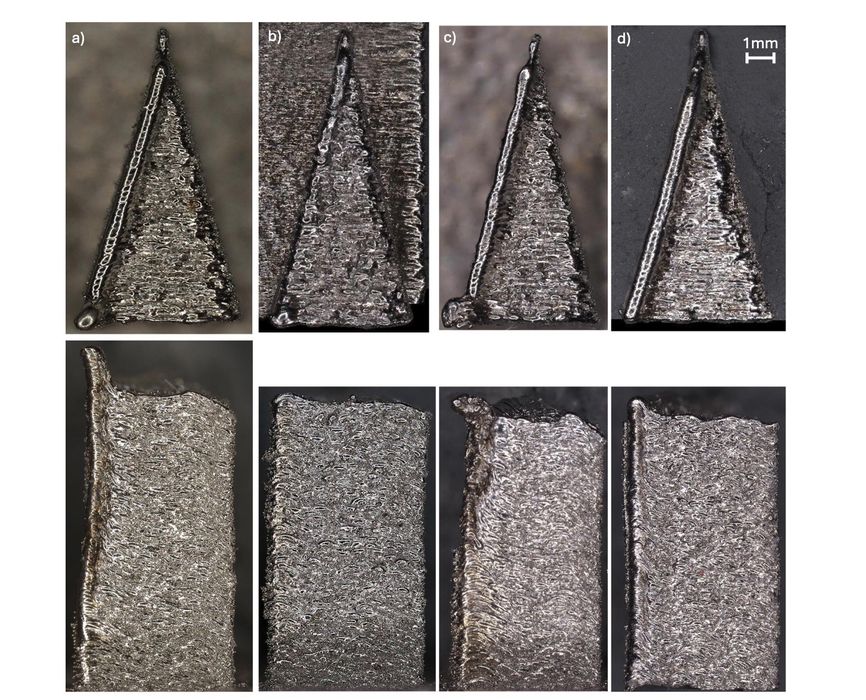
A new dual loop controller approach could make laser powder bed fusion more tolerant of thermal surprises.
LPBF has an unusually difficult control problem. The laser is scanning very rapidly across changing geometry, powder, previously solidified material, and heat accumulated from previous passes. Print parameters that work well on a basic object may not work at all on a production part.
That is why melt pool monitoring has become a major focus in metal additive manufacturing. Cameras and other sensors can observe the ongoing print process, but observing a problem is not the same as correcting it immediately. Many closed loop approaches also require significant manual controller tuning, which is exactly what this research is trying to reduce.
In a paper submitted to arXiv this month, Junan Lin and colleagues describe a multi scale, data driven control strategy for LPBF surface temperature. The method combines rapid layer feedback with a slower layer to layer adjustment process, using policy optimization to select controller gains.
Two Timescales For One Melt Pool
The first loop is an in-layer linear output feedback controller. It activates during a scan when measured temperature drifts from the intended values. Its gains are optimized through a policy gradient method instead of being manually selected through repeated trial and error.
The second loop works from one layer to the next. It combines temperature trajectory optimization with iterative learning control, allowing the system to use what happened on an earlier layer to improve the next one. Some thermal disturbances need an immediate laser response, but others have repeatable heat buildups that can be anticipated.
Simulation results showed that the controller could stabilize temperature despite substantial model mismatch and measurement noise. That could make this a possible commercialization target, since the approach is apparently able to handle the variations of a real-life print job.
The researchers also performed a physical validation using a simplified version, but constrained by available hardware. They tuned the controller entirely offline from uncontrolled print data collected on a single calibration layer. Against a tuned baseline, the method reduced mean temperature tracking error by 3.4% and mean input constraint violation by 47.5%.
Promising Results
The 3.4% tracking improvement is not a lot, particularly compared with the large claims sometimes attached to new AI approaches used in metal AM. The 47.5% reduction in constraint violations may be the more important result, however. If laser power commands are less likely to hit limits, an LPBF process could behave more predictably around difficult geometric features without requiring as much operator intervention.
The research paper also reports high frequency excitation dynamics that reduced vector head swelling. This is an interesting observation because scan path endpoints and turnarounds are common locations for excess energy deposition and therefore meltpool temperature problems.
This approach is very interesting because it’s more than just collecting more data and instead moving to making real time decisions.
Via arXiv
