
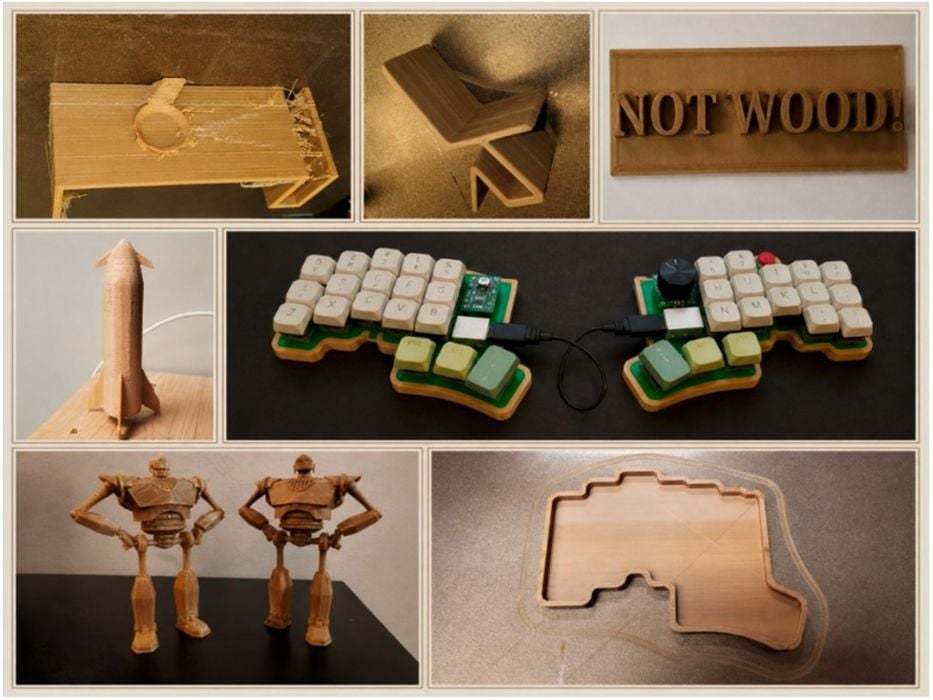
A new research paper examines whether soy hull fiber and PLA filament is workable for FFF 3D printing.
The study, titled “Feed Controlled Filament Extrusion of High Loading Micronized Soy Hull Fiber/PLA Biocomposites for Fused Deposition Modeling,” focuses on a composite problem: Plant filled polymers can lower bioplastic content and use agricultural byproducts, but they are not as easy to process as plain PLA.
Soy hulls are the outer coatings removed during soybean processing. Turning that low value waste residue into tiny fibers and then into a 3D printing material could be an interesting materials recycling proposition. PLA is already widely used in desktop FFF, so it could be a way to lower polymer use and be a bit more sustainable.
But high fiber loading of a filament material changes the job significantly. Fibers affect melt flow, thermal behavior, interlayer bonding, surface finish, moisture sensitivity, and the force required to push material through a small nozzle. A filament that seems visibly acceptable can still experience under extrusion, inconsistent deposition, or a nozzle blockage during a long print.
Controlling The Feedstock Before The Print
The interesting bit is the paper’s focus on feed controlled filament extrusion. Conventional composite filament production must balance screw settings, temperature, puller speed, and cooling to make filament with a consistent diameter. Introducing substantial quantities of low density natural fiber makes that balance much more difficult because the material can bridge, separate, or enter the filament extruder unevenly.
A controlled feeding approach attempts to make the incoming ratio and mass flow more consistent. In other words, rather than hoping a bulk blend behaves identically throughout a production run, the extrusion system actively manages what enters the process. That could be important for natural fillers, where irregular particle shape and bulk density can cause more troubles.
If their approach produces filament with repeatable diameter and a printable fiber distribution, it could support more than just an experiment. Filament producers could offer agricultural fiber blends with clearer processing advice, while universities could investigate regional biomass materials as fiber sources.
There is also a practical economic angle here. PLA is not usually the biggest cost in a small spool operation, where drying, compounding, quality control, packaging, failed prints, and distribution are the majority of the costs. However, replacing some resin with a readily available agricultural byproduct could become meaningful at higher volumes.
Material Characterization Is Only The First Step
This sounds good, but a successful extrusion experiment by the researchers is not yet evidence of a dependable commercial filament. Natural fiber composites must be dried carefully, as absorbed moisture can degrade PLA during melt processing and lead to poor print quality. Fiber size distribution, actual loading, nozzle diameter, print temperatures, and post processing behavior all need to be understood by 3D printer operators.
There is another issue: fiber filled PLA may be attractive for fixtures, models, packaging concepts, or decorative parts, but it is unlikely to replace real engineering polymers simply because it contains a renewable filler. Mechanical properties can vary by print orientation, and biological fillers introduce questions around lot consistency, odor, color variation, and long term storage. Bio material is not as consistent as polymers.
The paper nevertheless looks at an area where many sustainable filament announcements are less clear: getting a heavily filled material through production equipment consistently. Agricultural waste is everywhere, but reliable filament is a lot harder to find.
Via Fibers
