
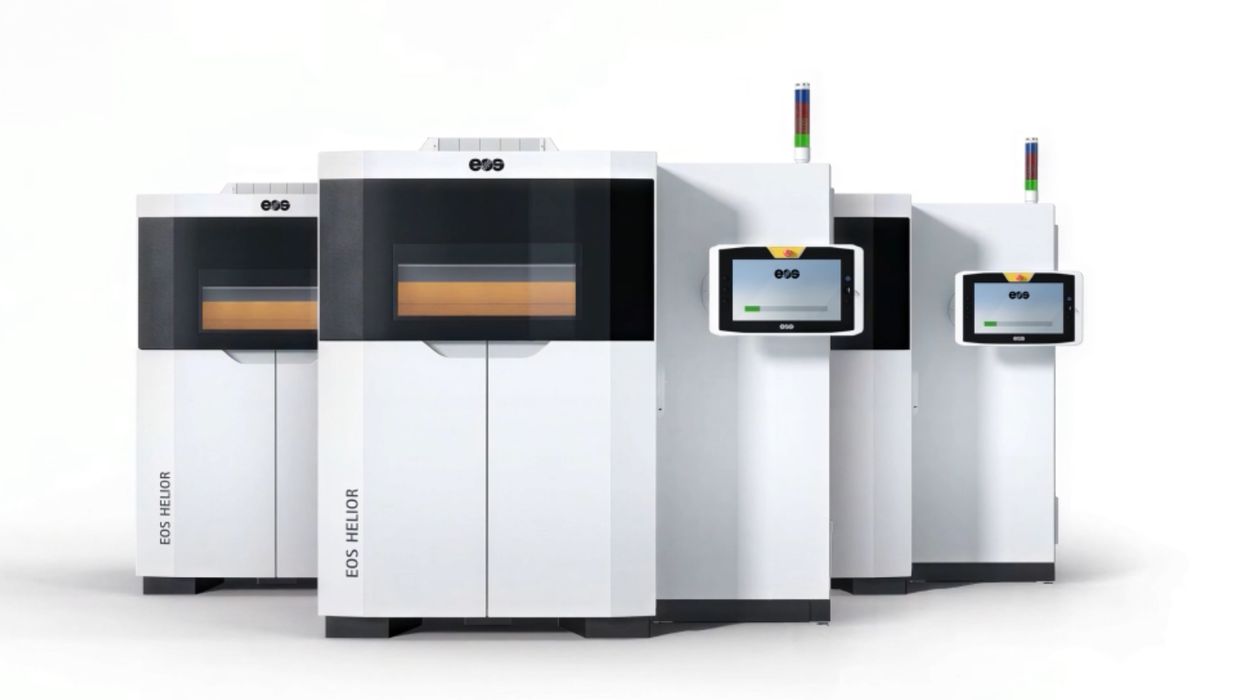
EOS has redesigned its largest polymer 3D printer around the most basic goal: finish a huge SLS build job every day.
We saw the new HELIOR at Formnext 2026 and spoke briefly with EOS about why this machine has a new name instead of another P770 variation. The answer was that so much has changed it deserved a new name, even though the build volume has not changed.
The HELIOR keeps the P770’s 700 x 380 x 580 mm build volume, about 154 liters. That’s a huge powder bed, with room for parts approaching one meter along its three-dimensional diagonal. But those identical dimensions hide some pretty substantial changes.
Most visibly, there are now three 70W CO2 lasers instead of just two. EOS uses dynamic load balancing to distribute scanning work between them, rather than leaving one laser waiting while another tackles a busy region. The company claims up to 80% greater throughput, depending on the job.
At Formnext, EOS described a typical build filling the entire chamber at 10% packing density and completing in about 24 hours.
There’s still a cooling challenge, though. EOS told us the completed powder cake requires roughly another 24 hours to cool before unpacking. However, the build frame can be swapped out, allowing another job to begin while the previous one cools elsewhere. Exchangeable frames weren’t new to the P770, but the faster build cycle makes them even more important.
EOS has also changed what happens during recoating. An adjustable roller can independently vary its rotational and travel speeds as powder is spread across each layer. Combined with geometry-aware laser exposure settings, this produces a softer powder cake, which should be considerably easier to excavate after cooling.
EOS claims up to 80% less post-processing effort in some applications. That figure becomes more believable when you look at its testing efforts: Prototal Group reported up to five times less depowdering effort for complex housings. Anyone who has spent time clearing powder from small cavities will understand the importance here.
Better temperature and exposure management are intended to improve the parts themselves. EOS’s 3D EOSAME compensates for thermal effects across the build area, while Smart Scaling targets dimensional accuracy in the vertical direction. The company also says operators can tune parameters for better mechanical properties, accuracy and fine details.
EOS didn’t design these changes just because they seemed like a good idea. Instead, EOS collected feedback from dozens of production users, then worked with five pilot customers: FKM Additive Manufacturing, Prototal Group, Materialise, Shapeways and Formrise. EOS’s published examples report 44% higher productivity for a Materialise aerospace component and 67% for a particular FKM part.
Maintenance was another focus. EOS says the HELIOR is designed for simpler servicing and can complete more than 1,000 liters of builds over a week before maintenance operations. Closed powder feeding and automated unpacking can also be added to the production setup.
EOS told us the machine uses the same material family as the P770. Initially, however, EOS is launching validated parameters for PA 2200 and PA 2220 HighReuse, with other materials to follow according to demand. Commercial availability starts in December 2026.
The interesting achievement here is the build schedule: one huge build per day, while the previous day’s parts cool, and less labor required to get them out. That’s a clean planning assumption that manufacturers will really appreciate.
Via EOS