
EPFL researchers have shown fast, accurate overprinting in tomographic volumetric additive manufacturing, placing new features around real parts and inside sealed chips using open-source software.
Volumetric printing, often called Tomographic Volumetric Additive Manufacturing (TVAM), cures entire 3D regions of photopolymer by projecting many patterns into a rotating vial. It is blisteringly fast — centimeter-scale parts in seconds — but hard to control when the light field encounters occlusions, refraction, or scattering.
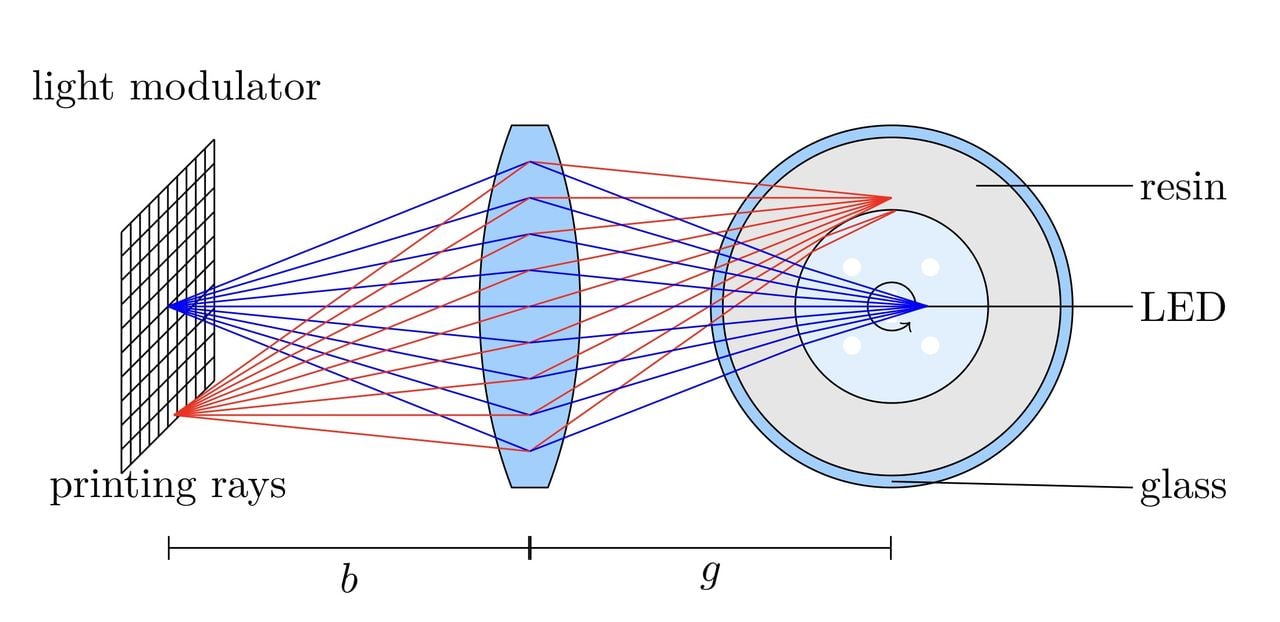
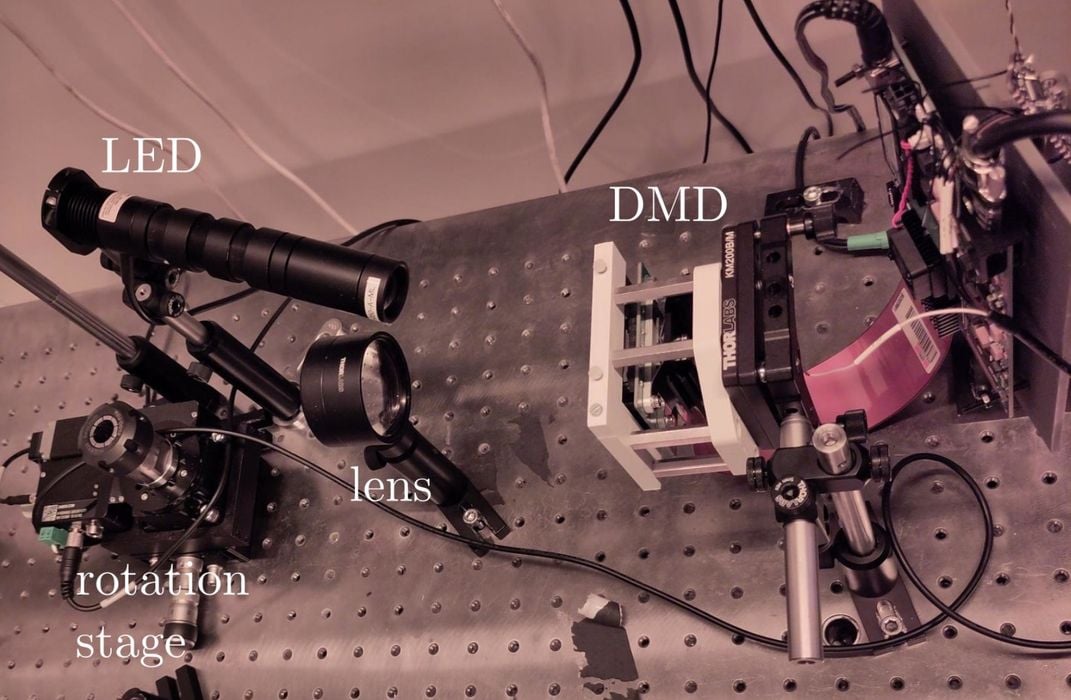
The researchers present a physically based optics approach — implemented in the open-source Dr.TVAM framework — that computes patterns while accounting for absorption, refraction, reflection, and scattering. It supports both LaserTVAM and LEDTVAM, including non-telecentric optics that other open platforms generally do not simulate.
Why Volumetric Overprinting Matters
Layered processes struggle to build around existing objects because supports, limited approach angles, and shadowing get in the way. TVAM’s rotating-vial geometry, in contrast, approaches a part from all sides, making “overprinting” on or around embedded components a natural fit — if the optics are modeled correctly.
The team printed perfusable microfluidic channels directly inside pre-assembled, square cuvettes using a biocompatible Gel-MA resin. The patterns modeled the square walls and the absorbing inlets and outlets. Measured channel diameters were close to design, with deviations attributed to polymerization, swelling, and dye diffusion. The workflow succeeded: print inside a sealed, imaging-friendly chip and skip the messy assemble-and-seal steps that invite leaks and contamination.
They then pushed “context-aware” overprinting by detecting two glass spheres with a simple two-view camera, reconstructing their 3D positions in under a minute, and generating channels and cavities around them. By dialing simulation fidelity down, optimization ran in roughly thirty seconds yet still achieved good accuracy. In other words, the workflow adapted to the scene and printed functional features on demand.
How Dr.TVAM Changes The Game
Reflective and scattering surfaces are the weak point of pattern design. To improve it, the team overprinted a gear on a polished steel rod. Using the common “fully absorbing rod” assumption, inner holes were overcured and deformed. When they switched to a measured scattering model, print fidelity improved markedly, and visible features preserved next to the metal. Their conclusion: if you do not model reflections and scatter, TVAM will happily cure where you did not intend.
They also used LEDTVAM to print a lens and a symbol directly on a small LED, then reimaged that symbol onto a screen when the LED lit up. Across cases, printing times were on the order of tens of seconds per part, with pattern optimization ranging from seconds to minutes depending on resolution and GPU horsepower.
What This Means For Users — And What’s Missing
This sounds great, but there’s one issue: the method needs accurate optics. Success hinges on knowing refractive indices, attenuation, vial geometry, and the surface scatter model — plus reliable registration of whatever you are overprinting. That is doable in a lab, yet it is more calibration than many workshops are used to.
The implications of this technology could be large. For biofabrication, overprinting inside sealed, flat-window chips could streamline organ-on-chip and perfused tissue workflows. For tooling and devices, building grips, gears, or optics directly onto metal or emitters opens an entirely new design space. The researchers released code, configurations, and meshes on GitHub, so expect fast replication by academic and advanced industrial labs.
Printing around the part — not just on top of it — might be what moves volumetric AM from mostly curiosity to true capability.
