
What are the typical prices for FFF filament these days?
It’s been a while since we last took a look at the filament market overall, and it appears there have been some price adjustments. Last April, I looked through Alibaba to see if there were good online deals for a spool of filament.
I learned that prices vary considerably, with “generic” filament as low as US$3.73 per kg. Other prices were also low, but only when purchasing in quantity.
However, many casual 3D printer operators would not consider buying products from Alibaba, as it is really a B2B site, and AliExpress is a bit scary for some buyers in the West.
So what are the best deals these days? I took a look at some conventional sources to determine the cost of a 1kg spool of white PLA, and here’s what I found as of this writing:
| BRAND | TYPE | PRICE | QTY | PER KG |
| 3DHOJOR | PLA Lite | 12.99 | 1 | 12.99 |
| Anycubic | PLA Basic | 14.50 | 1 | 14.50 |
| Bambu Lab | PLA Basic | 22.99 | 1 | 22.99 |
| Bambu Lab | PLA Basic | 68.97 | 4 | 17.24 |
| Bambu Lab | PLA Basic | 149.43 | 10 | 14.94 |
| Creality | Hyper PLA | 17.99 | 1 | 17.99 |
| Elegoo | PLA | 13.99 | 1 | 13.99 |
| eSun | PLA Basic | 20.73 | 1 | 20.73 |
| Geeetech | PLA | 9.79 | 1 | 9.79 |
| Jayo 3D | PLA | 13.99 | 1 | 13.99 |
| Jayo 3D | PLA | 97.93 | 8 | 12.24 |
| Jayo 3D | PLA | 139.90 | 12 | 11.66 |
| Kingroon | PLA Basic | 15.99 | 1 | 15.99 |
| Kingroon | PLA Basic | 104.99 | 10 | 10.50 |
| Overture | PLA | 15.49 | 1 | 15.49 |
| Polymaker | Panchroma Matte | 19.99 | 1 | 19.99 |
| Prusa | Prusament PLA | 26.99 | 1 | 26.99 |
| SunLu | PLA | 77.94 | 6 | 12.99 |
As you can see, the pricing varies considerably, with the lowest price being 64% less expensive than the most expensive on the list.
The average and median pricing for this survey seems to be US$15.83 / US$14.72. This suggests that the “typical” price for a single kilo of basic PLA is now around US$15. The standard deviation is US$4.50, meaning the typical price range should be US$10-20 per kg.
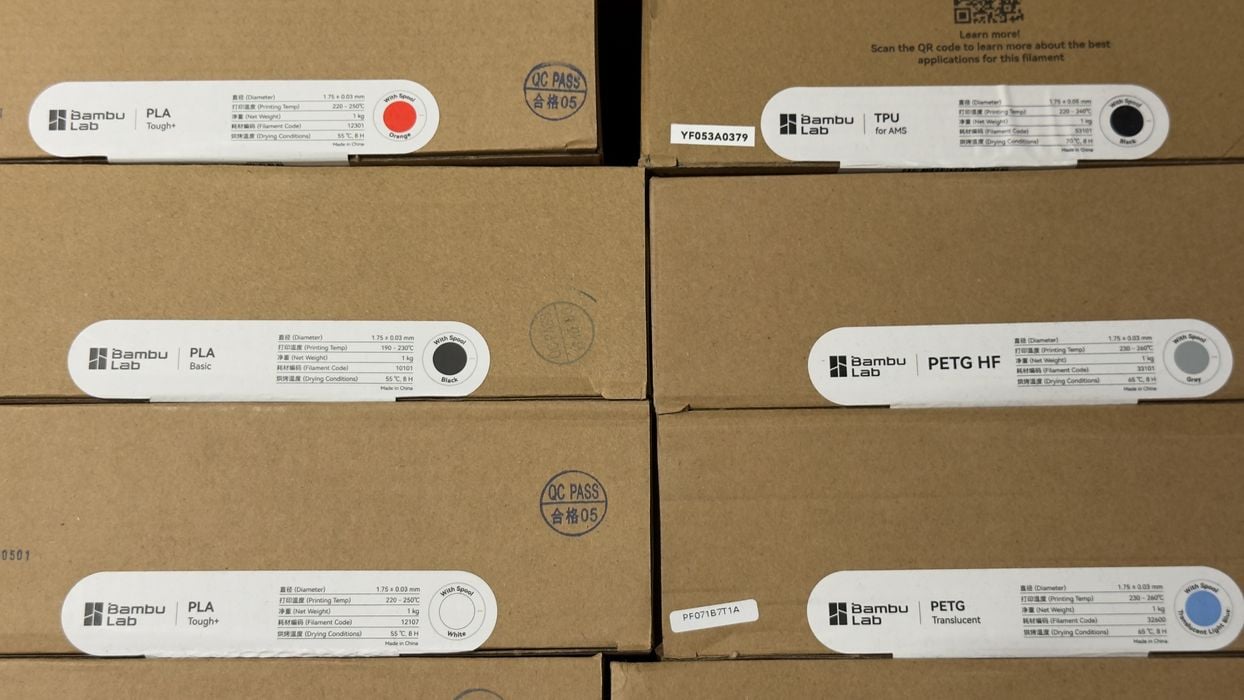
However, we see that several products are more expensive and outside that range. Bambu Lab, Prusa Research, and eSun are all above US$20 per kg. It’s very interesting to note that the manufacturers that provide RFID-style spools tend to be more expensive, and I don’t think it’s because the chip adds to the cost. It’s because they believe they have a premium, exclusive function that comes with their product — when it’s used on their equipment.
Also, note that several providers, including Bambu Lab, offer notable discounts when you purchase more than one spool. Bambu Lab’s 10-spool discount lands them only in the average pricing range, however.
There are a couple of products that are priced at about US$10, the lowest currently available in our survey. Kingroon, Geeetech, and Jayo are all priced very low, and, according to informal reports, deliver decent-quality materials.
These are certainly among the lowest-cost spools offered — years ago, the typical cost per kg was close to US$30, but now it’s slowly becoming a commodity.
That said, each situation is different. We surveyed White PLA, but your requirements might be quite different. Perhaps you want a different colour, or a specialty filament, such as rainbow or glow-in-the-dark? These can be priced higher, sometimes much higher than the basic materials.
Then there’s the issue of compatibility. Some may value the automated spool recognition features much more than others. If so, you should buy the spools from the 3D printer manufacturer: Bambu Lab spools for Bambu Lab devices, for example. On the other hand, if you’re adept at managing your own spools, you can save a considerable amount of money by using third-party materials.
It’s clear that competition has not only driven down the price of filament but also has enabled an explosion of different varieties. In my travels looking for White PLA, I found literally hundreds of different colours and variants of PLA — and other materials, too.
It’s the best time in history to choose a filament for your 3D printer.
