
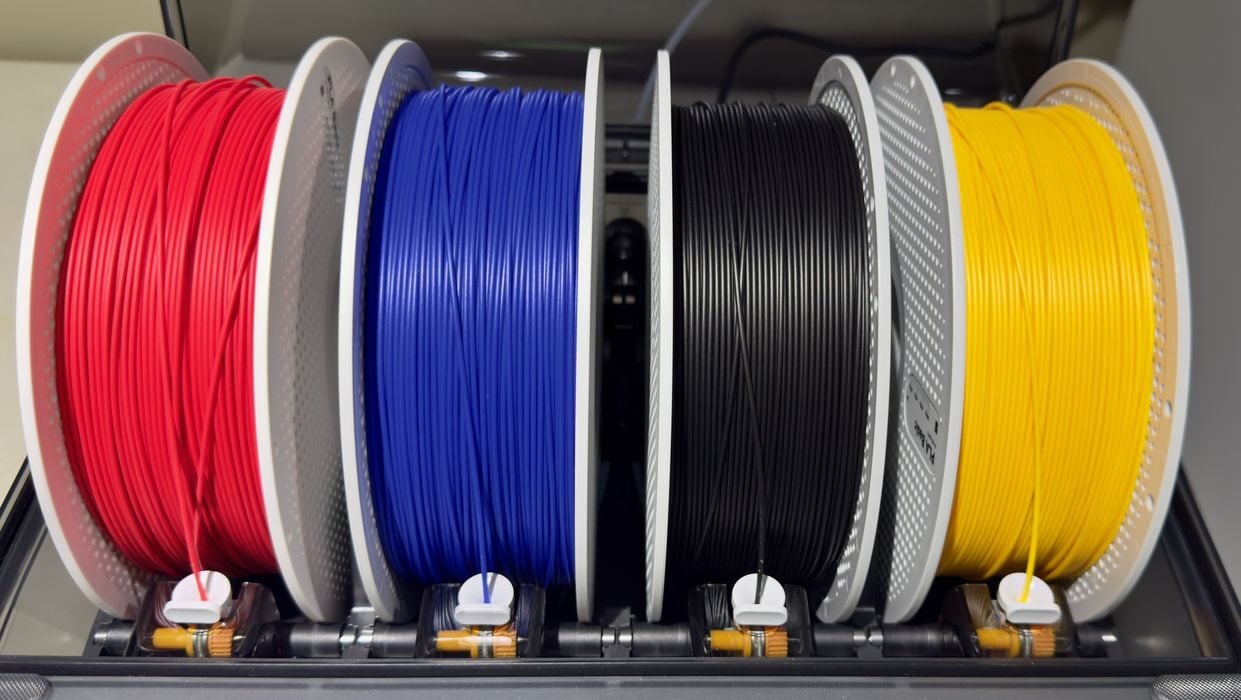
Recent surprises from 3D printer manufacturers are tipping over established machine designs.
The two most recent events were the astonishing success of Snapmaker’s low-cost toolchanger 3D printer, and Bambu Lab’s sudden announcement of Vortek, an entirely new way to perform multicolor 3D printing.
But those two are only the most recent happenings in what now seems to be a long chain of events that is transforming the desktop 3D printing industry.
Multicolor 3D Printing Background
It started with Bambu Lab’s introduction of the AMS, an accessory that enabled dynamic switching of filaments during print jobs. Multicolor 3D printing. This was attempted previously by E3D, which built an expensive toolchanging device that was not widely accepted in the market, and more notably, Prusa Research.
Prusa Research introduced their MMU accessory several years ago, pioneering the filament swapping paradigm. The problem was that the initial MMU was extraordinarily difficult to use and most users gave up on it. Later, Prusa Research introduced new versions of the MMU (currently at version 3), but the damage had been done in the marketplace.
Bambu Lab’s AMS actually worked, or at least it worked well enough for wide customer acceptance. The company has sold hundreds of thousands of these devices, and as a result has lit up the world to multicolor 3D printing.
A Multicolor 3D Print World
We now see countless 3D models uploaded to repositories that require multiple colours. Multicolor 3D printing is slowly moving towards becoming a standard feature for desktop 3D printers, although it’s not quite there yet.
In an effort to avoid the costs of toolchangers, which require multiple toolheads, many desktop 3D printer manufacturers turned to the Bambu Lab AMS-style system: a single nozzle fed by multiple filaments.
That technology absolutely works, but there’s a massive problem that everyone encounters: enormous waste of material. Each time the filament is swapped, the nozzle must be purged. This wastes a huge amount of material, sometimes up to 10X the amount used on the print itself.
But that’s where we were, and the only purchasable multicolor technologies would produce lots of waste.
Waste Free 3D Printing
That was the case until Snapmaker somehow broke through the price barrier and developed a toolchanging 3D printer that was available at a price comparable to AMS-style multicolor 3D printers. The market spoke loudly, committing nearly US$13M in orders with a month to go. 3D printer operators DO NOT want material waste.
Bambu Lab reacted by abruptly announcing a new technology, Vortek, which swaps hot ends instead of extruders or filaments. This brilliant concept would eliminate waste and provide a number of other benefits. They intend on releasing a device with this capability later this year, the H2C.
Bambu Lab said this about the timing of the challenge they faced with the Vortek announcement:
“If we announce it now, it will certainly hurt sales of H2D and H2S, and affect the company’s revenue, since H2C hasn’t even reached our warehouse yet, and news of a new model could make people hesitate to buy now. On the other hand, if we don’t say anything about H2C, many people might regret their purchase of H2D or H2S later. It’s really a difficult choice.”
But there will almost certainly be another effect from the sudden Bambu Lab announcement: if buyers are aware that Bambu Lab is coming up with a waste-free solution in a few months, then why buy a Snapmaker U1? It should be interesting to see if the momentum of the U1 campaign slows at all as a result of Bambu Lab’s announcement.
Competitive Reaction
Meanwhile, Prusa Research had been teasing an entirely new design for their next MMU. However, the design concept appears to be some form of filament swapper, similar to previous MMUs. I’m now wondering if they are going to go back to the drawing board to move on to a more waste-free solution.
The solution might already be happening. Bondtech, makers of high-end 3D printer components such as nozzles and hot ends, announced earlier this year a concept they call “INDX”. It’s essentially a specialized toolhead that can mount an inexpensive “thin passive tool” that acts like a hot end. The idea is to build a system that can swap in these tools to change material without waste. It’s somewhat similar to Bambu Lab’s Vortek.
However, Bondtech makes components, not 3D printers. Their products make their way into other companies’ machines. One possibility would be for a company like Prusa Research to incorporate INDX into a future CORE One system to enable 3D printing without waste. That might allow them to more quickly catch up to the competition in this rapidly changing space.
It’s also possible other 3D printer manufacturers might grab onto INDX in order to catch up to Bambu Lab.
Let’s look at what the desktop 3D print world might look like by the end of the year: Bambu Lab would be selling the H2C, a waste-free 3D printer, likely at about the same price as their current options. Why would anyone buy a filament swapper at that point?
Multicolor prints made on a filament swapper effectively require two, five or even ten times as much filament. That is equivalent to paying US$200 for each spool of filament on a waste-free machine, and no one would want to do that.
That’s why Snapmaker’s campaign is so effective, and also why Bambu Lab’s H2C will almost certainly be a huge hit later this year. No one wants to waste material, and if the price is right for these new advanced multicolor machines, few will be buying filament swappers.
Other 3D printer manufacturers that have just started deploying filament swapping systems, including Creality, Flashforge, and Anycubic, now have to reconsider their strategy. Do they continue with filament swapping, or change gears and move to a waste-free solution? But what is that waste-free solution? They may not have been working on one, as Bambu Lab has been doing for three years. Catching up could be difficult.
Elegoo is also in an interesting position. Their Carbon Centauri device is probably the best low-cost device on the market, adjusting price expectations for everyone. They have yet to release their filament swapping system, and now everything is changing in the market with the Snapmaker and Bambu Lab announcements. Their investment in developing a filament swapper may not pay off at all at this point.
These rapid changes are going to place many desktop 3D printer manufacturers under extreme stress. They almost certainly will have to adapt, change, or give up.
Next year will be quite interesting.
