
Charles R. Goulding spotlight’s COBOD’s record-breaking 3D construction printers and their landmark Qatar schools project, showing how innovation at scale is rewriting the future of sustainable building.
The Giant Leap: COBOD’s World’s Largest 3D Printer and the Qatar Schools
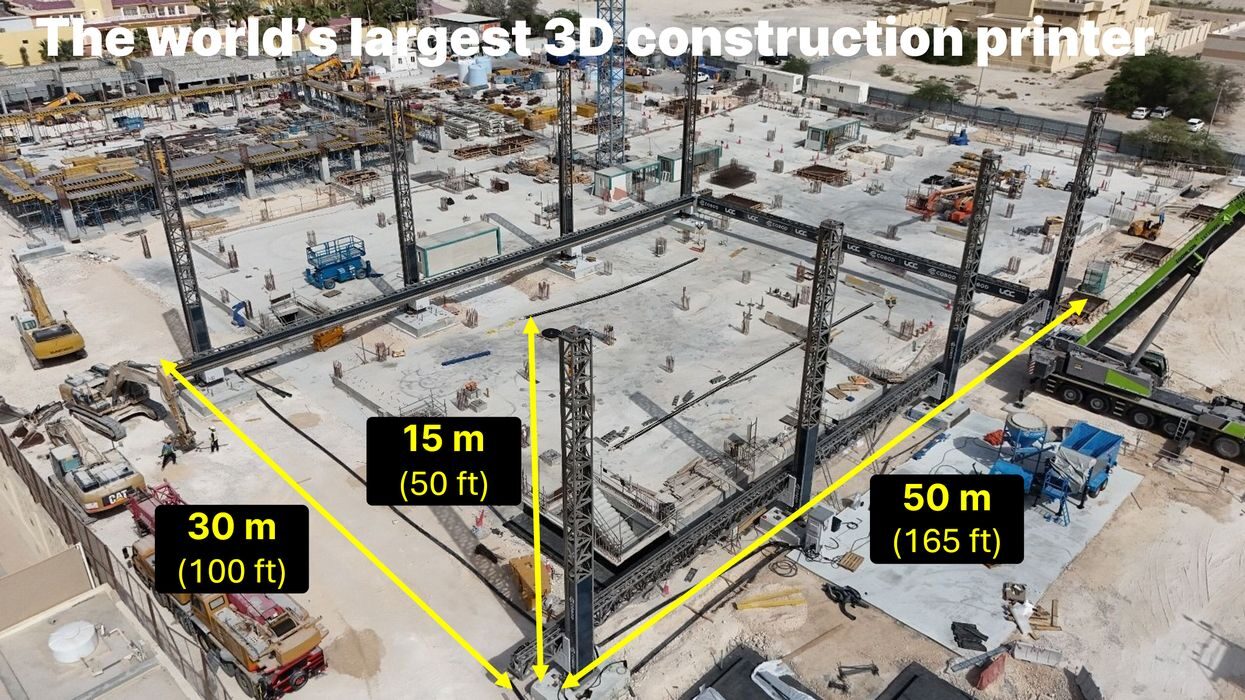
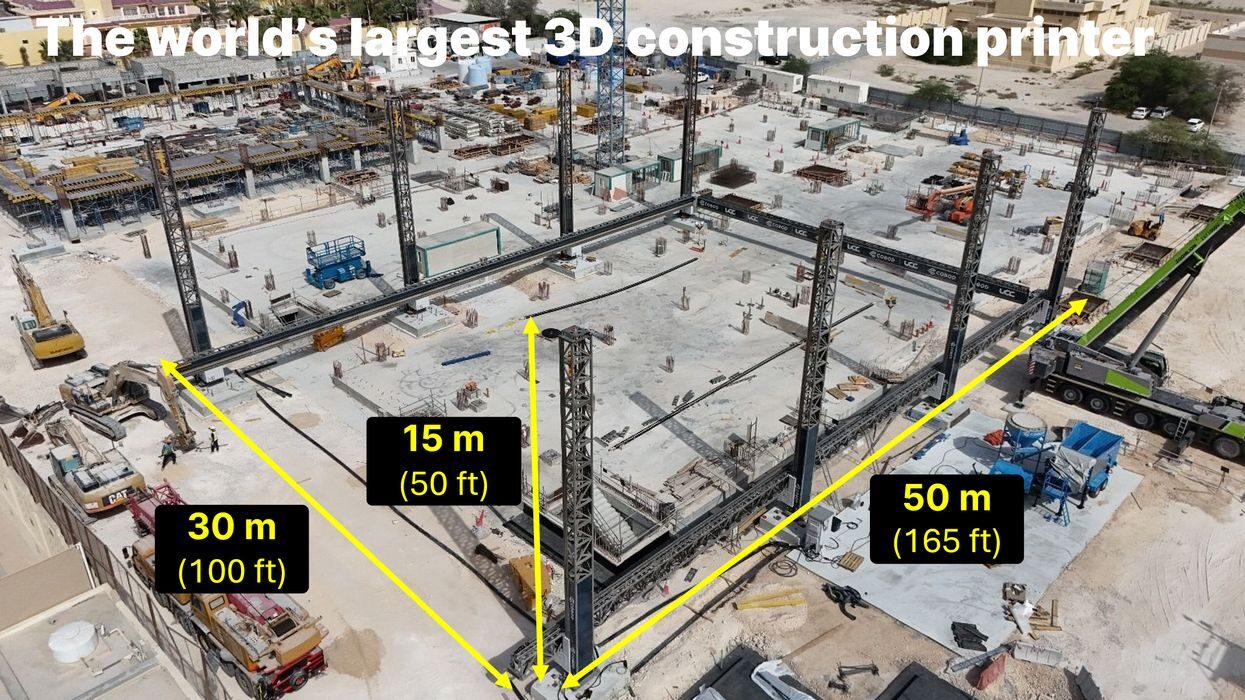
This summer in Copenhagen, I had the privilege of catching up with Henrik Lund-Nielsen—the talented CEO of COBOD and a fellow University of Copenhagen alumnus—and learned first-hand about COBOD’s gargantuan achievements. On his return from Doha, he shared insights on their latest installations: two custom-built BODXL machines, each measuring approximately 50 m long, 30 m wide, and 15 m high—about the size of a Boeing 737 hangar.
These are not just big—they’re the largest 3D construction printers in the world, capable of laying down walls for structures up to five stories tall within a 1,500 m² build volume, yielding a total of 7,500 m² per printer. When both units operate in tandem, they’re set to 3D print two expansive, two-story schools totaling 40,000 m²—40 times larger than the previous largest 3D-printed building.
Preparing for the Desert Environment
Before construction began, an intensive eight-month phase took place in Doha featuring over 100 full-scale test prints using COBOD’s smaller BOD2 printer. These trials refined locally suitable concrete mixtures, tested custom extrusion nozzles, and validated the printers’ performance under Qatar’s harsh climate.
To optimize curing and preserve equipment integrity, printing occurs during the cooler night hours, enhancing energy efficiency, reducing dust and noise, and ensuring better material quality.
A Design Born from the Desert
The architectural forms of the schools are a tribute to Qatar’s natural landscape. Curved, dune-inspired walls, nearly impossible to fabricate with conventional methods, are comfortably realized through 3D printing’s geometric flexibility.
COBOD’s Driving Vision: Smarter, Sustainable Construction
COBOD isn’t content with merely building big—they’re driving innovation across multiple fronts.
Launch of the BOD3 Printer
In late 2024, COBOD unveiled the BOD3, its most advanced 3D construction printer. Key features include:
- Extendable ground track system: Enables continuous, linear printing of multiple buildings without downtime.
- Advanced Hose Management System and Universal X-Carriage: Enhance material delivery, adaptability, and future expansion (e.g., for finishing tasks like painting or insulation).
- On-site additive dosing: Speeds up layer curing and allows for real-time adaptation to environmental conditions.
Already operational in countries like Indonesia, Angola, and Bahrain, the BOD3 reflects COBOD’s commitment to scalability and efficiency globally.
Partnerships for Better Material Solutions
COBOD’s work with CEMEX Ventures has birthed D.Fab, an admixture that transforms traditional concrete into a form optimized for 3D printing: more fluid and quickly self-supporting. This collaboration significantly reduces construction time and cost and is already yielding results across various projects.
Beyond Qatar: Global Impact and Emerging Applications
COBOD’s influence spans continents:
- Europe’s first permitted 3D printed building in Copenhagen set early standards for regulatory acceptance.
- In Dubai, a 202 m² villa was 3D-printed, revolutionizing home construction design and delivery.
- Germany’s first 3D printed home was built using a BOD2 printer, printing 1 m² of wall every 5 minutes.
- The pedestrian bridge in Nijmegen, Netherlands (29 m long) showcased material savings of ≈50% by printing only where structurally necessary.
- Habitat for Humanity and ICON used COBOD printers in the U.S. to construct dwellings rapidly and affordably—printing homes in under 30 hours and supporting low-income housing solutions.
- COBOD-assisted projects also include Oman’s largest printed house and Kuwait’s on-site 3D printed water tanks, which were completed in just five days, saving 25% on concrete and reinforcement.
Looking Ahead: Syria, Gaza, and the Promise of Reconstruction
With the monumental Qatar schools underway, COBOD is already backing additional large-scale projects. One is in Syria, and there’s strong strategic positioning for the future Gaza rebuild—offering fast, cost-effective, and sustainable infrastructure solutions for post-conflict recovery.
These capabilities—speed, design flexibility, material efficiency—could profoundly impact how devastated regions rebuild smarter and greener.
The Research and Development Tax Credit
The now permanent Research and Development (R&D) Tax Credit is available for companies developing new or improved products, processes, and/or software. 3D printing can help boost a company’s R&D Tax Credits. Wages for technical employees creating, testing, and revising 3D-printed prototypes can be included as a percentage of the eligible time spent for the R&D Tax Credit. Similarly, when used as a method of improving a process, time spent integrating 3D printing hardware and software counts as an eligible activity. Lastly, when used for modeling and preproduction, the costs of filaments consumed during the development process may also be recovered.
Whether it is used for creating and testing prototypes or for final production, 3D printing is a great indicator that R&D Credit-eligible activities are taking place. Companies implementing this technology at any point should consider taking advantage of R&D Tax Credits.
Final Thoughts
COBOD’s work marks an inflection point in construction history. The Qatar Schools project alone redefines what’s possible—from scale and sustainability to design and delivery. With advances like BOD3, innovative materials like D.Fab, and partnerships across the globe, COBOD is forging the path toward an automated, resilient future in architecture and infrastructure.
Henrik’s passion—and our shared university roots—only deepen my confidence: COBOD is shaping not just buildings, but the very future of construction.