
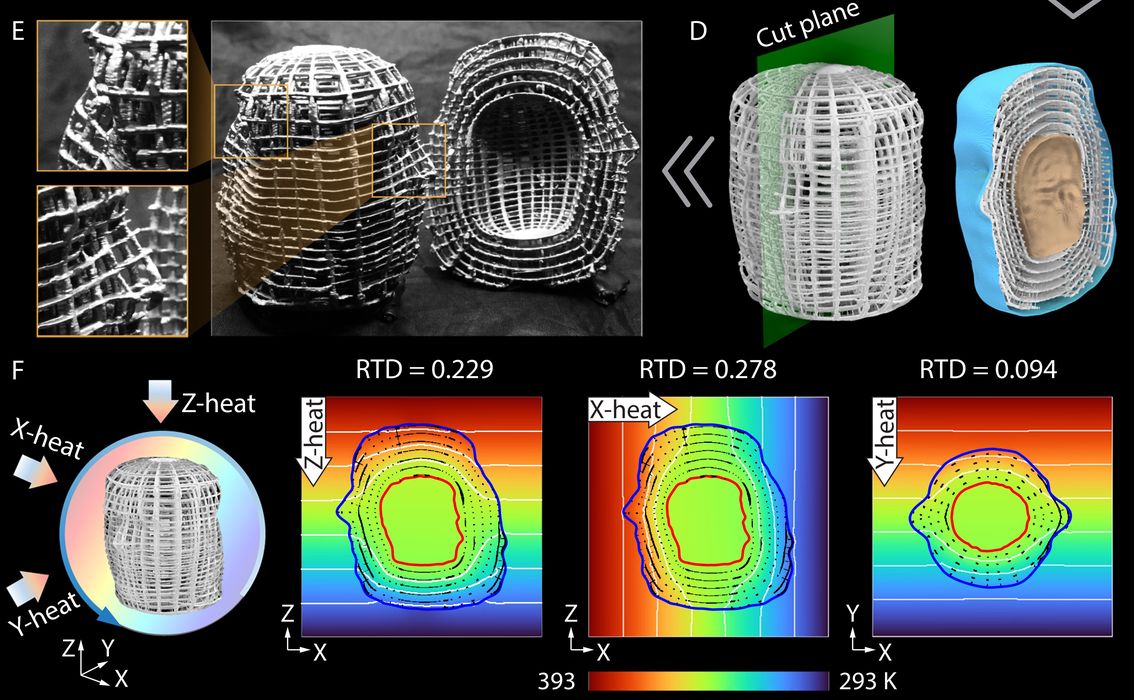
Researchers have used a 3D printed metal lattice to make heat effectively disappear.
Most applications of lattice structures in 3D printing are about mechanical properties. We see them reduce weight in aerospace brackets, absorb impacts in helmets and footwear, tune stiffness in medical implants, or improve energy absorption in automotive components. Occasionally lattices are used to increase surface area for heat exchangers.
This latest research from the University of Illinois Urbana-Champaign takes lattice structures in a completely different direction. Instead of optimizing mechanical properties, the researchers designed a lattice whose only purpose is to control the flow of heat.
That’s one of the more unique applications of 3D printed lattices I’ve seen.
The work, published in Nature Communications, describes what the researchers say is the first physical realization of an omnidirectional, free form three dimensional “thermal cloak”.
The concept of thermal cloaking has existed for years in theory. Rather than insulating an object, a thermal cloak redirects heat around it so smoothly that an infrared camera sees little disturbance in the surrounding temperature field. In effect, the object becomes thermally invisible. This does not mean it is optically invisible, however — different wavelengths.
Previous demonstrations generally relied on simple two dimensional geometries, simulations, or highly idealized materials. Creating a 3D version has proven far more difficult because the required thermal conductivity changes continuously throughout the structure and in different directions.
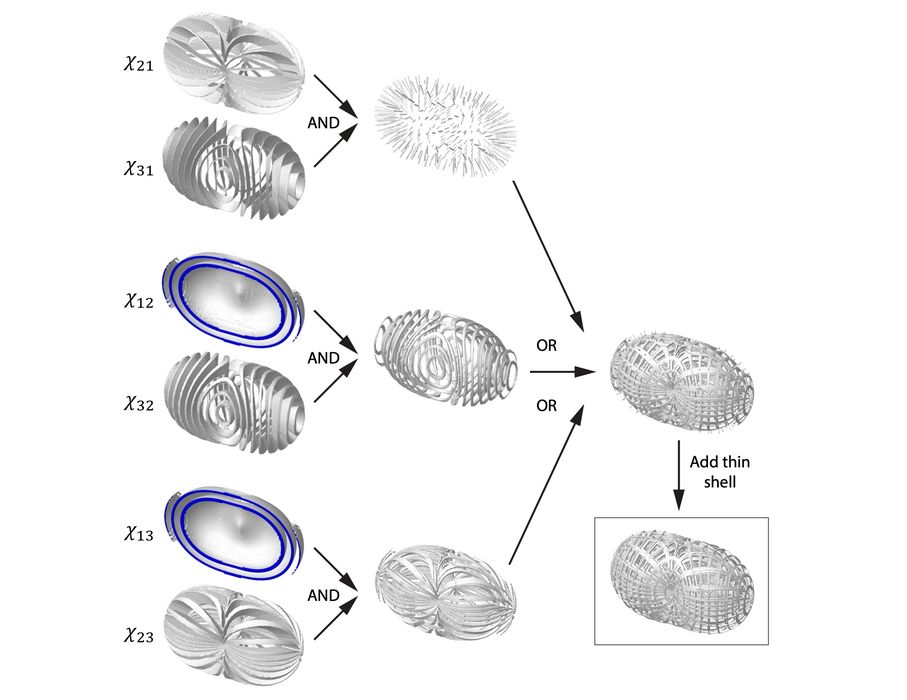
The Illinois team solved that problem by developing a deceptively simple lattice composed of three perpendicular bar networks. By varying the thickness and orientation of those members throughout the volume, they could locally tune thermal conductivity while maintaining a structure that could actually be manufactured.
Fabrication of the cloak combined several manufacturing processes.
The conductive framework was produced in AlSi10Mg using Direct Metal Laser Sintering with a minimum feature size of 0.5mm. The remaining volume was filled using mold cast PDMS silicone, while a thermally conductive silicone encapsulant formed the surrounding matrix. The finished part was then tested between heated and cooled aluminum plates while an infrared camera recorded temperature distributions.
The experimental results closely matched simulation, demonstrating that the lattice successfully guided heat around hidden objects regardless of heat flow direction. Among their demonstrations were an apple concealed inside a pear shaped cloak, several increasingly complex geometries, and even a thermal cloak capable of hiding one human face inside another.
This is a very interesting move because it demonstrates how additive manufacturing enables functions that would be effectively impossible with conventional manufacturing. Every limb of the lattice exists because it contributes to a carefully engineered thermal conductivity tensor.
In other words, the geometry itself becomes the material.
This sounds remarkable, but a real, commercial deployment is still many years away.
The design methodology may prove more important than the cloak itself. The researchers believe the same approach could be extended to other conduction driven systems, including electrical conduction and pressure flow, opening the door to entirely new classes of functional metamaterials.
For the 3D printing industry, this work is also a reminder that lattice design still has plenty of unexplored territory. We may have become accustomed to seeing lattices solve mechanical problems, but this research demonstrates they can be just as powerful for controlling entirely different physical phenomena.
Via Nature
