
LLNL is making a metal powder bed fusion machine print like an MSLA resin system.
The Lawrence Livermore National Laboratory patent application, US20260273840A1, proposes replacing the usual laser raster scan with a large, digitally shaped burst of light that can melt selected areas of a powder layer in one operation. That’s just like when resin systems moved from laser tracing to all-area LCD/DLP projections for each layer.
In traditional LPBF, a laser spot moves back and forth across the powder bed, following the geometry of the current layer. A typical layer may be only 50-100 microns thick, but the laser still has to visit all the required locations, which is quite time-consuming.
LLNL’s proposed system starts with a high-power diode array rather than a single focused beam. The array can be built from diode bars, with the output arranged as a two-dimensional pattern. The light then passes through a computer-controlled selective area mask, described in one embodiment as a liquid crystal module combined with a polarizing mirror.
Think of the mask as a very large optical stencil, except that its openings are changed electronically for every layer. Pixels can block light from selected parts of the powder bed while allowing it through elsewhere. The exposed regions melt or sinter, and the unexposed powder remains available as support material.
That changes the motion problem completely. The optical system can project a full two-dimensional image onto the layer instead of moving a small spot across it. The patent claims specifically cover generating a 2D beam pattern, modifying that pattern for each new layer, and adjusting power density as needed.
The claimed power control is more interesting than it first appears. The processor can select different power density levels based on the powder’s composition, particle diameter, absorptivity, bed thickness and base-plate temperature. Aluminium, iron, titanium and tungsten do not absorb or conduct heat in the same way, so a single exposure parameter would be a bad idea.
The filing gives calculated average power flux requirements ranging from 12 W/cm2 for aluminium to 2,900 W/cm2 for tungsten, using assumptions including 30 micron powder in a 90 micron layer. Those figures explain why this cannot simply be done with an ordinary projector. The diode array is described as providing at least about 10 kW/cm2, with a maximum above 100 kW/cm2 at a two percent duty cycle.
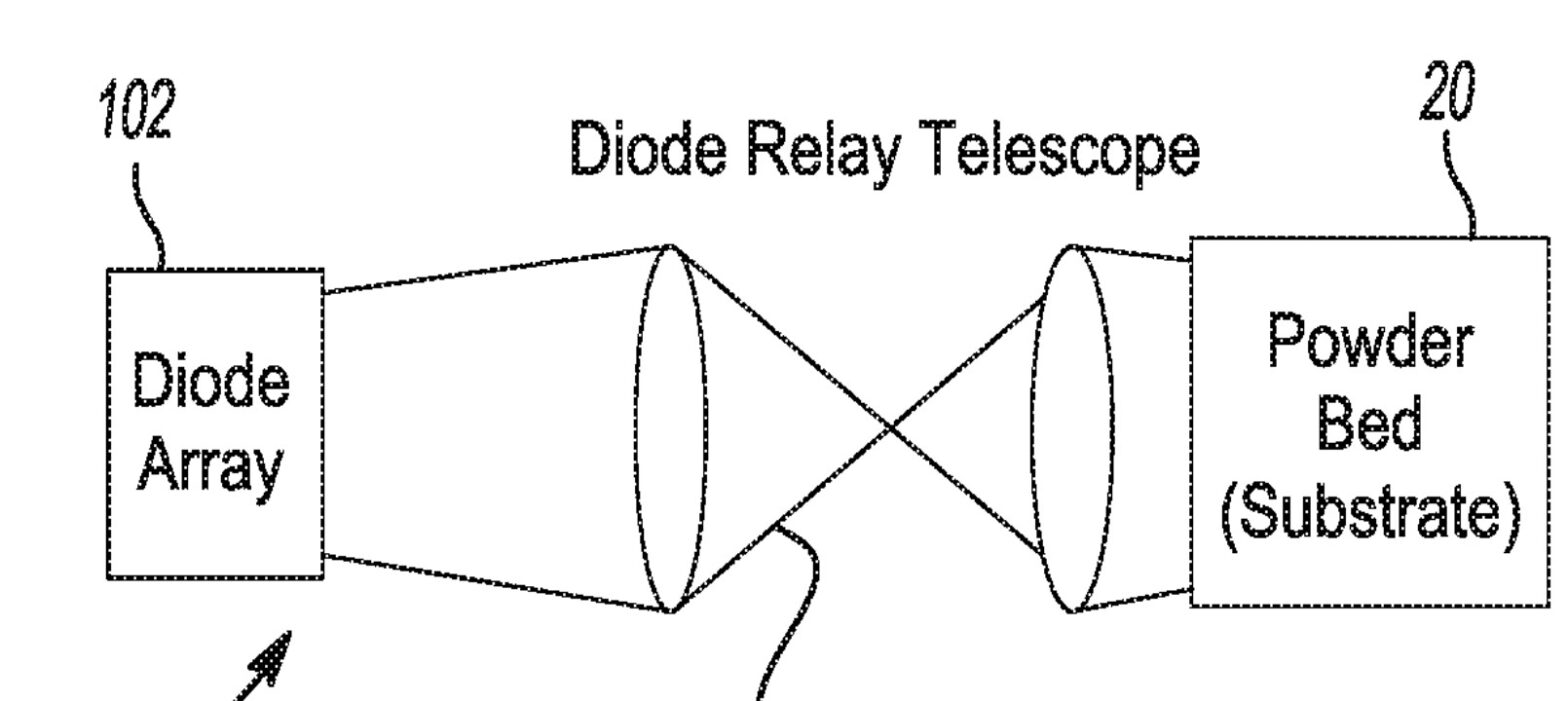
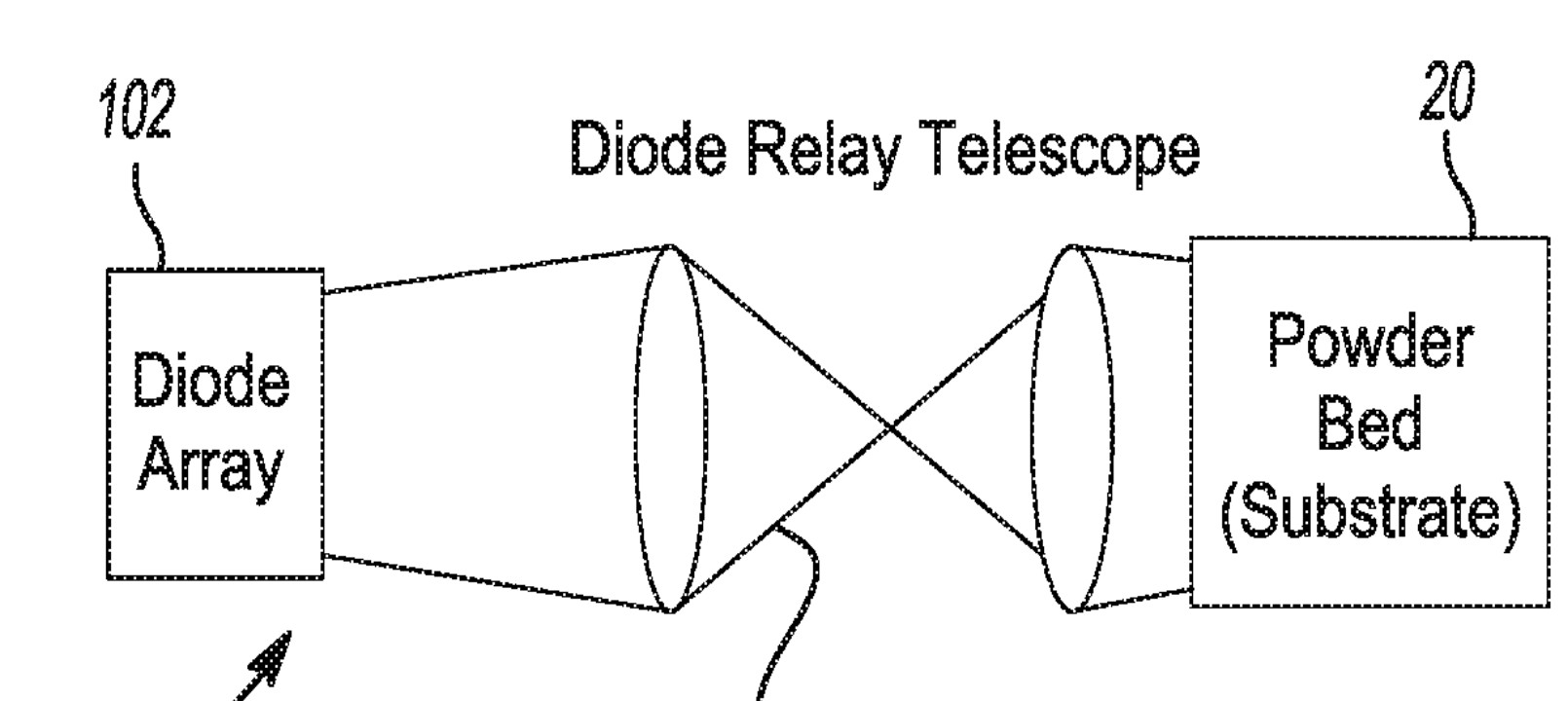
The proposed optical hardware also has several forms. A relay telescope can digitally control light “tiles” across the bed, while another arrangement uses multiple focusing lenses to create parallel optical sheets. The patent even describes scaling the diode array toward a one-square-meter area, assuming a powder bed and supporting structure large enough to use it.
There is a particularly bold claim here: a complete layer could be irradiated simultaneously. The filing says a 25 cm by 25 cm part was the largest size then possible with a rastered beam, so a full-field system could attack both layer time and build-area limits. It also suggests that multiple powder nozzles could deposit different metals before the optical exposure, with the mask and power controls applying the appropriate energy to each region. Now that is very interesting!
This is an interesting approach for speeding up the normally slow LPBF process. If their unusual optical system can deliver the required energy evenly and repeatably, the machine becomes a high-power digital exposure system. That could be a substantial change in the architecture of metal 3D printing.
Via Espacenet
