
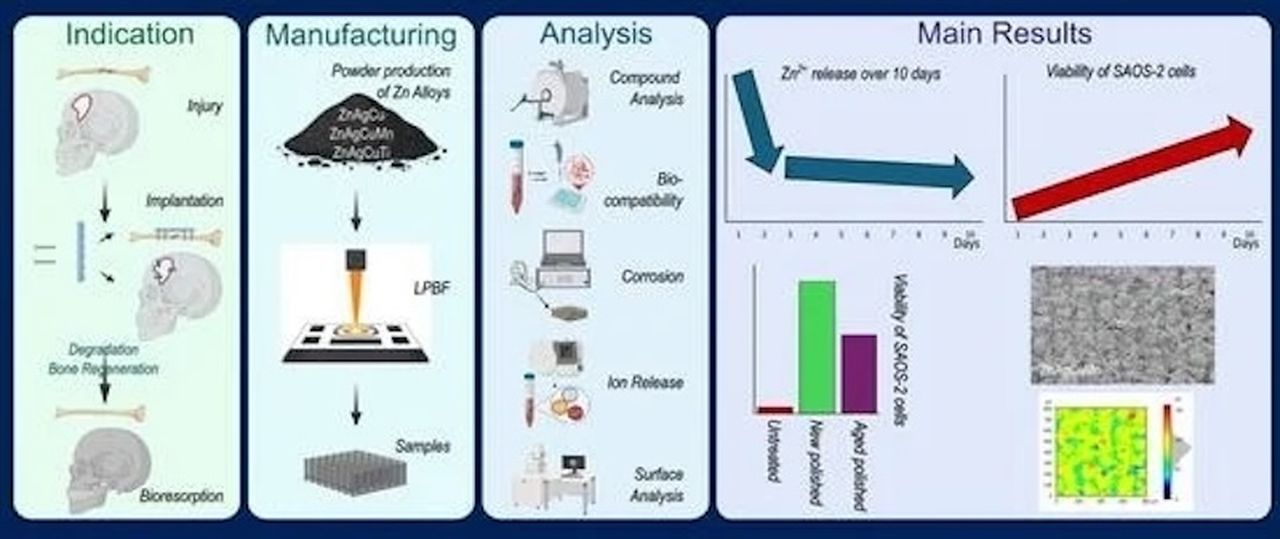
Researchers used Laser Powder Bed Fusion to 3D print zinc–silver–copper alloys and report promising cytocompatibility for future biodegradable implants.
Biodegradable metals are attractive because they carry load during healing stages, and then resorb later, eliminating the need for removal surgery. Zinc is in a useful middle ground for degradation rate — typically slower than magnesium, which often degrades too fast, and faster than iron, which can persist too long. The ability to tailor a zinc alloy’s corrosion, strength and antibacterial behavior by adding small amounts of other elements makes it a strong candidate for resorbable hardware such as plates, screws and patient specific fixation.
Laser Powder Bed Fusion (LPBF), also called SLM, is the metal AM workhorse for titanium implants, but zinc presents real process challenges. For example, it has a rather low boiling point and high vapor pressure, so zinc can volatilize under the laser if parameters are not tightly controlled, risking spatter and porosity. Demonstrating cytocompatibility, LPBF printed zinc alloys could open the door to on demand, anatomy matched implants that quietly disappear once their job is done.
Why Zinc Alloys For Resorbable AM Implants
The study focused on zinc alloyed with silver and copper, two elements widely explored for strengthening and antimicrobial effects. Silver is known for broad spectrum antibacterial activity at low concentrations, while copper can both strengthen and contribute to bacterial kill. In degradable systems, though, these benefits come with an issue: excessive ion release risks local cytotoxicity. That is why cytocompatibility is a requirement before any serious work proceeds.
AM offers an additional lever beyond bulk composition. The LPBF processs can produce intricate microstructures, which in turn shape corrosion and ion release profiles in physiological situations. Porous architectures, easily produced by LPBF, can further tune mechanical compliance and surface area, but also change degradation behavior. That combination of composition control, microstructure control and geometry control is unique to 3D printing.
What The LPBF Study Demonstrates
The researchers fabricated zinc–silver–copper specimens by LPBF and evaluated their in vitro cytocompatibility. While the paper’s detailed print parameters are not summarized, the paper reports that the LPBF manufactured alloys met accepted cytocompatibility thresholds in standard assays, indicating that, under the tested conditions, ion release from these compositions did not unduly suppress cell viability. The work supports the premise that LPBF can produce cytocompatible, degradable zinc alloys suitable for further preclinical study.
What is new here is not simply that zinc can be printed — prior efforts have shown this at lab scale — but that a multicomponent Zn–Ag–Cu system survived both the thermal realities of LPBF and the biological environment, too. That suggests the process window can be controlled to limit zinc vaporization and avoid excessive enrichment or depletion of silver or copper. It also implies that surface chemistry after printing, which often dominates early degradation and ion release, landed within a biologically tolerable range without requiring exotic post processing.
That said, several constraints and unknowns remain. The study does not, at least in its summary, disclose full processing details such as layer thickness, laser power, scan speed, hatch spacing or gas flow, nor does it address powder reuse. Those factors matter because preferential evaporation can shift composition over time, and closed loop control is rare on LPBF platforms when printing volatile systems. Throughput, build volume limits and support strategies for zinc were also not detailed, leaving questions about practical manufacturing and cost. Mechanical properties across degradation, uniformity of corrosion and the risk of localized pitting in complex geometries are further technical hurdles.
For clinicians and device developers, the adoption path could be nontrivial. In vivo data are needed to correlate in vitro cytocompatibility with tissue response, inflammation and healing across weeks to months. Antibacterial claims, if pursued, require robust microbiology and careful dosing to avoid cytotoxic trade offs. Manufacturing will need statistical process control around composition drift, porosity and surface state, plus sterilization and packaging that do not perturb early corrosion.
Still, the direction is encouraging. If LPBF can reliably print zinc alloys that keep cells happy today and vanish on schedule tomorrow, it could shift parts of the orthopedic and trauma toolbox toward single stage, patient specific care — and lighten the surgical calendar by one removal at a time.
