
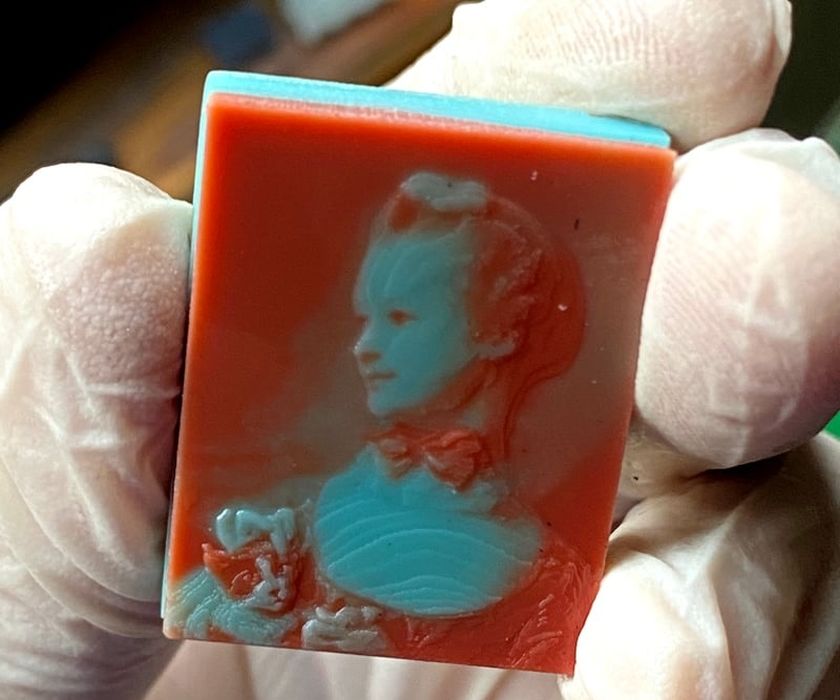
There’s a full-colour resin 3D printer in the works.
Developed by New Hampshire-based MAASS, the SHIMMY is one of the most unusual resin 3D printers I’ve seen.
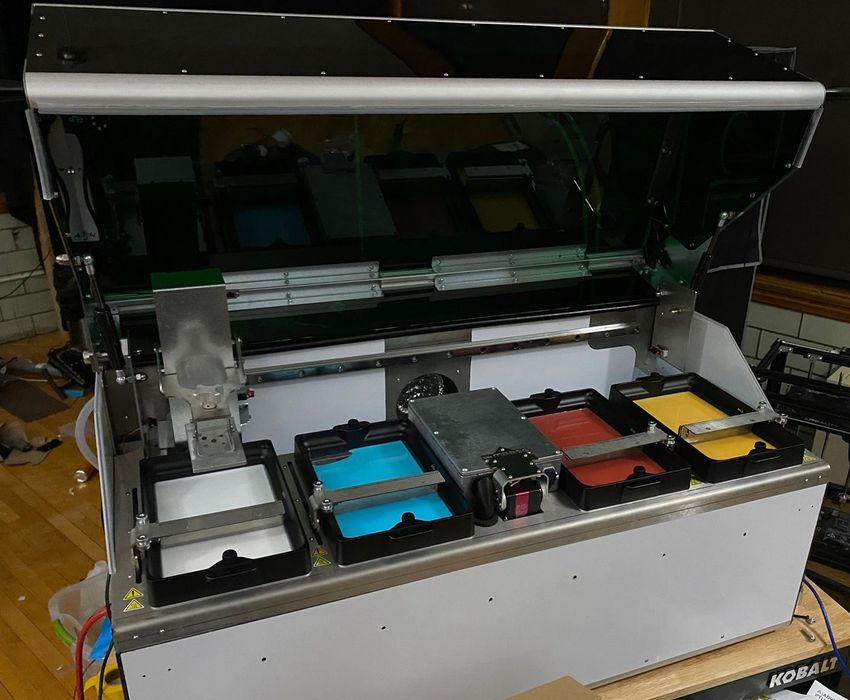
Unlike most resin 3D printers that use a single resin tank, the current SHIMMY uses two. The idea is to have a different colour (or material) in the second tank.
But how could you print a job that uses both tanks?
Their technology is pretty interesting. It seems that as each layer is completed on a tank, the build plate is moved to a special ultrasonic vat to pull resin off. This is required because otherwise the wet resin clinging to the partial print would contaminate the other tank. Apparently, they use an air knife for rapid drying.
And so it goes: the job shuffles between the two tanks, each adding material on a layer. At the top, you can see a print result, showing a high-resolution resin print that has used two different colours.
If that sounds interesting, then listen to their latest claim:
“Shimmy ships with two vats, but we have been working on a second system that uses six vats, allowing for three colours (Cyan, Magenta, Yellow), with White for the core, Black for shading, and a Clear or Dissolvable Resin to protect or support the print. This allows for complete reproduction of every colour in the palette.”
This appears to be a feasible approach for 3D printing full-colour textures that is quite different from the current standard, UV inkjet deposition. That process is used by Stratasys and Mimaki in their popular full-colour systems.
MAASS said that while FFF can produce parts with strong materials, it cannot approach the detailed resolution possible with their resin system. Also, they say that UV inkjet approaches can achieve the resolution and full colour, but cannot use strong materials. They believe their approach is better than both.
I’m pretty sure this approach will technically work, but I have two concerns.
First, there’s print speed. Normally, a resin system would spend a specific amount of time per layer, delayed by lift/peel and resin reflow between layers. In the MAASS concept, that process would be repeated, well, six times for each layer!
MAASS said their two-tank SHIMMY system can print at up to 10mm/hr, so a six-tank system would obviously be much slower, perhaps less than 2mm/hr.
The second consideration would be cost. Today’s resin systems have pricing that is well understood: light source, tank, motion system, plate, etc. A six-tank SHIMMY would have all those components times six. The expectation would be a price at the very least 6X that of a competent resin system, so US$6,000 at an absolute minimum. We don’t know the pricing of the future 6-way SHIMMY, but I would guess it could be more than US$10,000.
Nevertheless, that price would still be far less than Mimaki or Stratasys options, so perhaps there is an opening for this technology in the market.
Via MAASS
