
It seems the market has spoken about toolchanging 3D printers.
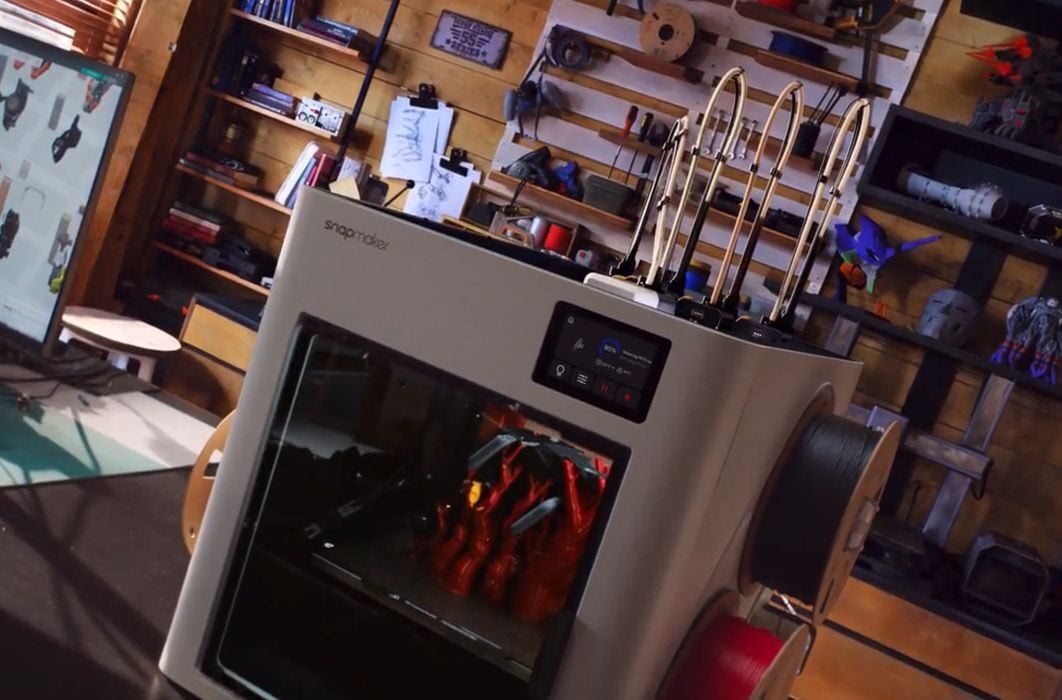
Last week Snapmaker announced their first toolchanger, the U1. It’s a desktop FFF 3D printer that has four separate toolheads, which can be dynamically swapped during print jobs. This enables the machine to print in up to four colours per job.
There are many FFF machines on the market that can print in four colors, but they all suffer from a problem: material waste. As filaments are swapped, old material must be purged from the single nozzle on these devices. This is discarded as waste, known throughout the industry as “poop”.
The problem is that the proportion of poop can be staggeringly huge. It’s not uncommon to see a multicolor print that required 10X its weight in poop. This effectively raises the price of material per model enormously for 3D printer operators.
Toolchangers, on the other hand, don’t waste anything because the nozzles are dedicated to specific materials during the entire print job.
Toolchangers have been around, but they’ve been quite a bit more expensive (like 3-10X more expensive) than filament-swappers. As a result, there aren’t many toolchangers seen in the wild.
Snapmaker has changed the equation with their U1 system, which is priced about the same as many filament swapping systems. Buyers would save a considerable amount of money on material if doing many multicolor prints.
The U1 appeared on Kickstarter last week, and I was very curious to see how the market would react. Would they be cautious about a new technology? Would they be concerned about how Snapmaker could actually make a less expensive toolchanger when other companies could not? Would they be attracted to the prospect of saving cash on materials?
The answer is now very, very clear: the U1 is extraordinarily popular on Kickstarter, one of the biggest campaigns ever, and certainly the biggest 3D printer launch ever seen on the platform.
As of this writing, the campaign has collected around 13,000 backers, paying US$12M. Astonishingly, the campaign has another 35 days to go, suggesting that they could hit far higher totals. Could they hit US$20M?
That is a statement: The market wants toolchangers, at reasonable prices.
Filament swapper manufacturers, beware. The time for that technology appears to be closing.
There’s something else going on here. Setting Kickstarter records is fine, but history does show a bit of a trend with such achievements. Two notable record breakers from the past are Formlabs and Bambu Lab.
Both of those companies are now clear leaders in their 3D print technologies, having grown massively from their initial products.
Now Snapmaker is a record holder, too.
Via Kickstarter
