
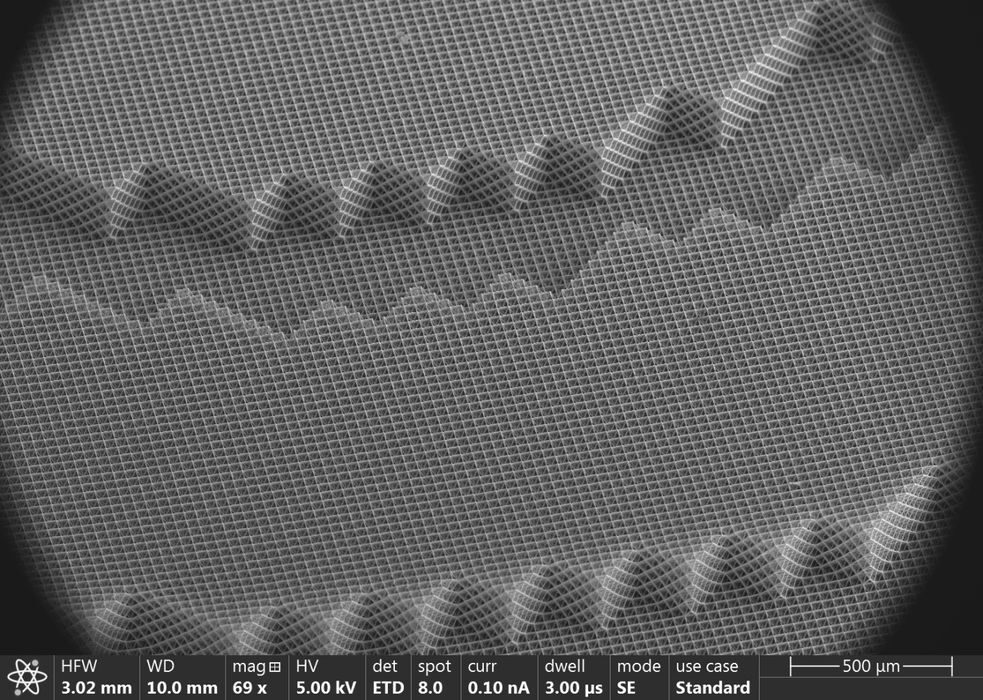
There could be a way to dramatically scale up the two-photon lithography process.
“TPL” is a well-understood technology for 3D printing extremely small structures. It typically involves focusing a laser at a tiny point within a resin vat, solidifying a very small region. By moving the focus point around in 3D space, you can gradually build up an object.
The goal with TPL is tiny-size structures, as the resolution is basically the dimensions of the laser focal point, which are extremely small. TPL is commonly used today to produce very small and complex objects, typically for industrial use. It’s also been used to produce demonstration prints of microscopic objects.
But wouldn’t it be great if we could scale up this technology to build large (meaning typical 3D printer-sized) objects with TPL? This is not really possible with today’s technology because there are two problems.
You could simply move the laser focal point around in a much larger vat of resin, but then it would take far too long to produce anything of size. That won’t work.
You could use lenses to scatter multiple points and perform solidification in parallel, but attempts at doing so have largely failed as the size grows. Printing “patches” and linking them together also doesn’t work because the joints aren’t bonded in the same way, making the parts weak.
Now a new approach has been developed by researchers at Lawrence Livermore National Lab, who use metalenses to vastly increase the area of printing with TPL.
Xiaoxing Xia writes on LinkedIn:
”Last month, we were finally able to share our answer in Nature after five years of research plus one year of writing and revision. In this work, we used a metalens array to generate more than 120,000 focal spots that can be individually addressed to perform two-photon lithography (TPL) in concert, enabling ~1000X faster 3D printing with nanoscale resolution across a write field of 12 cm².”
You might be wondering what a “metalens” is all about. It’s an alternative to traditional curved glass surfaces for bending light. Instead of glass, it’s a flat array, only a few hundred nanometers thick, of nanoscale pillars or antennae. Each nanostructure locally shifts the phase of incoming light. This allows you to produce an array of beams, each with individually selected frequencies.
You could, for example, use one frequency for polymerization of resin, with other frequencies not doing so. In other words, the array of beams can selectively cure a pattern on resin.
The approach can be scaled up massively over traditional TPL, although the resulting area is still pretty small with only twelve square centimetres. However, objects printed in this way do not require a microscope to be seen.
Because the array sends countless beams all at once, the curing of a layer can be done entirely in parallel. This speeds up the process significantly. At the top you can see an image of a printed surface using this technology.
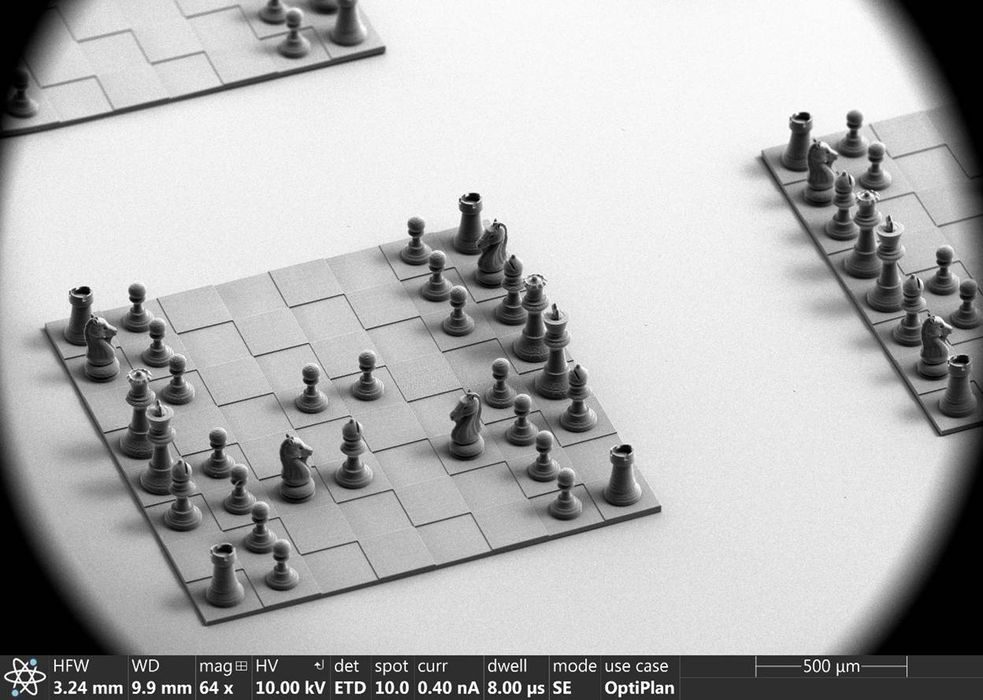
Here you can see a more interesting image that is a set of chess moves. The chess board is about 2mm across, to give you an idea of the size of this object. However, the print job produced 16 different chess boards all at once. That is scaling.
This is an extremely interesting development that could, if properly commercialized, lead to entirely new 3D print applications. Ultra-high resolution large objects are just not a thing right now, but with this technology they could be.
Via LinkedIn
