
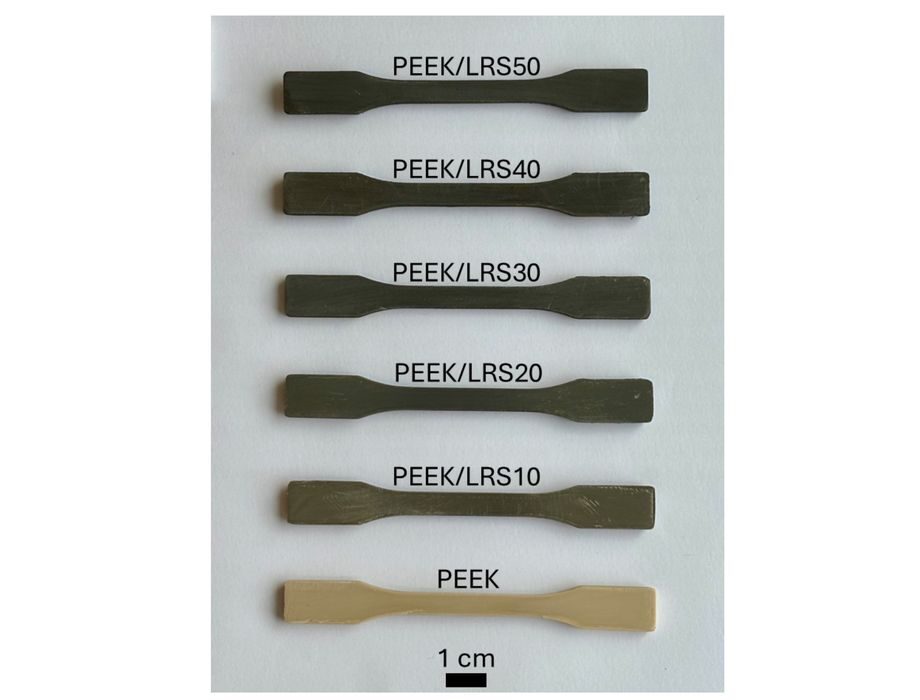
Researchers have been experimenting with mixing lunar regolith with PEEK for 3D printing.
With the increased interest in lunar activities comes the need to build structures on our Moon’s surface. However, shipping construction components and materials from Earth is spectacularly expensive, so the game is to use as much local material as possible.
3D printing is seen as a key approach for lunar builds, but what is the best way to do it? A new research paper explores the idea of mixing PEEK, a common high-temperature 3D printing material, and lunar regolith.
Mixing in additives can make the materials situation much more complex. “Filler” often adds some rigidity to the parts, but at the cost of tensile strength: there are fewer polymer bonds throughout the structure. What would happen if regolith is used with PEEK?
The researchers used a lunar regolith simulant in their experiments, where they mixed it with PEEK in various ratios. The resulting material was 3D printed in coupons that underwent a series of mechanical tests.
A key finding was that they could hit a 50% ratio of regolith to PEEK, so long as careful print parameter tuning was observed. This is a major finding because it could potentially lower the amount of PEEK to be shipped from Earth at great expense. Regolith is freely available on the lunar surface everywhere. It’s the “dirt” of the Moon, except without any organic content.
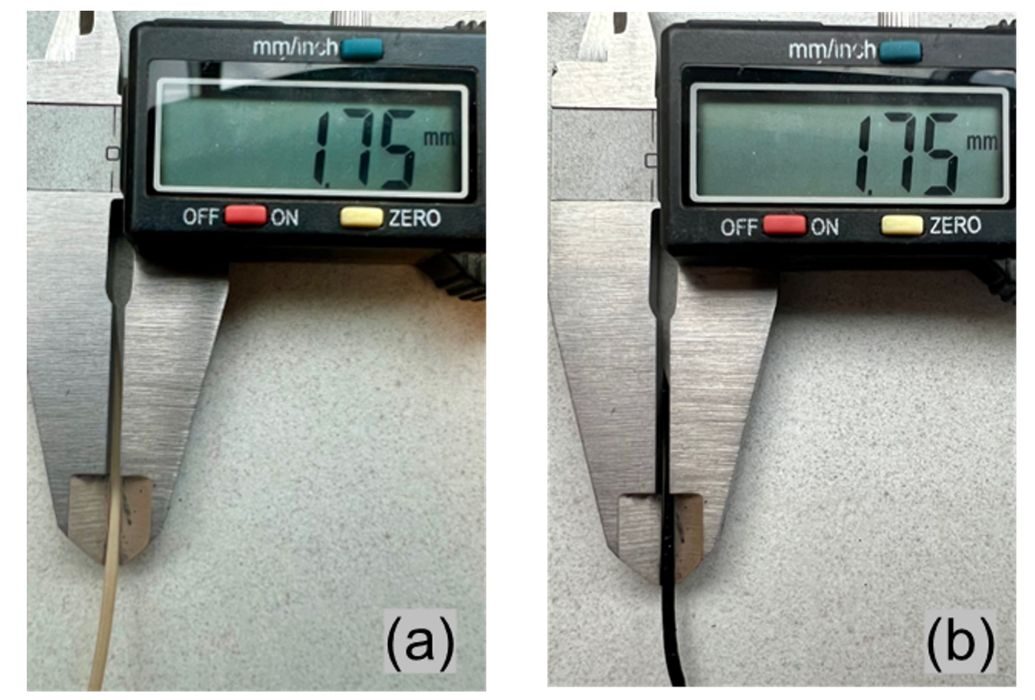
They achieved the 50% ratio through the use of an advanced screw design for the filament extruder. This design, along with some operational tweaks, enabled smooth and consistent filament extrusions of the mixed material.
The regolith-spiked PEEK also was found to be more dimensionally stable. This additional rigidity could be of significant benefit in certain applications, especially with the high thermal resistance of PEEK.
Another very interesting finding was that the addition of regolith increased layer adhesion, along with reduced warping. The reduced warping makes sense, as there would be less PEEK to warp, but I don’t understand the layer adhesion: regolith is rock dust, how does it stick together? It turns out that it’s not because the regolith “sticks” like a glue, but because it changes the thermal and stress conditions during printing in a way that helps the PEEK itself weld across layers.
Regolith is an excellent heat conductor, which assists in polymer binding, and it also reduces mechanical stress by disrupting crystal growth. It also acts like aggregate found in concrete.
They did find that mechanical anisotropy still exists in the 3D printed parts, which is not surprising. It was, however, somewhat better than natural PEEK 3D prints.
These are fascinating findings and it’s quite possible they are applicable on Earth. If you were 3D printing PEEK, would you not want better layer adhesion and reduced warping?
This research strongly suggests that someone should investigate the use of rock powder mixed with PEEK. If the advantages gained using lunar regolith are true, then why couldn’t the same effect be used for terrestrial applications? This seems to be an unexplored opportunity.
Another opportunity would be to adapt the advanced screw mechanism to produce rock-reinforced filament using materials in addition to PEEK. Another possible opportunity.
Via ArXiv
