
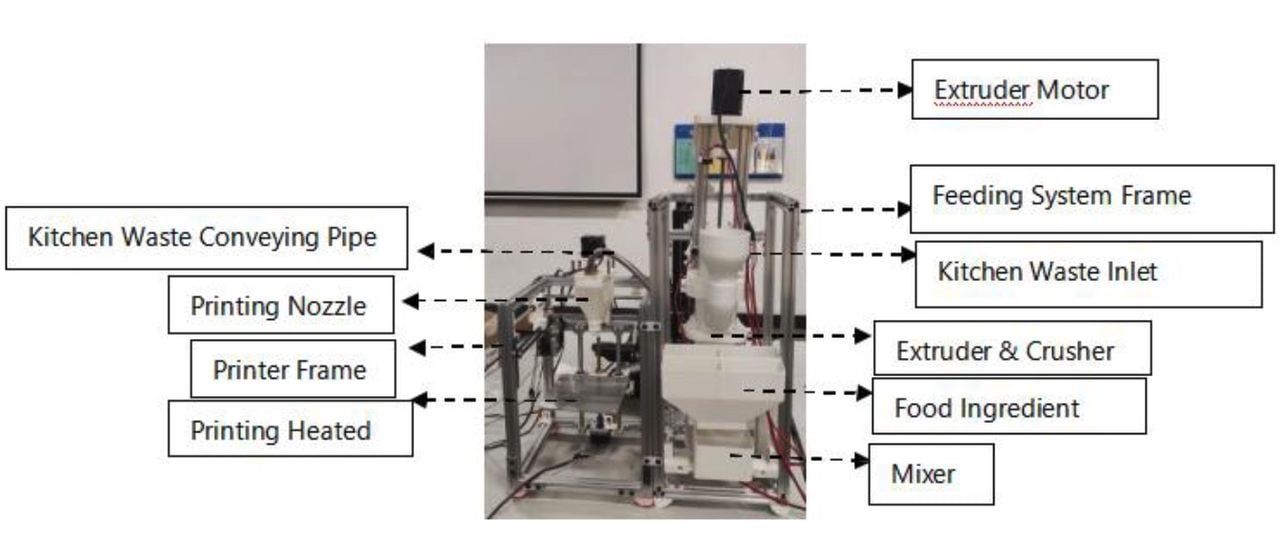
A new research paper describes a multifunctional “3D robot” aimed at kitchen waste recycling.
Wait, “3D robot”? In academic robotics, that usually means a mechatronic system operating in three dimensions, not a 3D printer. Regardless, this kind of prototype often depends on 3D printed fixtures, housings, and mechanisms to hit cost and iteration goals.
Kitchen waste is messy, variable, and everywhere. If a low-cost 3D printable robotics platform can sort, shred, dry, and compact food scraps reliably, you have a practical circular-economy tool that many makerspaces, schools, and even food-service operators might actually build and use.
The paper’s title emphasizes “design and implementation”, which suggests the authors built a working system rather than just modeling one. “Multifunctional” implies more than one operation — likely a sequence such as mechanical size reduction, moisture management, and either compaction or dispensing to compost or digestion streams.
Academic and hobby robotics typically use Fused Filament Fabrication (FFF) for brackets, guards, gearboxes, augers, impellers, and odd-shaped chutes that would be expensive to machine in one-off quantities. For a kitchen-waste robot, 3D printing enables geometry that handles wet material, protects hands, and encloses motors while keeping the costs down.
There’s also the iteration benefit. When you are fighting clogs, stray peels, and fibrous pulp, you will reprint parts often. 3D printing reduces non-recurring engineering and lets a design team adjust clearances overnight. If the researchers release CAD and STL files, the community can replicate the unit and feed back improvements — a pattern we have seen with open-source recycling rigs like home grinders and small extruders.
But there’s one issue. Kitchen waste is wet, warm, occasionally acidic, and sometimes abrasive. PLA will likely deform near heaters or get brittle over time. PETG and ASA are better choices for splash resistance and moderate heat, while nylon — preferably with carbon fiber reinforcement — can handle gears and bearings with higher loads. Smooth interiors reduce biofilm, and sealants or food-safe coatings may be necessary where sanitation is important.
For educators, this could be an excellent project-based platform: electronics, motion control, materials, and life cycle analysis in one box.
3D printing is the technology that enabled this experiment to take place. If 3D printed brackets and housings can help tame banana peels and coffee grounds, then then rest of the waste stream may not be far behind.
Via OpenAlex
