
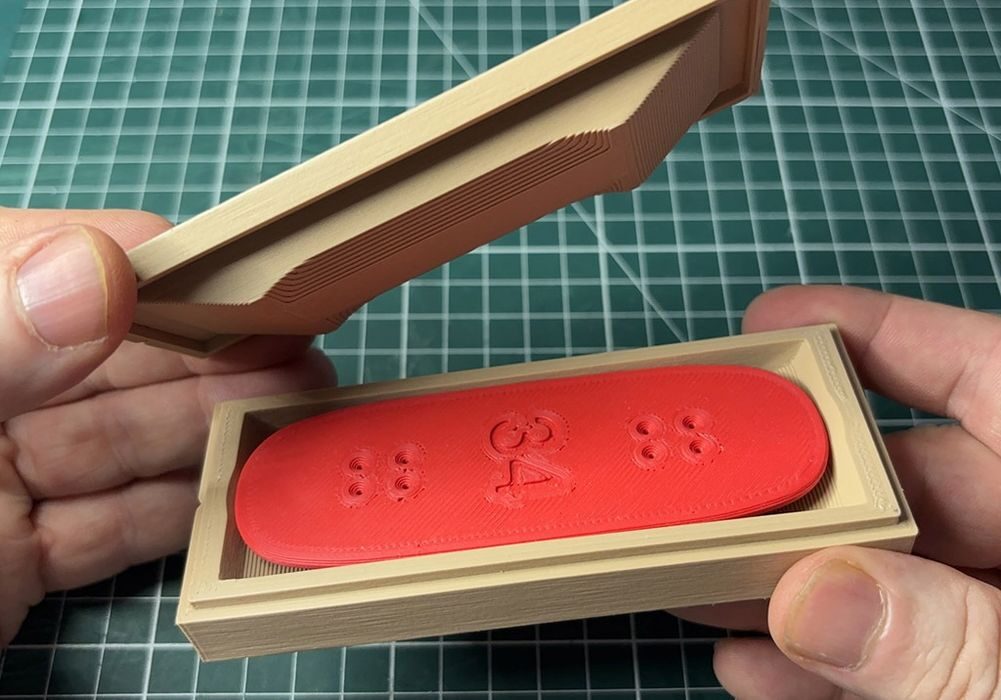
I saw yet another new technique for 3D printing objects.
It’s similar to molding, but not quite. In a Cults entry, “Fingerboard – Decks Factory”, designer THRASHMAXXX seems to have developed a new process for producing the tiny skateboards.
Here’s how it works:
- 3D print a two-part mold
- 3D print an object that fits in the mold
- When that object is printed and still warm, toss it into the mold
- Press the two parts of the mold together
- The second object, still warm, bends to the shape of the mold
- Remove the molded object
I’m sure every 3D printer operator knows that freshly removed 3D prints can be a bit malleable. This is particularly true for PLA prints that aren’t too thick and within the heat range of the build plate.
If you peel off these objects before they sufficiently cool, they will bend. That is a sure way to mess up the print’s geometry, so always wait for prints to cool before removal.
Here THRASHMAXXX has turned that disadvantage into a new approach. When the print is still malleable, bend it to the shape you want.
In the example shown, a small flat piece is printed, but then it is bent into a couple of directions by the mold.
This object could obviously be 3D printed in the final shape, but the molding method seems to be more efficient: you can print a flat version much more quickly and reliably, and without the need for support material.
THRASHMAXXX explained:
“I use my printer’s heated bed to soften the deck I printed just beforehand, and I place it in a mold to create the concave of the deck.
You can also use a heat gun, but the heat will be less uniform across the deck, it’s more difficult to control the temperature, and it’s less practical to hold the deck in place.”
The technique should work for any similar small item that requires an angled geometry. You just need to design an appropriate mold for the intended purpose.
Via Cults
