
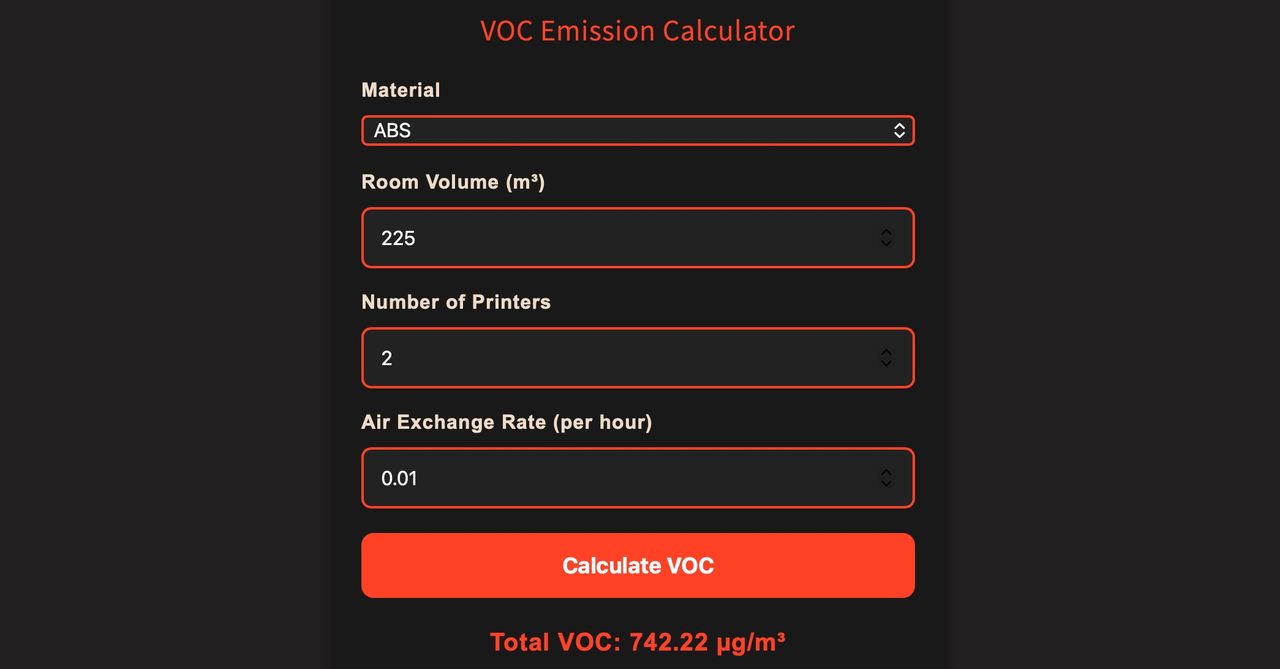
Heatforge 3D has put together a VOC calculator for 3D printing.
VOCs, or “volatile organic compounds”, are a mix of chemicals emitted during heating of various plastics used in 3D printing. There are hundreds of specific VOCs, and each may or may not have a level of toxicity. You can’t see them, you can’t usually smell them, either, but they are emitted by FFF 3D printers. In addition, desktop FFF 3D printers also emit nanoparticles that are basically chunks of the material so small they become airborne and can be breathed in.
FFF 3D printers are very widespread these days, but my suspicion is that few operators properly handle their emissions. Generally, you want to ventilate the area around the 3D printer to remove both VOCs and nanoparticles. However, many setups don’t have any ventilation at all.
Some 3D printers are enclosed, but those are not truly sealed and VOCs do leak out anyway. Other equipment sometimes offers internal filters to clean the air before it is exhausted into the room. That can improve things substantially, but it’s likely there is still some leakage.
The 3D Printer VOC Calculator by Heatforge puts all of this in perspective. It lets you set up a 3D print scenario and estimates the quality and type of VOCs in the room. There are some assumptions, of course, such as steady-state active printing operations and an 11g per hour deposition rate.
The calculator lets you choose the material being printed, and currently it lists HIPS, PVA, ABS, PLA, and nylon (PA). There are plenty of other materials, but their VOC emissions will be somewhat similar to those listed.
The scenario is relatively simple to set up:
- How big is the volume of the room where the printers are running?
- How many air changes per hour (ventilation) take place?
- How many 3D printers are running?
- Which material is being printed?
The calculator can then estimate the specific quantities of VOCs produced in each scenario in milligrams per cubic meter. For a given material, there might be a dozen or more VOCs listed, such as formaldehyde, decanal, 1-butanol, phensuximide, and other difficult-to-pronounce chemicals. The VOC estimates are based on actual studies of emissions produced by desktop 3D printers.
Those chemicals do have specific toxicity limits, so it would be possible to identify dangerous situations — but the VOC Calculator does not specifically do this. Instead, you’re looking at quantities of chemicals, and to determine toxicity, you will have to look it up for yourself. This is probably because toxicity levels vary by jurisdiction, so it’s difficult for a calculator to know all the rules. Heatforge 3D explains:
“Different VOCs have different health reference values. Most published limits are designed for workplaces—meaning short-term exposure in fully ventilated environments. Indoor hobby rooms typically require lower concentrations because exposure can be continuous, and ventilation is weaker. These values are rated for working adults and don’t take into consideration children, infants, sick people, and the elderly.”
The calculator also includes quite detailed explanations of each input field, which may be unfamiliar to calculator users. Many people might not be able to state their ACH values off the top of their heads, so there’s an explanation to come to a reasonable input value.
This is the first time I’ve seen a way to estimate VOC pollution in a 3D printer workshop, and it can be quite enlightening. By playing with the ACH values, you can clearly see the importance of ventilation.
This calculator is designed to work with FFF systems using filament. I am quite interested to see another calculator that performs similar estimates, but for resin 3D printing. Resin emits plenty of toxins, perhaps worse than filaments.
If you operate a desktop FFF 3D printer, particularly in a small room, you should definitely try this calculator to understand the ventilation requirements you need to operate the equipment safely.
Via Heatforge 3D
