
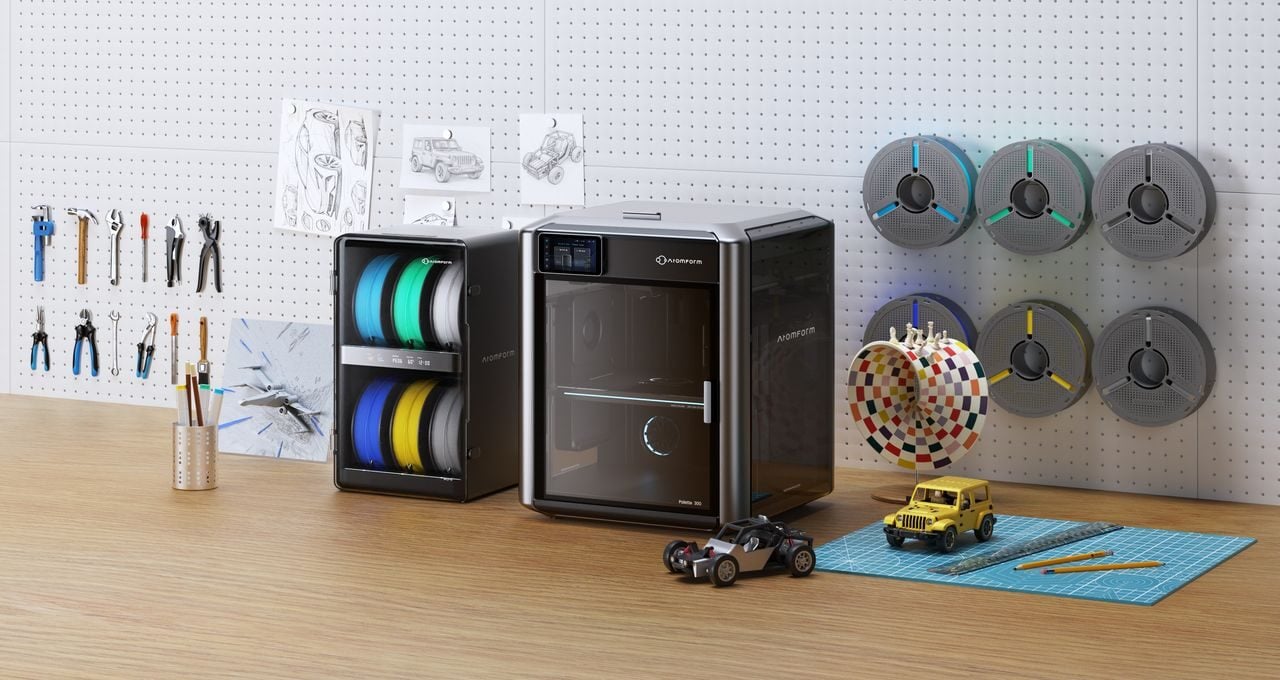
AtomForm has launched a new multicolor 3D printer, the Palette 300.
The machine enters the highly competitive low-waste FFF market that currently includes the Prusa Research INDX, the Bambu Lab H2C, and the Snapmaker U1. All of these systems use slightly different approaches for decreasing the tremendous amount of material waste generated by older filament swapping systems.
The Palette 300 uses an entirely new approach they call “OmniElement”. Below you can see how it works:
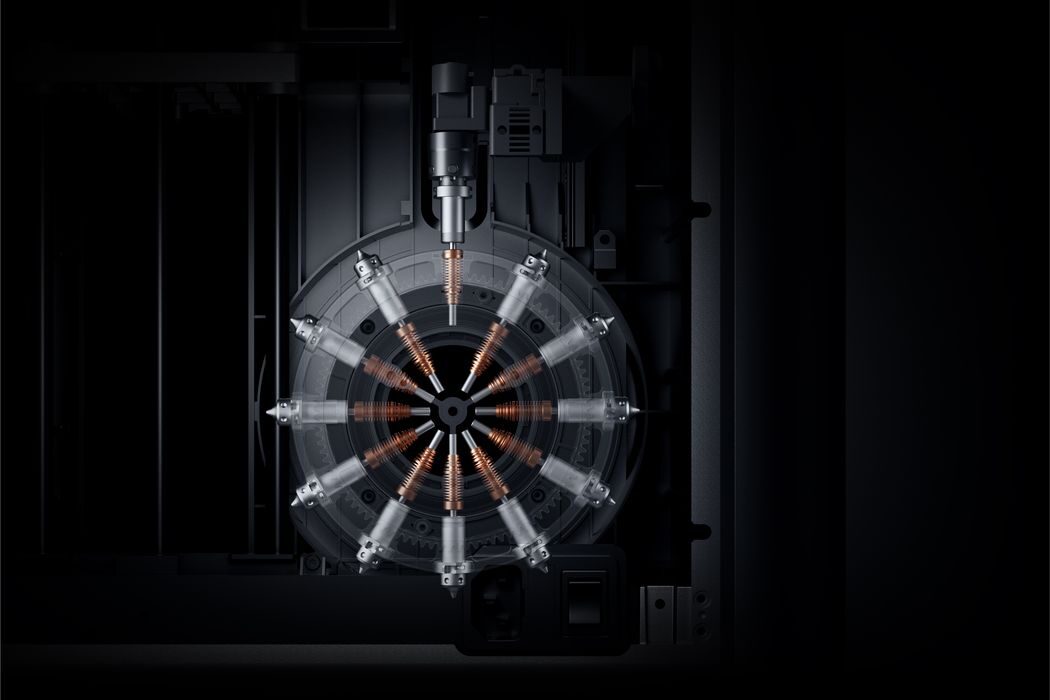
They have a circular pool of up to twelve (!) nozzles that are selected by simply rotating them around. This is a very fast process, one they claim is faster than all the other competition, aside from the INDX method. As the system rotates, the Palette 300 can immediately recognize the nozzle and adjust system parameters appropriately.
Will the nozzles be properly aligned when mounted? This is a critical feature because if they aren’t, different materials would appear shifted in the resulting prints. AtomForm said the alignment accuracy is within 0.02mm, twice as good as Snapmaker’s U1, and 10X better than the H2D.
For materials, they offer the RFD-6 filament storage unit, which holds up to six spools at a time. But wait, there are twelve nozzles, not six. Two RFD-6 units will get you to twelve materials, but it turns out that the Palette 300 can handle FOUR of them. This means that the Palette 300 could, in theory, run a job with 36 different colours.
Note: 36 spools at US$20 each would mean you’d be paying US$720 just for the materials to fill such a configuration. That’s more than you’d pay for some desktop 3D printers.
The RFD-6 also doubles as a drying chamber, and you can dry while you print. This means they can handle most engineering materials.
But what about the other printer characteristics?
The build volume is quite large at 300 x 300 x 300 mm, comparable to most of the larger competing machines.
The hardened steel nozzle can hit 350°C, and the build chamber is actively heated up to 65°C. This means it should be possible to easily print a wide range of engineering materials without much risk of warping.
Print speed is quite interesting. AtomForm claims the Palette 300 can print at up to 800mm/s, which is quite a bit faster than most other systems that tend to run at 300-500mm/s. We don’t know the maximum volumetric flow rate, as AtomForm hasn’t released that to us.
The Palette 300 includes around 50 sensors that perform closed-loop management during print operations. This should greatly increase the probability of near-perfect print results. In addition, there is a four-camera machine vision system to monitor the build chamber before and during print jobs.
The system is fully enclosed and includes a colour touchscreen for local control. AtomForm offers a smartphone app to provide monitoring and control, similar to those from other companies. There is also a desktop application to prepare jobs in the traditional manner.
Pricing for the Palette 300 is expected to be slightly less than the Bambu Lab systems and far less than the Prusa INDX system. However, Snapmaker’s U1 will cost less than the Palette 300 but with far fewer features.
Via AtomForm
