
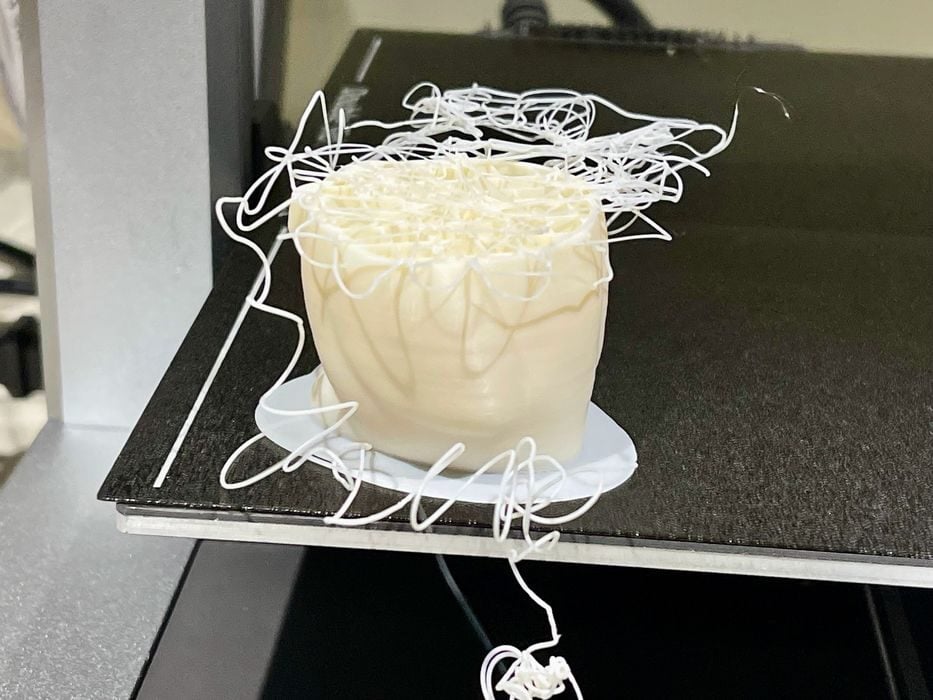
A new open 3D Printing Troubleshooting Guide could reduce failures across desktop and industrial workflows.
The huge 76-page guide is registered with a formal DOI, which makes it easy for teams to cite, share and embed in their internal procedures. While many OEMs publish tips and communities trade fixes in forums, a stable, citable reference can help standardize training and reduce variation across shifts, sites and student groups.
Additive Manufacturing (AM) spans a wide range of processes and failure modes, from stringing and first layer problems in Fused Filament Fabrication (FFF) to delamination, curling and porosity in Selective Laser Sintering (SLS) and Laser Powder Bed Fusion (LPBF). Teams often keep “tribal” knowledge in scattered checklists or slicer profiles; a consolidated troubleshooting document has the potential to bring these patterns under one roof with clearer decision paths.
Open knowledge is especially valuable in education and early stage labs where technicians rotate frequently and equipment mixes are eclectic. A DOI-backed guide also makes it easier for researchers to reference specific remedies or define experimental controls when publishing results that depend on print quality.
A Consolidated Playbook For AM Defects
Effective troubleshooting maps symptoms to likely causes and then to corrective actions. For FFF, classic entries include under extrusion (check drive gear tension, filament diameter, nozzle clog, and nozzle temperature), poor first layer (relevel bed, verify Z offset, increase bed temperature, ensure clean build plates and appropriate adhesion), and inconsistent dimensions (calibrate steps per millimeter, measure filament, and verify thermal stability across long builds).
Resin workflows such as SLA and DLP present different issues: parts detaching from the build plate due to insufficient base area or incorrect exposure, layer lines from peel forces, clouded surfaces from contaminated resin, and supports failing under suction. Remedies often combine exposure tuning, support redesign, and attention to resin handling — filtration, clean vats, and controlled temperature during long prints.
Powder bed systems introduce thermal and material management challenges. In SLS, curling and weak sinter can trace back to bed preheat, scan strategy, and powder refresh ratios. MJF users watch agent densities and lamp profiles to avoid orange peel or incomplete fusion. Metal LPBF adds gas flow, spatter and residual stress to the list; countermeasures include support optimization, build plate preheat, scan vector rotation and monitoring oxygen levels in the chamber. In all cases, drying and storage discipline matter: hygroscopic polymers benefit from dryboxes and spool ovens, while powders need controlled humidity between runs.
Limits, Unknowns And Practical Impact
The listing provides a DOI and an OpenAlex entry, but it does not, by itself, reveal scope, authorship, license or the depth of coverage. The guide does not include photos, decision trees, process specific parameter ranges, or validation data. Nevertheless, the guide is available to the public at no charge.
The immediate uses are straightforward: onboarding new technicians, establishing standard operating procedures, and shortening root-cause analysis after a failed build. Service bureaus can fold a guide into quality plans to reduce remake rates; schools can align it with lab checklists; and R&D teams can cite common remedies to clarify how they stabilized processes before testing performance.
This resource will likely remain a static PDF, instead of evolving into a living knowledge base with version control, process coverage beyond hobbyist FFF, and translations. Future integrations could be powerful: slicers could surface context sensitive advice, and machine dashboards could link failure detection to remediation steps. Pairing such a guide with build analytics and closed loop controls would turn troubleshooting from an art into a repeatable, auditable routine.
The cheapest part is the one you do not have to reprint — and a shared playbook is a terrific first step toward that goal.
Via Mendeley Data and GitHub
