Charles R. Goulding and Aaron Rofe highlight PALFINGER’s strategic pivot into automation and how its collaboration with ICON could accelerate the future of digital construction.
Industrial lifting equipment manufacturer PALFINGER is expanding its reach into robotics and digital manufacturing through a new strategic collaboration with US-based robotic construction company ICON. The Austrian engineering firm, best known for its crane and lifting systems used across construction, logistics, and industrial sectors, will contribute key mechanical and system technologies to support the development of large-scale robotic 3D printing platforms. The partnership reflects PALFINGER’s growing interest in applying its heavy machinery expertise to emerging automation technologies.
Founded more than 90 years ago, PALFINGER has built a global reputation for developing high-performance lifting and handling systems. The company operates approximately 30 manufacturing sites worldwide and employs around 12,000 people, generating more than 2.3 billion euros in annual revenue. Its product portfolio includes service cranes, loader cranes, mechanics trucks, and other heavy-duty lifting systems designed for demanding industrial environments. These machines are engineered for precision positioning, durability, and high strength, allowing operators to perform complex lifting operations safely and efficiently even under harsh conditions.
Many PALFINGER cranes combine lightweight structural designs with powerful hydraulic systems that enable lifting capacities ranging from several thousand pounds to more than 14,000 pounds. Advanced materials, extended hydraulic reach, corrosion protection systems, and integrated safety technologies allow the equipment to perform reliably across a wide range of job sites. The company’s long experience of designing machines capable of handling large loads with precise control is now being applied to a new area: robotic construction.
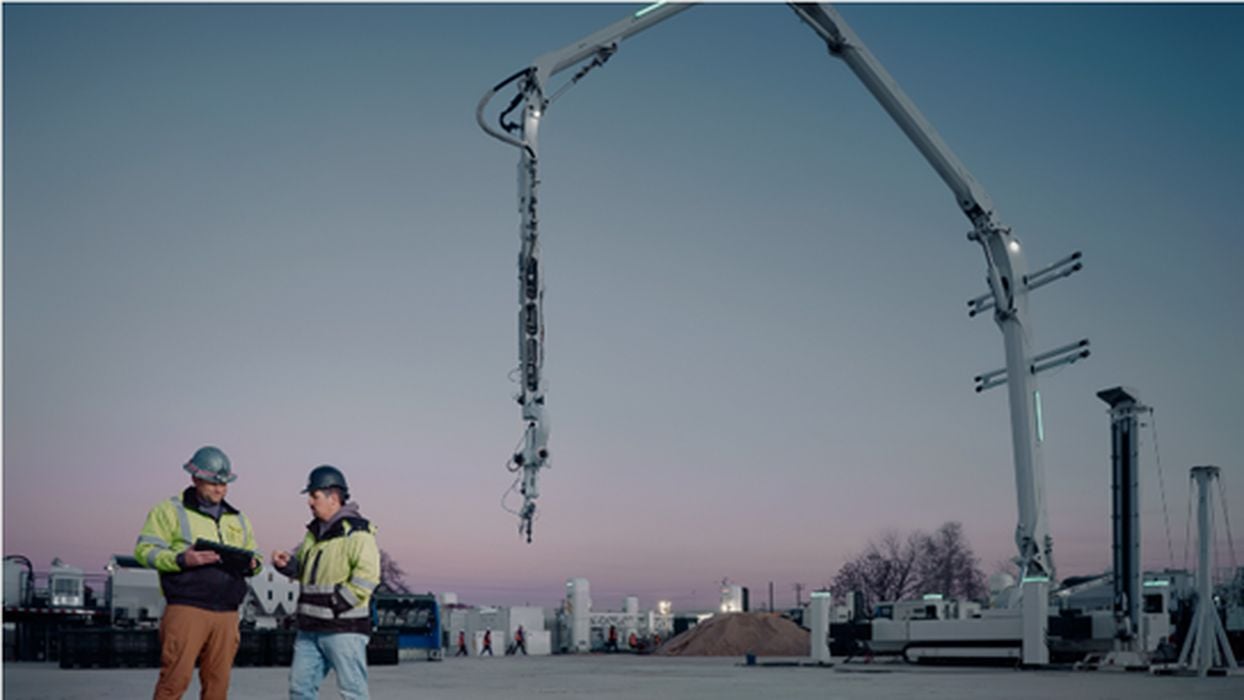
Within the collaboration, PALFINGER is contributing engineering and system integration capabilities to the development of Titan, a large robotic platform designed for automated construction-scale 3D printing. A key component of Titan is PALFINGER’S Special Lifting Solutions technology, which provides the stability and precise positioning required for large robotic printing systems. Construction-scale additive manufacturing presents unique mechanical challenges, as robotic systems must maintain accurate movement across large outdoor environments while depositing structural materials layer by layer to build walls and structural components from digital designs.

PALFINGER’s experience designing cranes and heavy lifting equipment is particularly relevant in this context. Titan integrates stabilizers, crawler systems, and modular mechanical components derived from PALFINGER’s machinery technologies to ensure positioning accuracy and structural stability during operation. The system is capable of printing structures up to 27 feet (8.2 meters) in height and supports multi-level construction projects. It is also designed for continuous 24/7 operation, using modular components that allow the platform to adapt to different construction environments. Initial prototypes of the Titan system have already been tested, demonstrating readiness for industrial deployment.
For PALFINGER, the project reflects a broader strategy to expand its capabilities beyond traditional heavy equipment markets and into robotics and digital manufacturing. Construction and industrial equipment sectors are often cyclical, closely tied to infrastructure spending and economic conditions. By applying its engineering expertise to emerging automation technologies, the company hopes to develop new growth opportunities while diversifying its technology portfolio.
Innovation has become a key focus within the company. In 2024, PALFINGER invested approximately US$108.2 million USD in research and development, representing about 4.2% of its total revenue. Around 700 engineers working across 24 locations are involved in R&D initiatives focused on digitalization, intelligent lifting systems, automation, and autonomous operation. Programs under the company’s Strategy 2030+ initiative aim to drive future growth through smart technologies, connected equipment platforms, and new applications for heavy machinery.
The collaboration also aligns with broader trends affecting the global construction industry. Labor shortages remain a persistent challenge in many regions, particularly for skilled construction trades, while the demand for faster and more cost-efficient building methods continues to grow. Automated construction systems, including robotic 3D printing technologies, have the potential to reduce labor requirements while improving safety and accelerating project timelines. Additive construction methods can also reduce material waste by depositing material only where it Is needed, improving efficiency compared to conventional construction processes.
By combining its expertise in lifting systems, mechanical engineering, and industrial machinery with emerging construction-scale additive manufacturing technologies, PALFINGER is positioning itself at the intersection of heavy equipment, automation, and large-format 3D printing. While the company remains best known for its cranes and lifting solutions, projects such as Titan demonstrate how traditional industrial engineering companies are increasingly exploring new roles in robotics and digital manufacturing. As automation continues to reshape construction and infrastructure development, PALFINGER’s move into large-scale robotic systems could represent an important step in the evolution of industrial construction technologies.
The Research & Development Tax Credit
Table 1.
PALFINGER
Per Capita R&D Expenses 2021-2024
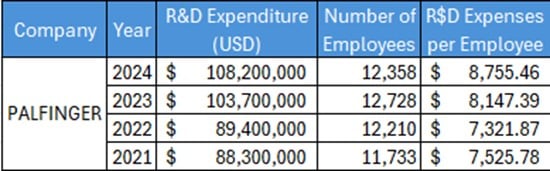
[Source: R&D Tax Savers]
The now permanent Research & Development Tax Credit (R&D) Tax Credit is available for companies developing new or improved products, processes and/or software.
3D printing can help boost a company’s R&D Tax Credits. Wages for technical employees creating, testing and revising 3D printed prototypes can be included as a percentage of eligible time spent for the R&D Tax Credit. Similarly, when used as a method of improving a process, time spent integrating 3D printing hardware and software counts as an eligible activity. Lastly, when used for modeling and preproduction, the costs of filaments consumed during the development process may also be recovered.
Whether it is used for creating and testing prototypes or for final production, 3D printing is a strong indicator that R&D-eligible activities are taking place. Companies implementing this technology at any point should consider taking advantage of R&D Tax Credits.