
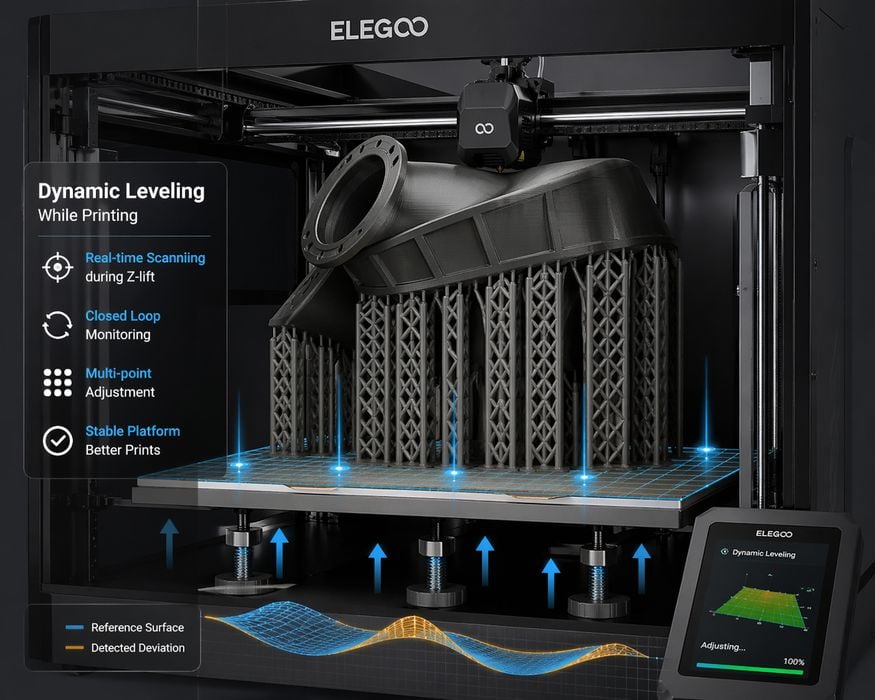
Elegoo appears to be working on a way to keep a 3D printer’s build platform level while the job is already underway.
A newly published Chinese patent, CN121871127A, filed under Shenzhen SmartPie Technology Co., Ltd. (a.k.a. Elegoo), describes “a fully automated intelligent leveling method and system for a 3D printing platform.” SmartPie is the desktop 3D printer maker best known for resin systems and, more recently, increasingly capable FFF machines.
We could not find the entire patent text, as is typical with freshly registered patents, but we could see the abstract. It describes what seems too be a way to continuously compensate for build plate changes during print jobs.
This is not another job-start bed leveling routine. Most desktop systems probe the bed before printing, create a mesh, and then compensate during the first layers by slightly adjusting the Z-axis. That approach works well enough for most uses, but it assumes that the platform remains geometrically stable during the entire print job.
That assumption weakens as print times get longer. A build plate can shift under thermal cycling, mechanical stress, vibration, or accumulated load from a large part. On FFF systems, heat from the bed, chamber, and part can slowly change the build plate’s geometry. In both cases, the platform may not be quite the same shape at hour 15 as it was at minute one.
Why do this? Imagine you’re printing a large part, and there’s a support structure being slowly built to hold up an overhang several centimetres above. The top of that support structure will be “off” if the build plate changes its geometry during the job. The idea here is to determine those changes so that compensation can take place.
Leveling While Printing
The patent describes a closed loop monitoring and adjustment system that first establishes an initial reference surface model. During the print, the system uses the otherwise idle time during Z-axis lifting to perform rapid sampling scans. It then identifies areas with abnormal offset and compensates by coordinating multiple platform support structures.
That is the interesting part. Rather than treating the build plate as a fixed plane and correcting only through normal Z motion, the patent suggests a multi point support arrangement capable of adjusting local platform flatness. The printer could detect that one region of the platform is drifting and mechanically correct it without stopping the print.
However, this is still only a patent publication. The patent abstract does not provide platform size, scan speed, sensor resolution, adjustment range, material compatibility, or the mechanical design of the support system. A moving platform must be rigid enough to avoid introducing new errors, and the control software needs to distinguish real deformation from noise, residue, vibration, or ordinary layer geometry.
The competitive angle is clear enough. Elegoo has been pushing beyond low cost resin printers into more ambitious desktop machines, and reliability now becomes much more important. Users no longer compare printers only by build volume and price. They increasingly compare how often high quality prints complete with little intervention.
If Elegoo can turn this patent into production hardware, it could make long prints somewhat more dependable. The most likely first appearance would be on a premium machine, where the extra of costs and complexity can be justified.
Watch for language such as “dynamic leveling,” “real time compensation,” “multi point platform control,” or “closed loop Z correction” in future Elegoo product launches.
