
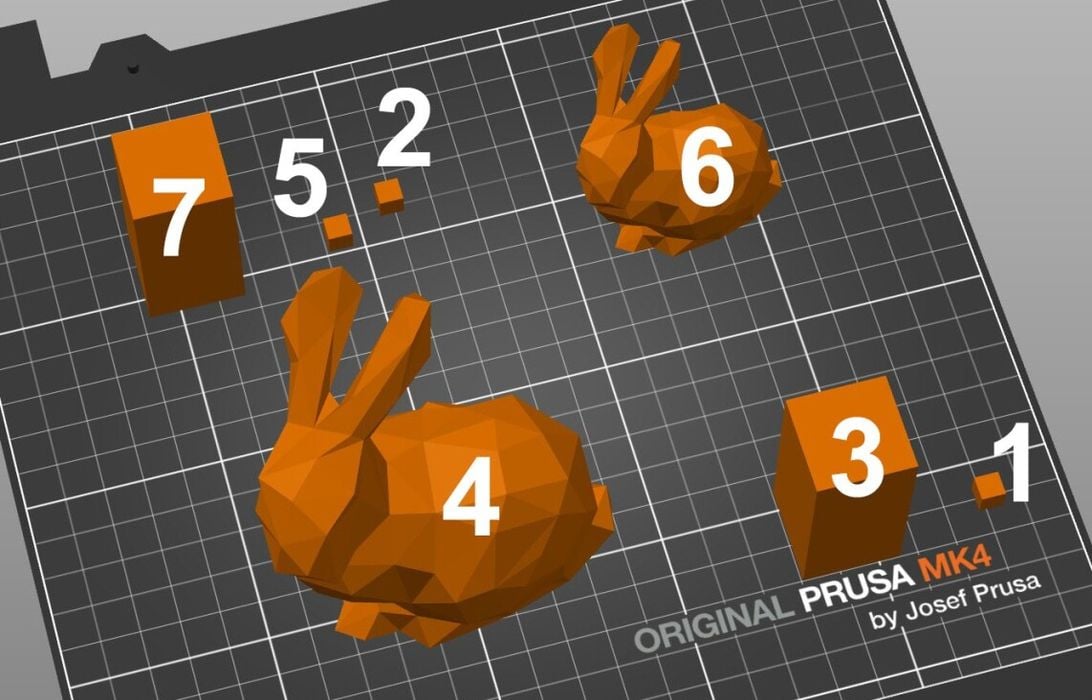
A new portfolio-based scheduler for sequential 3D printing could lead to denser, safer builds and reducing the number of plates used.
A new pre-print research paper describes “Portfolio-CEGAR-SEQ”, a software approach that leverages modern multi core CPUs to solve the complex combination of packing and ordering parts for one-at-a-time printing. The work uses an earlier algorithm, CEGAR-SEQ, that models arrangement and scheduling as a linear arithmetic formula and solves it with a technique inspired by “Counterexample Guided Abstraction Refinement” (CEGAR). Instead of betting on a single placement algorigthm, the new method runs several in parallel and selects the best feasible plan.
Sequential printing — common in FFF when users enable one at a time mode — trades inter-layer travel for full-part completion, but it introduces strict collision constraints. The toolhead and gantry must never clip a finished part while building the next, so both XY placement and the print order must account for each part’s height and the printer’s clearance envelope. Off-the-shelf slicing software typically handles this with simple rules and a safety radius; they work, but they are not as efficienct as possible, especially in multi-plate batches.
Why Sequential Printing Needs Smarter Scheduling
Unlike classic 3D nesting used in SLS or MJF, sequential FFF is a joint optimization: where to put parts on the build plate and in what order to print them so that no move violates the machine’s kinematics. The objective might be to minimize the number of plates for a given batch. Service bureaus and print farms feel this effect; a single saved plate can remove an operator intervention, free a 3D printer for an overnight run, and improve overall throughput.
The new approach formalizes the constraints and solves them algorithmically rather than relying on hand-tuned heuristics baked into slicers. The original CEGAR-SEQ started with a coarse abstraction of the problem, asked a solver for a candidate arrangement, and then refined the model only when the candidate violated a constraint — iterating until a valid schedule emerged. That is a good fit for modern constraint and SMT solvers, but any single heuristic for seeding placements can still land in a slow neighborhood of the search space.
Parallel Portfolio Beats Single Heuristic
The paper’s key concept is to exploit the parallelism now standard in today’s laptops: run multiple CEGAR-SEQ instances at once, each seeded by a different strategy. Where the original centered parts on the plate, the portfolio tries alternatives such as pushing parts toward a corner and ordering by height. In practice, these seeds change the counterexamples the solver generates and steer refinement down different paths. The portfolio then accepts whichever instance first returns a valid, objective-beating schedule.
In the reported experiments, Portfolio-CEGAR-SEQ frequently reduced the number of build plates required when scheduling larger batches across multiple plates compared to the single-strategy baseline. That translates directly to fewer changeovers and less human touch time. The paper, however, does not provide detailed wall-clock speedups, hardware specs, or standardized benchmarks, so it is hard to quantify gains beyond the qualitative statement. Still, the approach seems good: if one heuristic stumbles, another running in parallel might find a better feasible arrangement sooner.
However, the model’s geometric assumptions are not fully spelled out — for example, whether collision checks use conservative bounding boxes or tighter envelopes tied to specific printer kinematics. Integration into production slicers or print-farm managers is not discussed, nor is code availability.
I’m interested in some real data on this approach. A side-by-side comparison with popular slicers’ sequential modes across a public dataset — measuring plate count, and failure rates under realistic clearance settings — would build a lot of confidence. If paired with per-printer profiles for toolhead envelopes and automated plate tiling, this could become a practical feature for print farms running many small jobs. It is also plausible to extend the system with past learnings, letting past batches more future runs more efficient.
Via arXiv
