
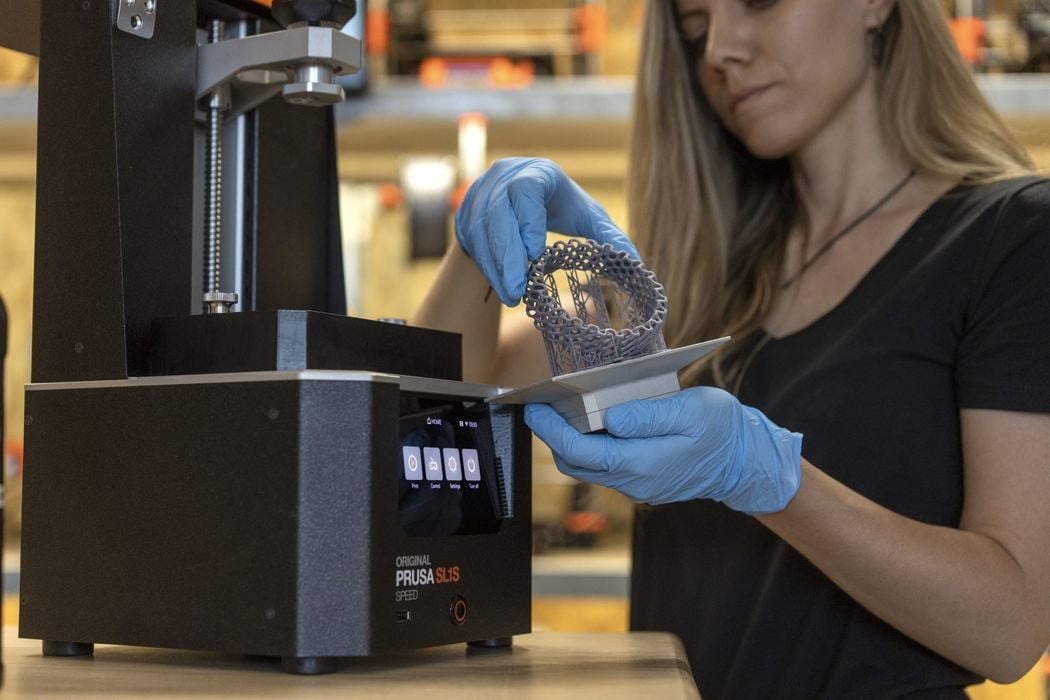
Prusa has updated its flagship resin into “Model+”, for faster prints, tougher parts, and a safer chemistry without making the material harder to use.
Prusament’s resins sit in an interesting middle ground in the stereolithography (SLA) market: engineered and controlled like pro materials, but sold and documented with hobbyist accessibility. The original Model resin became a go-to for visual prototypes and miniatures largely because it balanced detail, reliability, and a comparatively friendly handling profile for a photopolymer.
But photopolymer resin consistency is never just about the label on the bottle. Vendors fight variation in raw inputs, pigment dispersion, and reactivity that can shift exposure settings over time. Prusa says the prior Model formulation required multiple small tweaks over the years due to inconsistent reactivity in ingredients, which in turn altered exposure times and made long-term predictability harder than it should be.
Model+ is Prusa’s attempt to “lock in” the experience: consistent print behavior across batches, faster exposure, and better impact resistance. That matters not only to owners of the Original Prusa SL1S SPEED, but also to anyone trying to standardize an SLA workflow across multiple machines, users, and part revisions.
What Changed In Model+
Prusa says it reworked the formulation to improve both reactivity and mechanical resistance. The company is promising exposure times as fast as 2.0 to 2.6 seconds per layer at 0.05 mm, depending on printer and color, with more stable behavior over time and across resin batches. On the SL1S SPEED specifically, Prusa reports 2.0 to 2.4 seconds per layer depending on color, and 16 seconds for base layers at 0.05 mm.
The other day-to-day change is pigment sedimentation. Light colors like white and grey are notorious for settling, which forces operators to stir vats frequently or risk density issues and visible artifacts. Prusa says Model+ “significantly reduces” sedimentation, while still recommending at least brief mixing. If that claim is true, it reduces one of the sources of variability in resin printing: pigment concentration changing across a multi-hour job.
There are also specific safety moves. Prusa describes Model+ as even safer than the prior Model resin, and lists that it does not contain Bisphenol A, TPO, or ACMO. It also states 14% BioBased content. As always with resins, Prusa still warns that uncured material can pose a health risk and recommends protective equipment like nitrile gloves and glasses. Safety first, everyone.
Practical Tradeoffs For Makers
Model+ is not presented as a free lunch. Prusa notes a slight pine scent, emphasizing it is not an indicator of increased toxicity. More importantly for throughput, the resin is more ductile and impact resistant, which changes how supports behave. Prusa recommends moving away from thick, sparse tips and instead using a denser mesh of smaller support contact points. Done well, it says support removal can feel like “unzipping Velcro” with fewer marks, but there is a learning curve for anyone with a tuned support preset for the older material.
Two workflow constraints are important. First, Prusa recommends removing supports before curing. That is common advice with many brittle resins, but it can complicate automation if your post-processing line assumes a consistent cure-before-handling routine. Second, Model+ has higher viscosity, listed at 300 to 400 mPas, and may require longer pre-exposure wait times or printing at 25 to 30C. That hints at a resin that may benefit from warmer ambient conditions or a machine with onboard tank heating.
Another limitation is lower high-temperature resistance versus the previous formula, which Prusa says is unlikely to matter for miniatures and visual models, but could hurt the larger technical parts under elevated temperatures. That positions Model+ as a “daily driver” detail resin, not a functional engineering resin, despite Prusa saying it moves a step closer to industrial materials in consistency and toughness.
Pricing is given as US$72 for a 1kg bottle, with a wide color range including high-opacity Alabaster White and Solid Grey intended to maximize detail sharpness.
If users confirm the batch-to-batch exposure stability and reduced sedimentation, Model+ could become the kind of resin you standardize on for production-like SLA work, where the real cost is failed builds and parameter drift, not just the bottle price. In resin 3D printing, boring consistency is usually the biggest upgrade.
Via Prusa Research
