
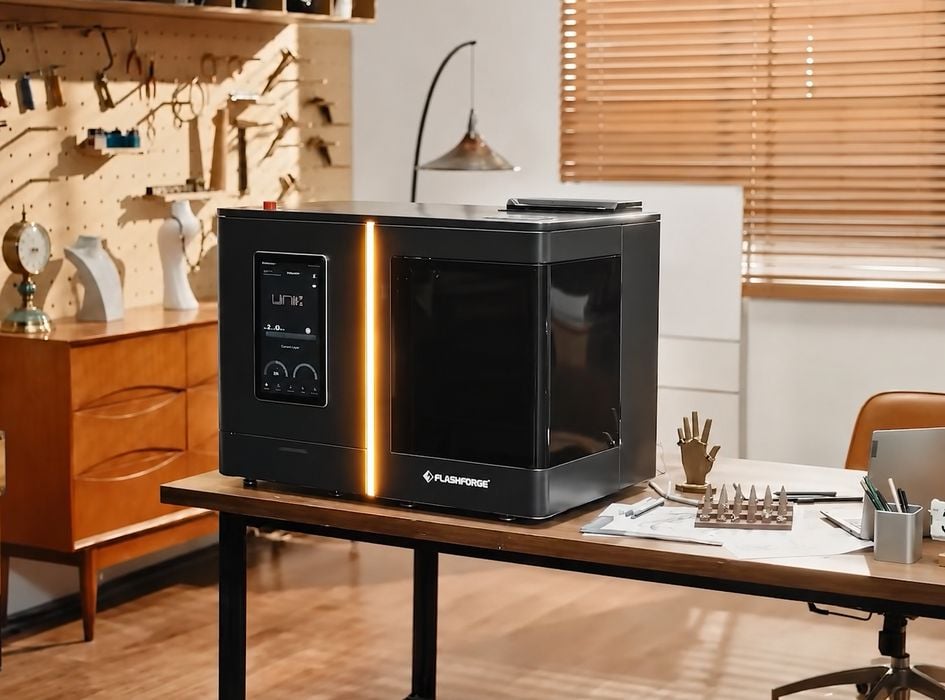
Flashforge announced a new 3D printer for the jewellery industry: the WJ51C wax printer.
Wax printing is not typically done by most 3D printer operators; it’s instead something done by jewellers. The idea is to print a model of a jewellery item in wax, and then use the lost-wax method to transform that model into metal jewellery. A wax 3D printer enables a jeweller to very quickly produce highly complex 3D wax prints that can then be made into actual jewellery.
The WJ51C is described as being “compact”, and it is in spite of it being quite a bit larger than your typical desktop FFF 3D printer. That’s because the normal wax printers are usually much larger, so Flashforge has made an advance here.
The build volume is relatively small as compared to FFF systems, but that’s okay because the WJ51C will be printing small items of jewellery. Specifically, the build volume is 235 x 138 x 100 mm.
The WJ51C uses a multijet printing process to deposit wax at high resolution: 2900 x 2900 x 1700 dpi (dpi is typically used by jewellers). This is approximately 0.00875mm, so this machine can produce very fine details easily.
Print speed is reasonable, considering the small size of the layers at 7mm per hour. This, combined with the wide area of the build plate, should allow jewellers to have significantly increased production throughput.
Flashforge has designed a new, stronger red wax material for this system, and it looks to be quite straightforward to load the machine. They’ve also designed software tools with algorithms to “enhance fine details”, something desirable on a machine for jewellers.
Flashforge seems to be driving costs down on this system, as it is designed to use materials in a more efficient manner, as compared to some other equipment.
As for the cost of the machine, it’s unclear. The WJ51C is sold through resellers, who can each set their own price point. That said, after some poking around, it seems that the price of this unit would be in the US$4-5,000 range, which is quite inexpensive for a wax 3D printer.
Typically, these systems cost tens of thousands from the usual suppliers. It may be that Flashforge is attempting to break the cost barrier in that market, which has not (yet) suffered the same fate that occurred in FFF and resin markets.
Via Flashforge
