
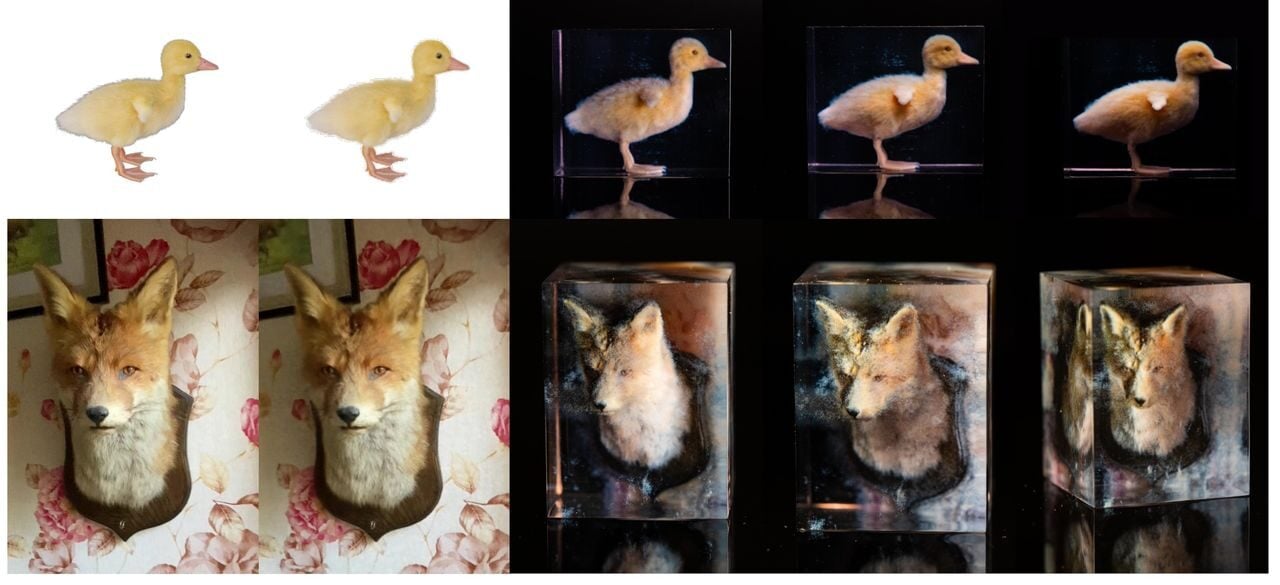
Researchers have developed a way to 3D print true volumetric color objects.
Hold on, don’t we already have full-colour 3D printing — that’s not filament-swapping 3D printers, but machines that can print objects with gradient textures in full colour? Yes, we do.
So what’s the difference here?
It’s about the colour and textures INSIDE the object.
The paper introduces DreamPrinting, a pipeline that converts volumetric radiance data (like NeRF or Gaussian splats) into Volumetric Printing Primitives (VPPs) for physical 3D printing. Unlike traditional surface-based or voxel-based methods, this system works at the voxel + pigment level, integrating physical colour science with 3D halftoning to reproduce geometry, translucency, and colour fidelity in prints.
In their model, VPPs are assigned pigment labels, which incorporate colours, translucency, and density mapping instead of just RGB colour as current full-colour texture systems have done.
This arrangement allows them to use spectrophotometric colour calibration to determine pigment absorption and scattering, and enables accurate simulations of translucent and mixed pigments.
While you might question why you’d want to see colours inside an object, here the translucency is the key. Many real-life objects are somewhat transparent, and this method allows for proper light simulation.
The researchers were able to 3D print accurate reproductions of fur, leaves, clouds, feathers, and other translucent objects.
They also built a “pipeline”, with direct integration with AI-driven generators. This created a seamless “digital to physical realism”.
What could this mean for 3D printing? The most obvious step is that it enables a shift for colour 3D printing from surface to volumetric. There’s also the possibility of making full-colour 3D prints far more realistic than they are now.
Finally, the idea of directly linking AI generators to 3D models in a more direct and practical manner could become a useful workflow in the future.
Via ArXiv
