
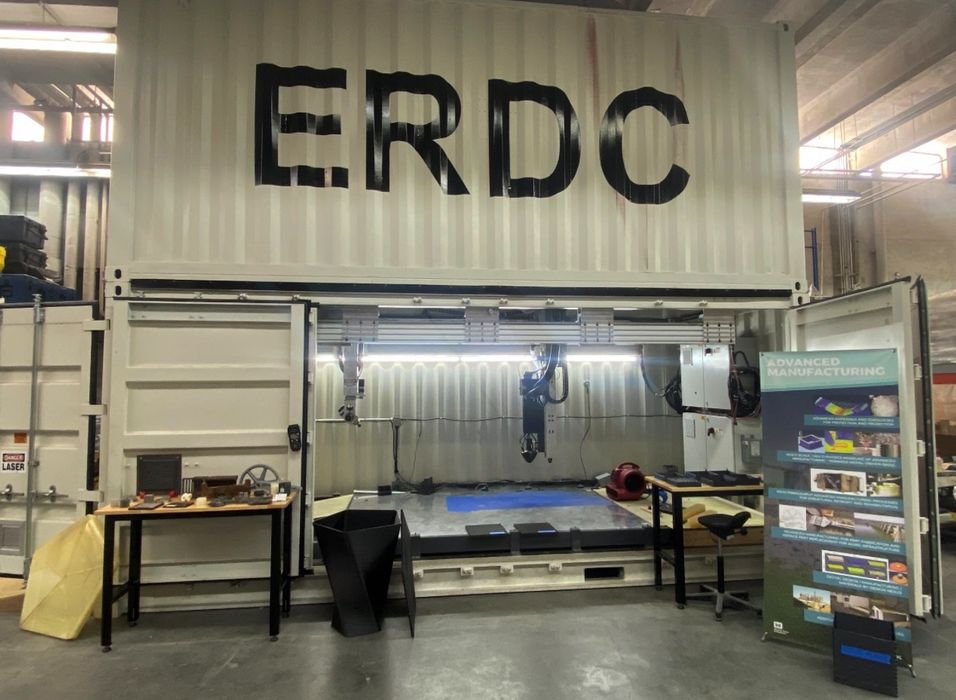
U.S. Army ERDC researchers have shown that fiber optic strain sensors can be embedded during large format additive manufacturing without changing the basic print process.
The research looks at structural health monitoring for large polymer components intended for civil infrastructure. Rather than inspecting a structure periodically or attaching sensors after manufacture, the idea is to print a sensing path directly inside the component.
That is a natural fit for Large Format Additive Manufacturing (LFAM), where a large extrusion bead is deposited layer by layer. The team used a containerized LFAM system with a Strangpress 19 extruder to print 20 short test bars from 3DXTech carbon fiber reinforced PLA.
Each bar used three 15 mm wide by 5 mm tall extruder passes to produce a 15 x 45 x 160 mm specimen. In the instrumented versions, operators manually laid a 155 micrometer diameter Luna fiber optic sensor along the center bead after the first layer, then printed the second layer over it at 200C.
A Distributed View Inside The Part
The sensor was connected to a Luna ODiSI 7100 interrogator, which uses Rayleigh backscatter to measure strain continuously along the fiber rather than at a handful of discrete gauge locations. The researchers configured it with a 0.65 mm gauge pitch and a 31.25 Hz sampling rate per port.
In other words, a sufficiently long embedded fiber could potentially reveal where a strain concentration develops inside a large printed structure. That is a lot more useful than simply confirming that an entire beam or panel has been loaded.
During ten displacement controlled fatigue cycles, the fiber signals tracked the load cell stress waveform well. Peaks, valleys, and transitions appeared in the right places across all three usable fatigue specimens. For monitoring loading events and accumulated use, that qualitative data is pretty encouraging.
The sensor also recorded large apparent strain values immediately after hot material encapsulated it. These exceeded plus or minus 15,000 microstrain, the instrument limit, and were attributed to thermal expansion and refractive index changes during cooling. That response was not used as a quantitative strain measurement, but it suggests that the same installation could observe manufacturing cooling behavior as well as later service loading.
Bond Quality Is The Immediate Problem
But there is one issue. X ray computed tomography on one embedded specimen found only 58.2% polymer contact around the fiber surface. Interlayer and intrabead porosity left much of the fiber surrounded by voids, limiting how faithfully strain transfers from the PLA matrix to the sensor.
Accordingly, the fiber consistently reported lower strain magnitudes than strain calculated from the Instron crosshead displacement. That does not automatically make the fiber wrong: crosshead displacement also includes grip slip, machine compliance, and deformation outside the gauge region. Still, an embedded sensor intended to provide absolute strain data will need calibration against an independent method, such as digital image correlation.
The team also compared plain polymer and fiber embedded samples in tensile and fatigue tests. There was no consistent reduction in peak force or displacement caused by the fiber, which is good news. However, the printed specimens themselves varied substantially, so the small test matrix cannot yet prove that sensor placement has no mechanical penalty.
This is a very interesting move for LFAM systems aimed at infrastructure, molds, or long lived field structures. A printer that can place sensing fiber reliably could offer a higher value component, not merely a larger extrusion. Yet manual placement, moisture related porosity, routing of fiber leads, and durable field interrogation hardware remain practical deployment questions.
