
Researchers have figured out the correct way to 3D print domes over lunar craters.
The concept of a pressure dome on the lunar surface has been a science fiction dream for many decades, but how exactly would you build one?
A technology that many have recently discussed is 3D printing — build the dome on site, rather than shipping components from Earth, which is quite expensive. The idea would be to somehow use material freely available on the lunar surface to construct the dome.
Several projects have investigated the possibility of 3D printing lunar regolith, the inorganic “soil” that covers our Moon. It’s available everywhere on the surface, so the only cost involved is collecting it. According to recent studies, the average depth of regolith is about 7 m. The material, when sufficiently thick, provides not only the ability to capture air for human habitation but also protects against solar and cosmic radiation.
The two approaches have been to use focused sunlight or lasers to fuse the regolith into larger parts; or use a binding agent shipped from Earth that mixes with the regolith to solidify the material.
Either way, an attempt at 3D printing domes over the top of craters could be made. Craters are ideal because they have a large portion of the structure already present: only a “lid” is required to cover a space that could be pressurized for human activities.
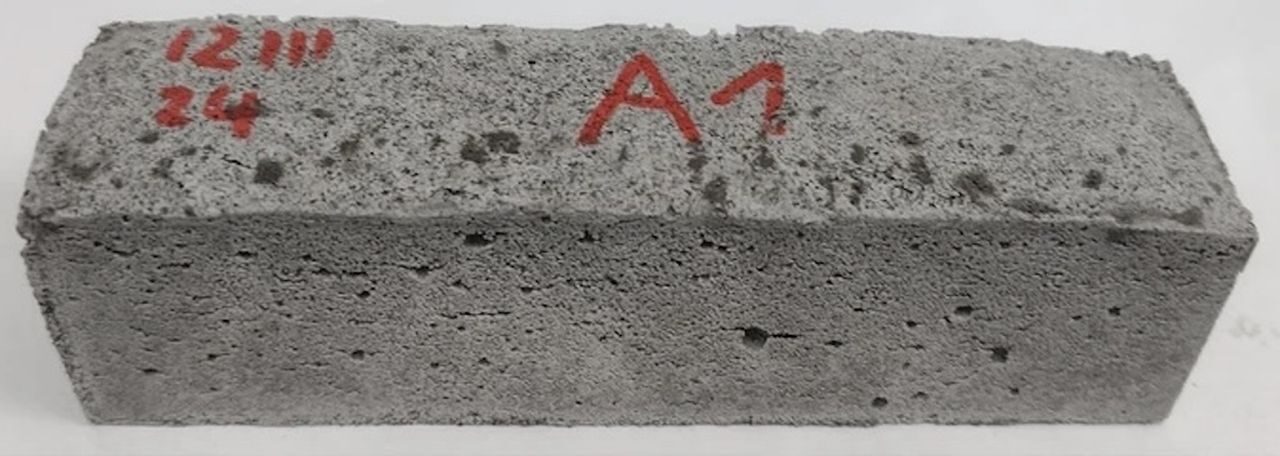
The researchers selected a geopolymer made from regolith and sodium hydroxide and sodium silicate, which solidifies the material. They did not specify whether the dome would be 3D printed as a single piece or whether it would be made from parts and then assembled. There were other more important decisions to be made first.
One was the basic structure of the dome. The dome would have to cover the entire crater and be able to withstand the pressure from inside the dome. Remember that on the Moon there is no air pressure, meaning that the air inside a dome would be pushing outwards with strong force. On Earth this is not a consideration because the air pressure on the inside and outside of a structure is about the same.
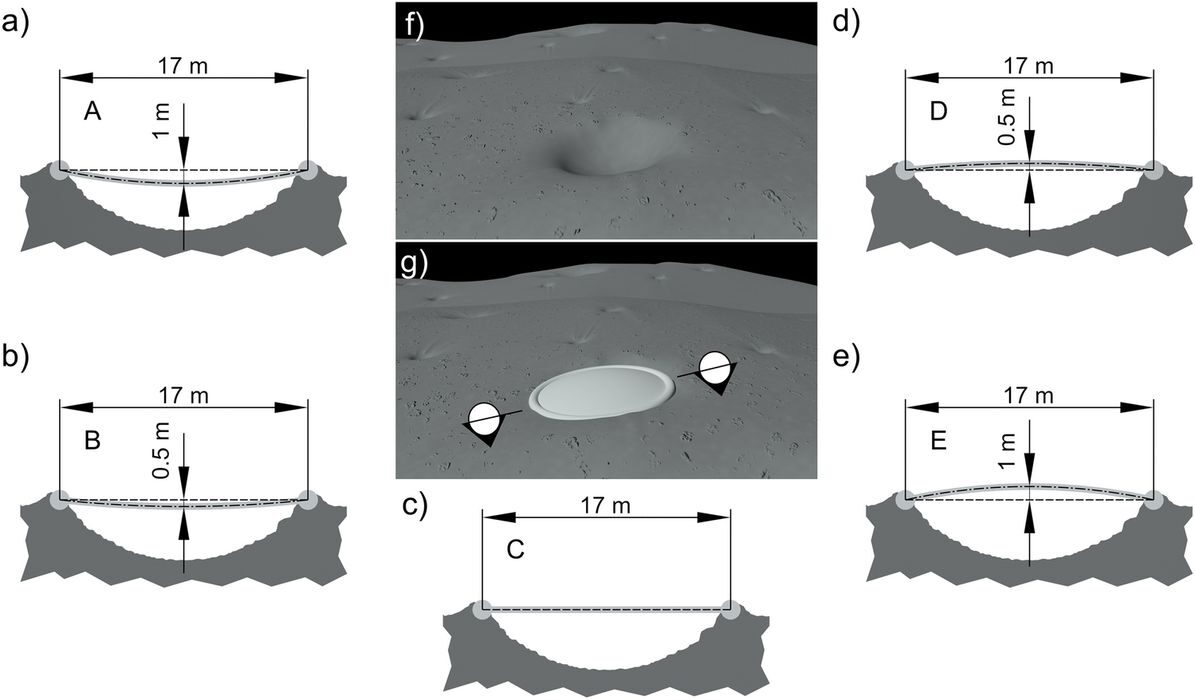
They evaluated configurations with several different air pressures and five different dome structures for a theoretical 17m diameter, 6m deep crater:
- Concave with negative 0.5m rise
- Concave with negative 1.0m rise
- Flat
- Convex with positive 0.5m rise
- Convex with positive 1.0m rise
They used finite element method simulations to evaluate the performance of these options and found the best to be a concave structure with 1.0 rise. This option provided better compressive stress and minimized risks of cracks and leaks.
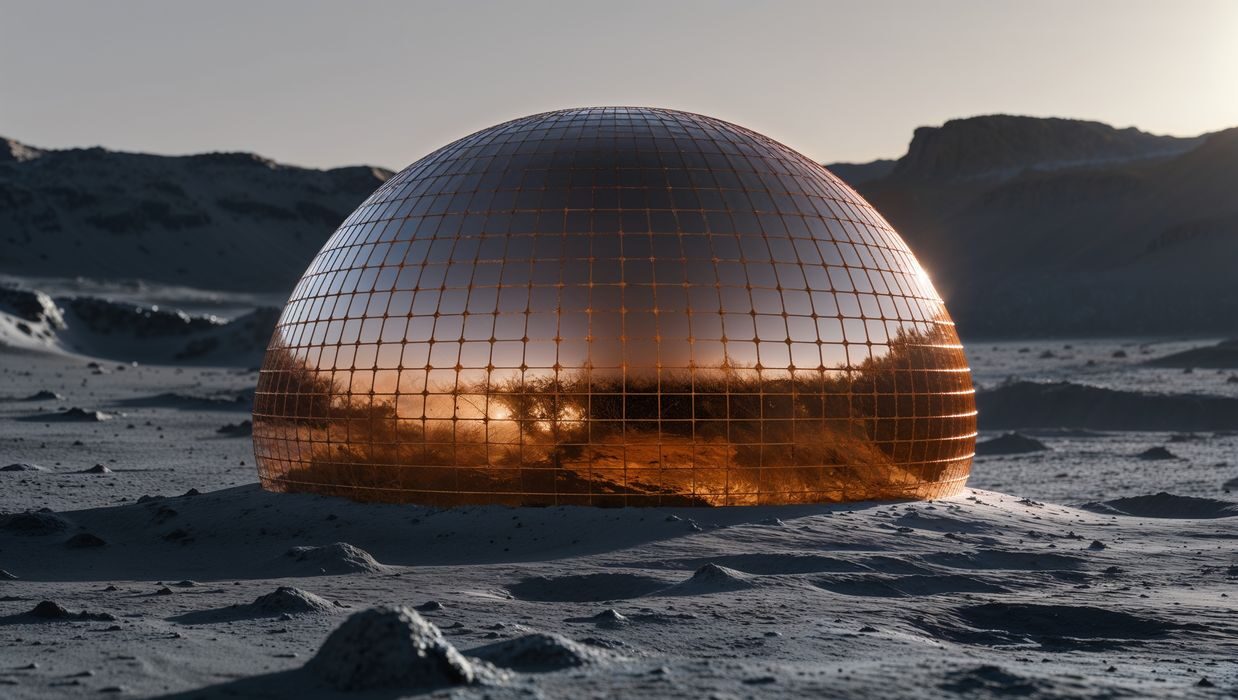
What does all this mean? It implies that our future won’t see those science fiction domes rising up on the Moon. Instead, we’ll see circular “dimples”. They’re not as dramatic to look at but much more functional.
Via Nature
