
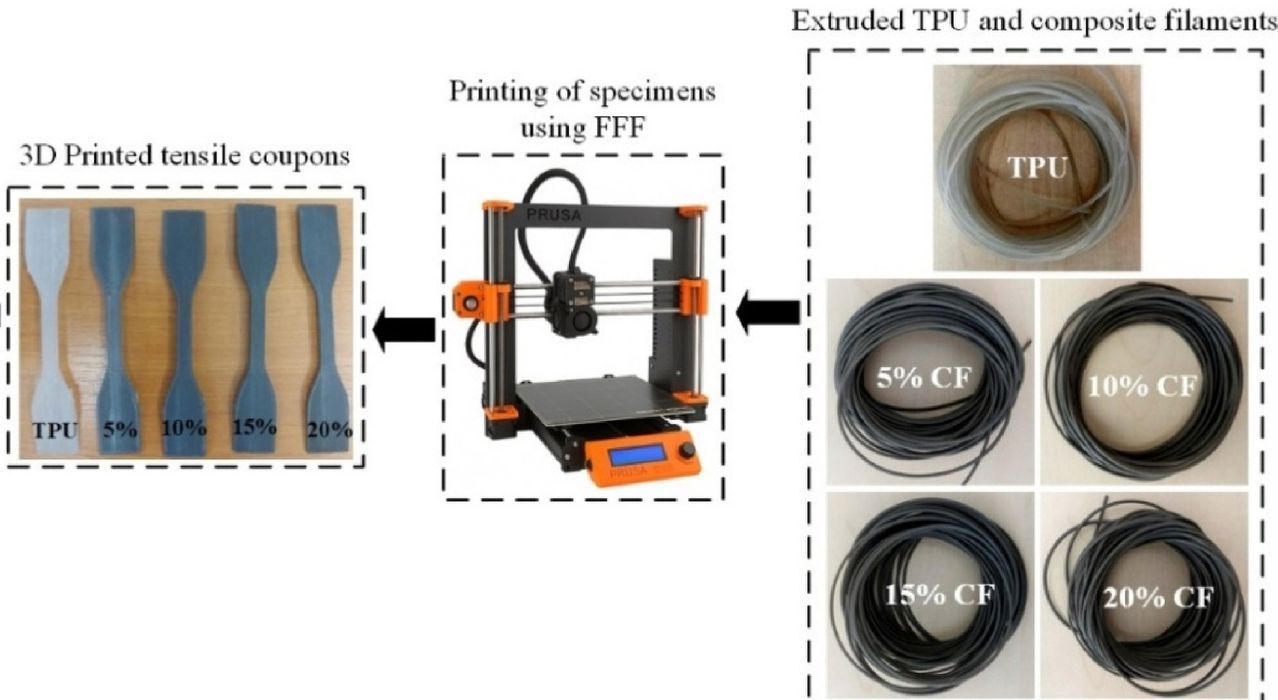
Researchers have produced a carbon filled TPU filament that stays flexible while becoming dramatically stiffer and electrically conductive.
A team at VSB – Technical University of Ostrava investigated a slightly unusual way to make carbon fiber reinforced thermoplastic polyurethane (a.k.a. TPU) for FFF. Instead of starting with polymer pellets or a commercial masterbatch, they mixed TPU powder directly with micron sized carbon fiber powder before filament extrusion.
Filler distribution is a persistent problem in composite filament production. Large polymer pellets and very small reinforcement particles can separate or form concentrated regions before they ever reach the extruder. The researchers reasoned that starting with two powders of more comparable size could produce a more even mixture.
They tested carbon fiber concentrations of zero, five, ten, 15 and 20 percent by weight. Each mixture was run through a single screw filament extruder to make 1.75 mm filament, then printed on a Prusa i3 MK3S using a 0.4 mm nozzle.
Powder First, Filament Second
Microscopy showed carbon fiber distributed throughout the filament even at the highest loading, without the large agglomerations the researchers were trying to avoid. All five formulations could also be extruded and printed with the common parameter set used in the study.
The material properties changed substantially as more carbon was added. Tensile strength rose from 9.13 MPa for pure TPU to 15.72 MPa at 20 percent carbon fiber. Young’s modulus increased from 118.78 MPa to 301.84 MPa, about 2.5 times the original value.
Yet the material did not simply turn into a rigid plastic. Shore A hardness increased only from about 87.5 to 93.5, and the researchers reported that the elastomeric behavior remained substantial. That combination could be useful where a part must deform but also carry more load than ordinary TPU.
The biggest change could be electrical. Pure TPU and the five percent composite remained effectively insulating, but conductivity jumped sharply between five and ten percent carbon fiber. The 20 percent material reached 12 S/m.
That conductive network also changed resistance when the sample was stretched. In preliminary testing, the 20 percent composite produced a gauge factor of about 3.4 and showed repeatable resistance changes during cyclic loading. In other words, a printed flexible part could potentially sense its own deformation!
Conductive, But Rougher
There is a cost to packing that much carbon into TPU. Surface roughness increased from 3.62 microns for pure TPU to 36.20 microns at 20 percent carbon fiber. Microscopy also showed progressively larger gaps between deposited extrusion lines at the higher loadings.
The researchers attribute this to increased melt viscosity and poorer coalescence as the rigid carbon material interferes with TPU flow. The printed material became stronger and more functional, but the surface became much less tidy.
The powder blending approach is interesting because it provides a relatively straightforward way to tune flexible FFF materials before filament is even made. If the surface and voiding problems can be reduced, the same printed TPU part might provide flexibility, reinforcement and electrical sensing without requiring a separate embedded sensor.
